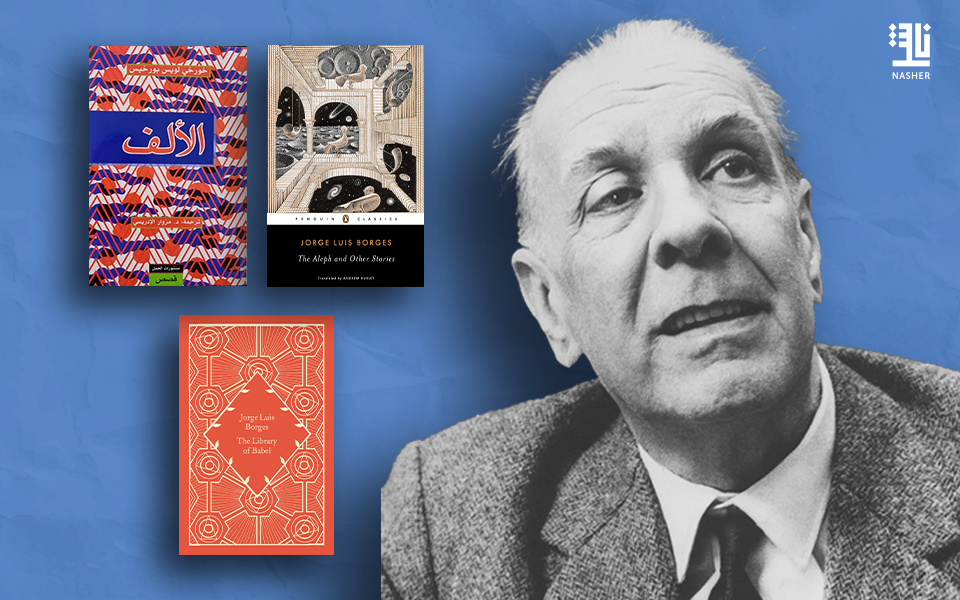
On 24 August 1899, a writer was born in Buenos Aires, the Argentine capital, who would spend his life among books, labyrinths, mirrors and questions without end. Jorge Luis Borges never knew the internet, never saw a smartphone screen or a search engine. Yet decades before the digital age, he imagined a world whose contours now feel strikingly familiar: a world in which knowledge accumulates without limit, information becomes readily accessible, yet truth grows increasingly difficult to find. Borges wrote of libraries and infinity, of copies and hidden connections between texts, as though he were exploring through literature the very experience we now inhabit in the digital realm. More than a century after his birth, some of his ideas seem less like fantasy and more like reflections of our contemporary world.
In his celebrated 1941 story “The Library of Babel,” Borges imagined the universe as an immense library made up of repeating chambers that stretch, in the perception of its inhabitants, into infinity. The library contains every possible combination of letters, and therefore meaningful books and false ones, truths and lies, everything that has been written and everything that could be written. All knowledge exists there, yet its presence does not necessarily mean that it can be reached or understood. The librarians spend their lives searching for a book, a clue or a catalogue that might lead them to certainty. It is difficult to encounter this vision today without thinking of a digital realm that places an almost limitless volume of content before us, an early insight into the dilemma created by an excess of knowledge.
In “The Aleph,” Borges takes his imagination in another direction, towards an image that feels strikingly close to our age of boundless connectivity: a tiny point from which the entire world can be seen without any of its details being lost. It is an image that today evokes a small screen opening a window onto cities, books, photographs, events and stories from across the world. Technology itself, however, was never Borges’s real concern. What fascinated him was the human being confronted with the vastness of the universe, forever attempting to compress what cannot be compressed and to grasp what exceeds the limits of understanding. This is why his literature remained preoccupied with infinity, labyrinths and worlds unfolding within other worlds, images in which a twenty-first-century reader can hardly fail to recognise something of the daily experience of moving endlessly between pages, links and information.
But Borges’s brilliance lay not only in imagining an abundance of knowledge; it also lay in recognising the bewildering side of that abundance. In his world, the complete library offers its inhabitants no reassurance. Instead, the sheer number of books becomes a source of confusion, while the boundary between the authentic and the false grows increasingly fragile. The paradox feels profoundly contemporary in an age when people suffer less from a shortage of information than from the difficulty of verifying it and deciding what deserves their attention. Every answer leads to another answer, every doorway opens onto another passage, until the seeker becomes part of the very labyrinth from which they are trying to escape. It is almost as though Borges were asking, decades before the arrival of the internet: what happens when nearly everything becomes accessible, yet we no longer know what we should be searching for?
Perhaps this is why Borges can still seem like a writer arriving from the future, even though his worlds were born from ancient books, philosophy, mythology and the libraries he loved throughout his life. He did not predict the internet in any technological sense, nor did he write about devices or networks. What he grasped was something deeper: the relationship between human beings and knowledge when knowledge becomes greater than their ability to contain it. On the anniversary of his birth, returning to Borges is therefore more than an act of homage to a writer who left a profound mark on twentieth-century literature. It is also a return to an early literary vision of the world we now inhabit, a vast, interconnected and almost infinite world, experienced today through a great library whose doors we carry in our pockets, entering it every day in search of the right page somewhere within a labyrinth without end.