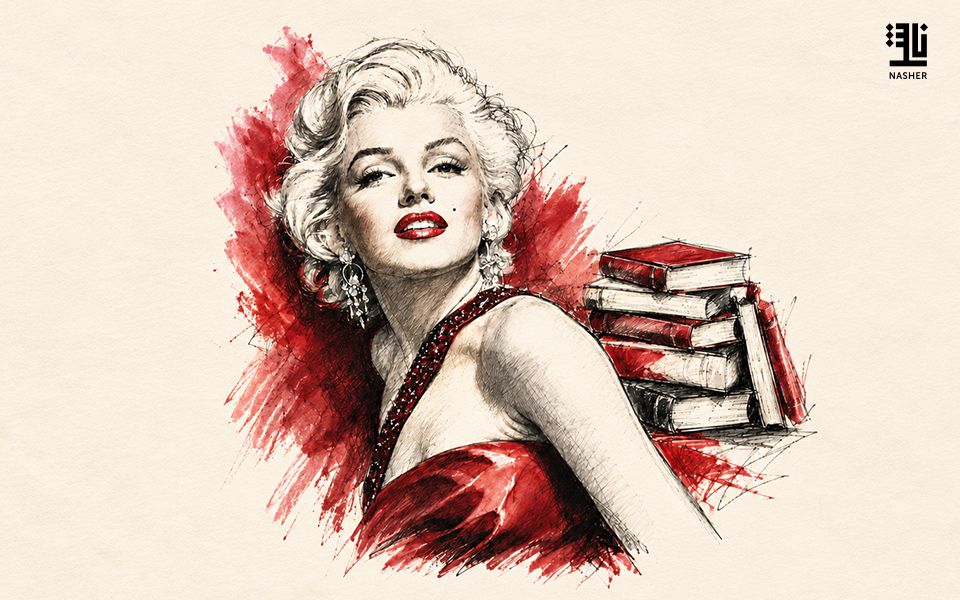
One hundred years after her birth, Marilyn Monroe’s favourite books are finally getting the attention they deserve – because behind the platinum hair and the sequins was a voracious reader. When she died in 1962, she had over 400 books in her house.
Besides being a Hollywood icon, Marilyn Monroe harboured a profound love for literature. Her personal library, spanned diverse literary genres and authors, reflecting her intellectual curiosity. This facet of Monroe’s life reveals her devotion to the written word and challenges the simplistic narratives often associated with her.
When Marilyn Monroe’s book collection was put up for auction at Christie’s in 1999 a new and surprising side of the artist arose. Not that her interest in reading was unknown, but her literary taste was more of a mystery.
The titles covered a wide spectrum of interests – especially poetry – but also American contemporary literature, politics, religion, and psychology. Many of her favourites were covered in her own notes; several were first editions; her reading ranged from Dostoevsky to Dorothy Parker, Proust to Kahlil Gibran.
She was fond of James Joyce, D. H. Lawrence, and Walt Whitman. She was acquainted with writers such as Carson McCullers, Truman Capote, Saul Bellow, and Carl Sandburg.
Far from the dumb blonde Hollywood sold, Monroe didn’t just collect books – she argued about them in press conferences, annotated her film scripts with ideas drawn from them, and built real friendships with the writers behind them.
Books in Marylin Monroe’s Library
The Prophet, Khalil Gibran
One of the books most strongly associated with Monroe’s reading life is The Prophet by Khalil Gibran. According to the author’s estate’s website, Monroe had four copies of her own and was often seen reading this book on movie sets, and sometimes gave copies out to friends.
During the filming of the movie Gentlemen Prefer Blondes, Monroe read a passage from the book’s section on marriage out loud to her costar Jane Russell. “…and stand together yet not too near together: For the pillars of the temple stand apart, and the oak tree and the cypress grow not in each other’s shadow,” she read.
Afterwards, the actress, who was married to Joe DiMaggio at the time, mused about Gibran’s meaning. “Is it true?” she asked. “I mean, do you have to keep yourself apart? I mean if a woman loves a man, does she have to give up her own individuality? Do we have to give our own identity up?”
Gibran was a Lebanese-American poet who published The Prophet in 1923. The Prophet gathers poetic essays in which a sage named Almustafa reflects on love, marriage, work, death, and the nature of freedom. Monroe reportedly gave her personal copy to a friend, later reflecting that it was not the kind of reading she could share with her then husband Joe DiMaggio – suggesting she used it as a private text rather than a social recommendation.
Ulysses, James Joyce
One of Marilyn Monroe’s favourite books was reported to be Ulysses, and the most famous evidence is photographic. Eve Arnold captured Monroe reading it on a beach in Long Island in 1955, and later recalled that Monroe kept the novel in her car and had been working through it for some time, reading passages aloud to herself. The image became one of the most reproduced photographs of the actress in existence – and one she herself reportedly preferred to the more sensationalised shots.
Monroe read parts of the book out loud as the photos were being taken, and explained that she found the text challenging and preferred to read sections of the book non-chronologically—a method used by many scholars and fans of Joyce’s famously abstract and nonlinear novel.
Ulysses is one of the major works of modernist fiction. Published in 1922, it retells Homer’s Odyssey in a series of literary styles and is known for its extremely experimental stream-of-consciousness style. It follows three people in Dublin over the course of a single day—June 16, 1904.
Madame Bovary by Gustave Flaubert
Monroe owned two separate editions of Madame Bovary, which speaks volumes. Emma Bovary – Flaubert’s restless, romantically deluded protagonist –a young woman trapped in a stifling marriage to a simple but well-meaning doctor. She spends her time daydreaming about fantasies from romantic novels and seeks escape through lavish spending and affairs. But before long, Emma’s search for true passion spirals into chaos.
Monroe was drawn, again and again, to female characters who were intelligent, vulnerable, and fundamentally misread – and Emma Bovary is one of the most defining examples of that type in all of European literature.
The Great Gatsby’ by F. Scott Fitzgerald
The Great Gatsby featured in Monroe’s library and has been cited among her most-loved reads. The novel’s portrait of a man who remakes himself entirely in pursuit of an idealised past – and is ultimately undone by the gulf between image and reality – maps onto Monroe’s own story with uncomfortable precision. Among the classics in Marilyn’s collection was F. Scott Fitzgerald’s The Great Gatsby. Originally published in 1925, this tale is Fitzgerald’s glittering yet tragic portrait of the Jazz Age. The novel follows aspiring bond salesman Nick Carraway after he relocates to Long Island. There, he enters the lavish world of his mysterious millionaire neighbor, Jay Gatsby. Known for his extravagant parties, Gatsby is driven by one obsession: rekindling his romance with the beautiful Daisy Buchanan. But beneath all the glamour lies a darker story of longing, illusion and heartbreak.
Roughing It’ by Mark Twain
Roughing It is Mark Twain’s 1872 lively and hilarious account of his years traveling through the American West and Hawaii during the 1860s. Part memoir, part travelogue, this beloved book follows Twain as he leaves behind his life in the East and ventures into the rugged frontier, where he encounters prospectors, outlaws, journalists and larger-than-life characters along the way.
The Little Disturbances of Man’ by Grace Paley
Grace Paley’s 1959 short story collection is the most unexpected – and, in some ways, the best-documented – title on this list. It was one of five books from Monroe’s library, all by American women, bought by a collector and donated to the Schlesinger Library at Radcliffe, where they went on public display in January 2000. Paley’s stories are set in mid-century New York and follow women who are funny, sharp, frequently abandoned, and permanently searching for meaning in the ordinary chaos of their lives.
This 1959 collection offered a savvy, funny and human look at the tiny dramas unfolding inside everyday life—and it was reportedly one of Marilyn’s favourite books! Set against the backdrop of mid-century New York, Paley’s stories capture the turbulence of love, marriage, motherhood and loneliness.
The Brothers Karamazov by Fyodor Dostoevsky
Monroe’s championing of The Brothers Karamazov became one of the most revealing press exchanges of her career. When she announced she wanted to play Grushenka in a film adaptation, a reporter asked whether she even knew how to spell Dostoevsky. Monroe replied, simply: ”Actually, have you read the book?” The hostility was telling – the press assumed the question would embarrass her, and it didn’t at all.
Director Billy Wilder came to her defence, noting that people who hadn’t read the novel didn’t realise Grushenka was a seductive, complex character, and that Monroe would have been ideal in the role. Arthur Miller, who shared her love of the novel, agreed she was born to play the part. The film never materialised, and the title was not among the volumes catalogued in her estate – though friends recalled her reading it, and her shelves did hold Crime and Punishment and The House of the Dead.
Letters to a Young Poet by Rainer Maria Rilke
The story of how Monroe came to own this book is perhaps the most perfectly Marilyn anecdote in existence. A director spotted her reading it on set and asked why she’d chosen it. Her reply: “On nights when I’ve got nothing else to do, I go to the Pickwick bookstore on Hollywood Boulevard and just open books at random – or when I come to a page or a paragraph I like, I buy that book. So last night I bought this one. Is that wrong?”
Elsewhere, she spoke about the book more directly: “There’s a book by Rainer Maria Rilke that’s helped me a lot. Without it I’d probably think I was crazy sometimes. I think that when an artist tries to be true, you sometimes feel you’re on the verge of some kind of craziness. But it isn’t really craziness. You’re just trying to get the truest part of yourself out.” Rilke’s letters – written to a young cadet seeking advice on poetry and life – have since become among the most beloved books on the creative vocation.
A Streetcar Named Desire by Tennessee Williams
Monroe’s copy of A Streetcar Named Desire was heavily annotated – studied, not just read – and she acted out scenes from it in private lessons with Lee Strasberg during her time at the Actors Studio in New York. The parallels between her and Blanche DuBois – beautiful, misunderstood, punished by the world for the crime of feeling too much – were not lost on Tennessee Williams himself.
Williams once said of her: “She was fragile and she was beautiful and she was silly… She was the lost kitten in the rain… She knew her power and she abused it, but in the demonstration of it she degraded herself and she knew this, so the spiral of destruction deepened and intensified.” That the playwright could say this in the same breath he might use to describe Blanche is no coincidence.
The Ballad of the Sad Café by Carson McCullers
Monroe owned a well-thumbed copy of Carson McCullers’ strange, poignant novella about loneliness and unrequited love – and the two women knew each other personally. Crowther recounts a lunch at McCullers’ home attended by Monroe and Isak Dinesen (Karen Blixen), and notes that many of the writers in the actress’s library counted her as a friend. The detail matters: Monroe wasn’t reading about the literary world from the outside, she was part of it.
Set in a small Southern town, the novella follows the improbable love triangle between a fierce, self-sufficient woman, a hunchback stranger, and a charming ex-convict – an odd, gothic fable about the nature of love itself. McCullers was interested in isolation, in people who don’t fit, and it is easy to see why Monroe, who spent her career being pigeonholed and flattened, resonated so deeply with the work.
The Collected Poems of W. B. Yeats
As one of her favourite poets, Monroe usually quoted Yeats in her personal letters or read his poems aloud. Her love for the genre was so that some of her lyrical writing surfaced in 2010 when Fragments: Poems, Intimate Notes, Letters was released.