
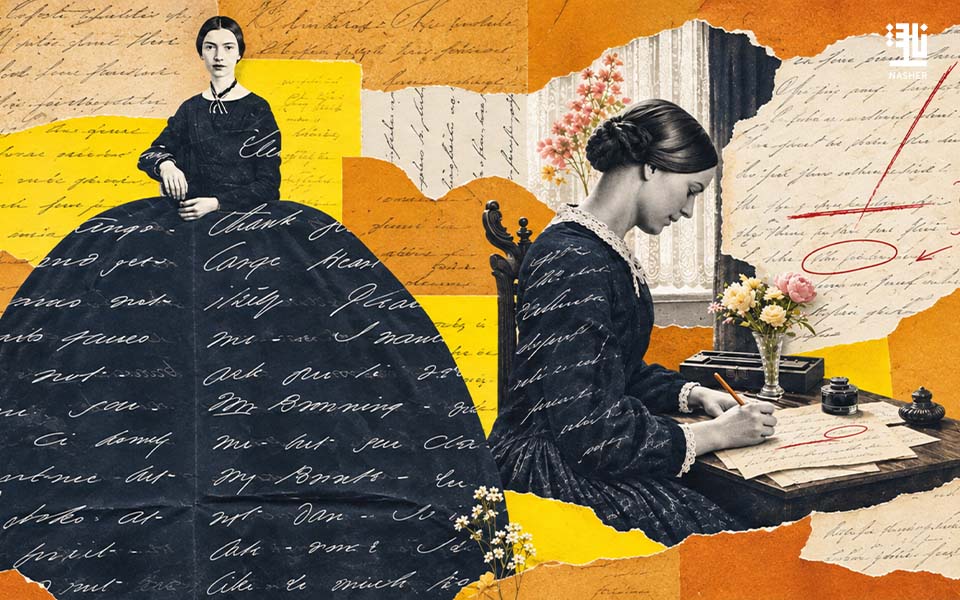
Emily Dickinson left nearly 1,800 poems behind, most unpublished during her lifetime. Her carefully preserved manuscripts reveal a remarkable creative life and an enduring mystery about why she avoided publication.
When Emily Dickinson died in May 1886, the literary world barely knew her name. Yet inside her family home in Amherst, Massachusetts, lay nearly 1,800 poems that would eventually establish her as one of America’s greatest poets. Most had never appeared in print, and many were preserved in carefully arranged handwritten manuscripts.
The discovery transformed literary history, but it also created a mystery that scholars continue to debate. Why had a woman capable of writing such extraordinary poetry chosen to keep so much of it away from the public?
Following Dickinson’s death at 55, her younger sister Lavinia discovered hundreds of poems among her possessions. Many belonged to small, handmade booklets that Dickinson had assembled herself. Between approximately 1858 and 1864, she copied more than 800 poems into 40 such collections, now known as fascicles, binding folded sheets together with string. These were not merely abandoned drafts. Their careful arrangement suggests that Dickinson took considerable interest in preserving and organising her work, even without conventional publication.
Only a small number of Dickinson’s poems appeared in print during her lifetime, generally anonymously and probably without her permission. Her reluctance was not simply the result of having no literary connections. Dickinson corresponded with Thomas Wentworth Higginson, a prominent writer and editor, and received encouragement from the celebrated author Helen Hunt Jackson.
Jackson believed her poetry deserved a wider audience and urged her to publish. Yet Dickinson remained hesitant, even when a publisher approached her about a collection. One possible explanation lies in her distrust of literary commerce. In her poem ‘Publication is the Auction’, Dickinson presents the sale of intellectual creativity as something morally troubling. However, scholars caution against treating this poem as a definitive explanation. Her actual intentions remain uncertain.
Dickinson was not entirely isolated from literary conversation. She maintained relationships through correspondence and shared hundreds of poems with friends and relatives. Her sister-in-law Susan Dickinson was an especially important recipient, alongside Higginson and members of her extended family.
This private circulation suggests that Dickinson valued having readers, even if she resisted the conventional publishing system.
Her unconventional punctuation, unusual capitalisation and compressed language also challenged the literary expectations of her time. Public acceptance might have required compromises she was unwilling to make.
Determined to preserve her sister’s achievement, Lavinia sought help publishing the manuscripts. The first collection appeared in 1890, edited by Mabel Loomis Todd and Higginson. However, the editors altered punctuation, introduced titles and sometimes changed words to make the poems conform to contemporary literary conventions. It was not until Thomas H. Johnson’s landmark 1955 edition that readers gained a substantially more faithful representation of Dickinson’s surviving poetry.
Dickinson left no clear instructions explaining what should happen to her poems after her death. Consequently, the question of whether she intended them for eventual publication remains unanswered. Yet her manuscripts reveal an important distinction between seeking recognition and taking one’s writing seriously. Dickinson may have avoided the literary marketplace, but she never abandoned the act of creating.