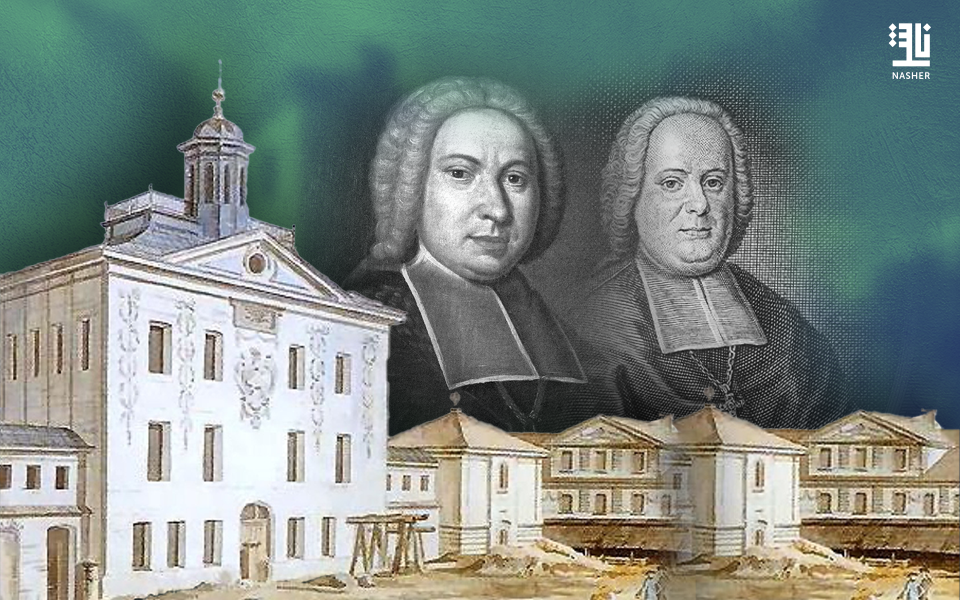
The Załuski Library in the Polish capital, Warsaw, stands among Europe’s earliest public libraries, with origins dating to the period between 1747 and 1795, a time when books were treated as private treasures, before two men chose to open that treasure to the public. Thus began a story not as a passing event, but as a profound shift in society’s relationship with knowledge and culture. Warsaw, then a city searching for itself between politics and history, found in this library another voice: the voice of knowledge.
Founded by the brothers Józef Andrzej Załuski and Andrzej Stanisław Załuski, the library was driven by an exceptional passion for books and a vision that transcended their era. Their aim was not merely to collect volumes, but to build a living archive that would preserve human thought and make it accessible to all who sought it. Through tireless effort, the library grew into one of the largest in Europe, housing hundreds of thousands of volumes and rare manuscripts. Its shelves were filled not only with pages, but with the voices of ages, philosophy and literature, science and history, transforming it into an open intellectual space and a meeting point between humanity and its deepest questions.
The influence of the Załuski Library extended far beyond the boundaries of city or country, becoming part of the very fabric of the European Enlightenment. It drew scholars and writers not merely in search of books, but of an environment that nurtured free thought. There, among its shelves, new ideas were born and the world was reread from shifting perspectives. The library helped break the monopoly on knowledge, opening access to wider segments of society, and redefining the book not as a commodity, but as an instrument of liberation. It became more than a cultural institution, it stood as a marker of an age beginning to reconsider its relationship with knowledge itself.
Yet this luminous story did not escape the upheavals of history. In the late eighteenth century, amid regional turmoil, the library was looted and its treasures scattered across cities, with a substantial portion transferred to Saint Petersburg. Although part of the collection was returned in 1920 by the Soviet government to the newly reestablished Polish state under the Treaty of Riga, its survival proved short-lived. During World War II, in 1944, much of what remained was deliberately destroyed and burned by German forces, marking one of the most devastating losses of cultural heritage in modern history.
Today, the National Library of Poland in Warsaw stands as the institutional continuation of the Załuski legacy and of what was dispersed across centuries. Its mission goes beyond recovering books; it is an ongoing effort to restore a cultural memory. What is being reclaimed is not only a collection, but an idea, that knowledge must remain accessible, preserved, and transmissible across generations. In this sense, the National Library is not merely an heir, but a living continuation that both safeguards and reinterprets that legacy within a contemporary context. Time, despite its ruptures, has not severed the thread between past and present; rather, it has rewoven it into something more enduring and expansive.