Home 5 Articles and Reports 5 Vietnam Book Street Attracts Global Attention

Vietnam Book Street Attracts Global Attention

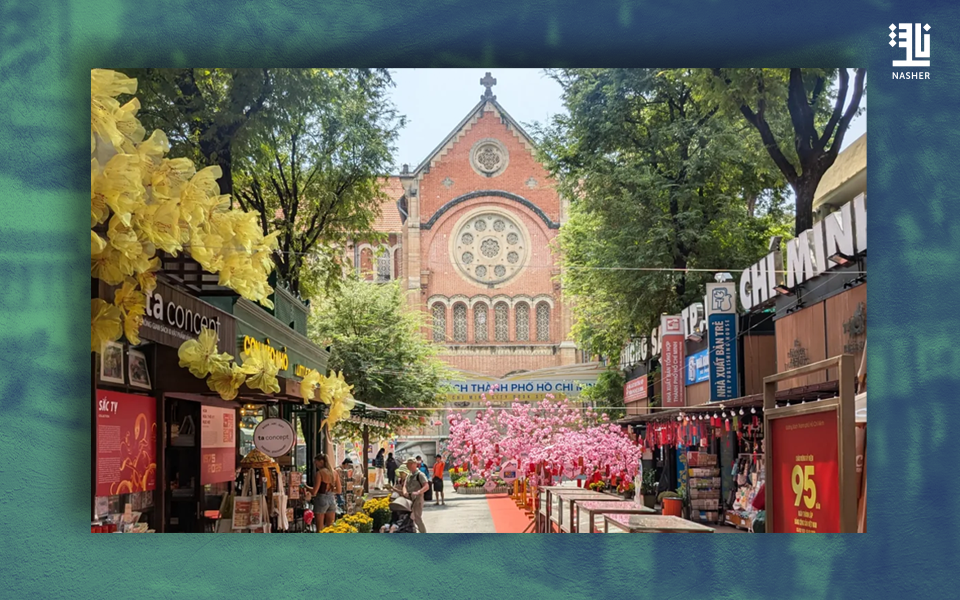
In the heart of Ho Chi Minh City, the largest city in Vietnam, and near two prominent heritage landmarks, Saigon Notre-Dame Cathedral and Saigon Central Post Office, Nguyen Van Binh Book Street stands out as one of the most compelling urban cultural models to have successfully embedded reading into everyday life. Over more than a decade, the street has evolved into what can be described as an “undercurrent” that nourishes intellectual culture and reinforces the city’s humanistic identity. No longer merely a space for selling books, it has become an interactive platform that embraces knowledge and redefines the relationship between people and books in an era of rapid digital transformation.


Launched on January 9, 2016, the project began as a modest 140-metre stretch, with limited expectations regarding its long-term impact. However, supported by local publishers and the city government, the initiative quickly demonstrated its ability to drive a qualitative shift in Vietnam’s publishing sector. As the country’s first dedicated book street, it introduced an innovative model that blends cultural vision with community investment, ultimately solidifying its position as a comprehensive knowledge destination.


The street has since experienced remarkable growth, expanding from 19 kiosks at its inception to 30 today, hosting more than 20 publishing houses and distributors from across the country. Over the past decade, it has welcomed millions of visitors, facilitated the circulation of nearly seven million books, and generated revenues exceeding 433 billion Vietnamese dong. According to Le Hoang, Director of the street, the initiative was never purely commercial in intent; rather, it was designed to build a sustainable knowledge ecosystem that serves as a cultural anchor for the community and strengthens the presence of books in daily life.


Despite the rapid rise of digital entertainment and e-reading, the street continues to assert its role as a “fortress” safeguarding the value of printed books. By hosting more than 3,000 cultural events annually, averaging nearly one activity per day, it has created a vibrant space that brings authors and readers closer together, revitalising the cultural scene. Its impact extends beyond the local sphere, as it has become a global cultural landmark attracting international visitors, reflecting the image of a modern city that celebrates knowledge and believes that books are not merely products, but bridges for human connection across cultures.

 

Recent News

31Aug
PocketBook Puts an E-Reader in Your Pocket

PocketBook Puts an E-Reader in Your Pocket

Swiss e-book company PocketBook has unveiled its latest ‘phone sized’ e-book reader PocketBook Q.  The company says: “The new PocketBook Q combines a slim, smartphone-sized form factor with all the essential features for comfortable reading on the go. Its 5.84-inch E Ink Carta™ 1300 display has a resolution of 788 × 1,576 pixels and a […]

25Aug
Pan Macmillan Tests AI-Assisted Publishing Model

Pan Macmillan Tests AI-Assisted Publishing Model

Pan Macmillan to publish AI-assisted business titlewanted to turn his existing body of economic analysis into a book but “would never have had the time to write” it. Harriman House therefore worked with sister company CHAPTR to develop Weave, a secure proprietary AI application grounded on Pal’s archive of previously published material, speeches, intellectual property […]

24Aug
SIBF Awards 2026 Nominations Open Until August 31

SIBF Awards 2026 Nominations Open Until August 31

The Sharjah Book Authority (SBA) is accepting nominations for the Sharjah International Book Fair (SIBF) Awards 2026 until August 31, with a total prize fund of AED 625,000 recognising outstanding achievements in writing and publishing, spotlighting Emirati and Arab talent, and supporting distinguished literary works locally and internationally. The awards span novels, academic studies, poetry […]

Related Posts

Did Borges Enter the Digital Labyrinth Before Us?

Did Borges Enter the Digital Labyrinth Before Us?

On 24 August 1899, a writer was born in Buenos Aires, the Argentine capital, who would spend his life among books, labyrinths, mirrors and questions without end. Jorge Luis Borges never knew the internet, never saw a smartphone screen or a search engine. Yet decades...

Mary Shelley Asked the AI Question First

Mary Shelley Asked the AI Question First

Mary Shelley was born in London on 30 August 1797, and would go on to give literature one of its most famous creations: Frankenstein. She was only eighteen when she began writing the novel, unaware that she was placing at its heart a question that would remain alive...

Books Written Behind bars

Books Written Behind bars

The prison cell is the perfect microcosm for a psychological novel. It raises issues of power and liberty, shame and repentance, memory and hope. Its claustrophobic walls can represent narrow-mindedness, social restrictions, the womb, the grave or the confined cubic...

Previous Next
Close
Test Caption
Test Description goes like this