
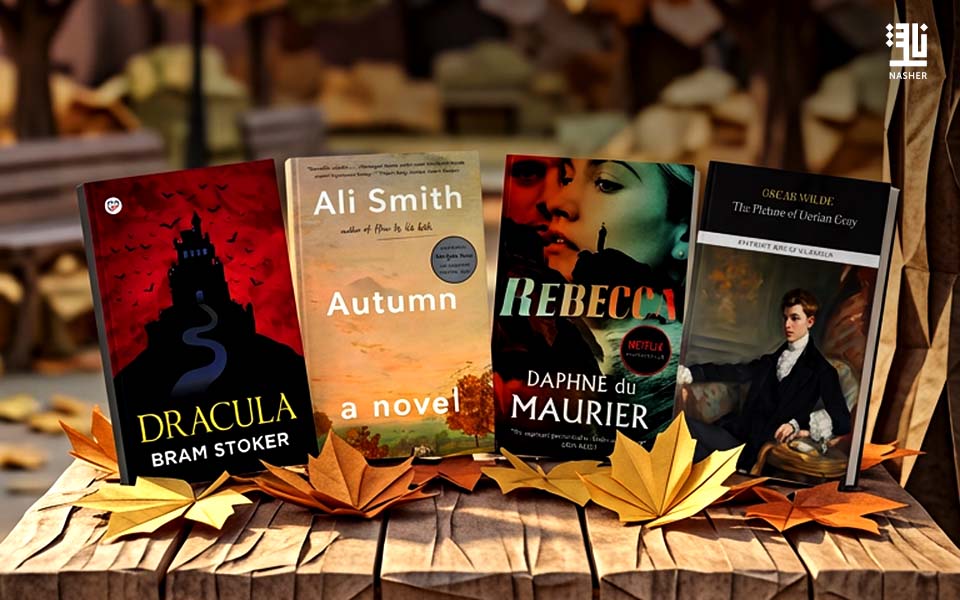
It has often been claimed that each season requires a different sets of books or genre, the weather, festivities or cultural events influence and dictate our reading lists. Reading fiction can be a life-affirming way to reconnect with what really matters, to develop more empathy, and to expand your horizons. Of course, everyone’s taste in fiction is different. But if you’re looking for the perfect book to usher in the season, and as we come to the mid point of Autumn and the flu season is in full swing here are some book recommendations with autumn at its core.
Dracula // Bram Stoker
Bram Stoker’s classic 1897 horror novel tells the famous story of solicitor Jonathan Harker’s discovery of the monstrous Dracula in Transylvania, and vampire hunter Professor Abraham Van Helsing’s quest to destroy him. Stoker drew heavily on folklore and research to compile the novel, which has become the definitive vampire text and has spawned countless adaptations.
Autumn by Ali Smith
Autumn is the first volume in Ali Smith’s Seasonal Quartet, an acclaimed series of four interconnected novels, all of which explore time, memory, love, politics, ageing and art.
The novel, which was shortlisted for the Booker Prize in 2017, opens with John Keats’s 1819 poem ‘To Autumn’, which was a ‘season of mists and mellow fruitfulness’. Keats’s sentiment becomes a stepping stone for Smith’s own contemporary reflection on this time of metamorphosis. Set in the UK in the aftermath of the 2016 referendum, as the country reels from this historic political moment, Autumn was hailed as the first Brexit novel.
Loitering with Intent by Muriel Spark
Muriel Spark was a prolific writer and is considered a literary titan of the 20th century. She was nominated for the Booker Prize three times over the course of her career, and her final nomination for the prize was Loitering with Intent – a metafictional masterpiece, considered one of her best.
One September, still sunny and bright and for autumn, Fleur Talbot begins a new job, working at the Autobiographical Association, an organisation that produces memoirs for wealthy eccentrics. Her snobbish boss offers a source of inspiration for the villain in Fleur’s own novel, and as she works on her manuscript, she notices that life is beginning to imitate art – with alarming consequences.
Rebecca // Daphne du Maurier
This Gothic suspense novel is set in a sprawling, remote estate called Manderley, which is as much a character in the book as any of the novel’s human cast. It tells the story of a young woman who marries a wealthy widow and moves to his remote estate, where she is tormented by an unfriendly housekeeper and constantly compared to her husband’s widow, Rebecca. With its lurking ghosts, air of mystery, and memorable setting, this is a sweeping and labyrinthine text that explores what it means to be haunted on many different levels.
The Moonstone // Wilkie Collins
Published in 1868, The Moonstone is one of the earliest detective novels. It tells the story of a young English woman who receives a valuable diamond stolen from an Indian temple. The diamond has immense religious value and is later stolen, sparking an elaborate investigation. With its twists and turns, opium-induced trances, and reflections on imperialism, class, faith, and fate, this richly immersive thriller provides a window back in time and still rings true today.
The House of the Spirits // Isabel Allende
Chilean writer Isabel Allende’s debut novel is a multi-generational saga that began with a letter Allende started writing to her 100-year-old grandfather after hearing he was dying. It explores four generations of a family, beginning with two sisters, one of whom possesses paranormal powers. A portrait of Chile’s military dictatorship told through intimate windows into family, intergenerational conflict, class struggles, and romance, it is ultimately a poetic ode to life’s continuity in the face of strife and transformation. Magical realism and semi-autobiographical storytelling come together to create a transportive narrative here perfect for disappearing into on quiet evenings.
The Death of Ivan Ilyich // Leo Tolstoy
Leo Tolstoy’s classic parable of a man confronting his choices at the end of his life is relatively short, but it contains profound moral questions and lessons likely to stick with you for a lifetime. The novel tells the story of a man who spends most of his life focused on his career only to find himself questioning everything as he dies of a terminal illness. This book is sure to make you reflect deeply on your own values and choices, and on the meaning and purpose of existence itself. Pair with a long, reflective walk by a river, a journal, and plenty of time to reflect afterward for optimal effect.
Persuasion // Jane Austen
Jane Austen’s final completed novel tells the story of Anne Elliott, a woman who reunites with a long-lost love whom she was forced to reject as a young woman. With its themes of second chances and its explorations of living with consequences and regrets, this book is often described as “autumnal” in mood.
A Novel Bookstore by Laurence Cossé
It centres on the French bookshop ‘The Good Novel’, created by its founders with a desire to sell only great literature. Initially embraced, the bookshop is eventually derided as a totalitarian concept and members of its committee begin suffering murder attempts. A Novel Bookstore is largely an unravelling of the mysteries behind these attacks, whilst simultaneously telling the story of the bookshop and celebrating the passion for literature that acts as its foundation.
The Picture of Dorian Gray by Oscar Wilde
The Picture of Dorian Gray follows the story of Dorian Gray, a beautiful young man who has his beauty immortalised by the painter Basil Hallword. Into the plot steps Lord Henry Wotton, a hedonist who expresses to the painter and his muse his view that beauty is the only thing of worth. As a result, Dorian wishes that he can remain young and beautiful forever, with the version of himself captured in the painting ageing in his stead. This wish comes true and we watch as Dorian falls into a life of carelessness and depravity, all the while his painting turning increasingly grotesque and unrecognisable.