Home 5 Articles and Reports 5 Jules Verne: A Novelist Who Inspired Scientists and Inventors

Jules Verne: A Novelist Who Inspired Scientists and Inventors

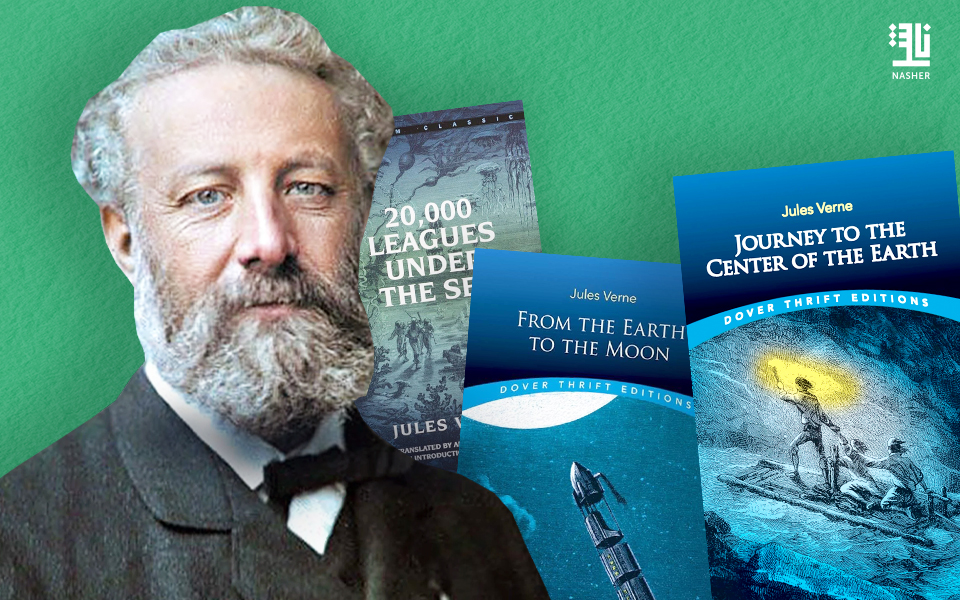
February 8 commemorates the death in 1905 of Jules Verne, French writer and forerunner of science fiction (1828–1905). A bestselling adventure novelist, Verne was also a visionary who envisioned a world filled with futuristic inventions and discoveries — many of them realized many years after his death — cementing his place as one of literature’s most influential figures.


Verne was born in Nantes, France, and was raised during a time of fast-paced scientific and industrial growth that inspired his thirst for knowledge and invention. This fascination manifested itself in his novels, in which he gracefully intertwined science fiction with geographic and technological realities, turning scientific ideas into adventurous prose for the lay reader. Some of his best-known works are Twenty Thousand Leagues Under the Sea, which foresaw modern submarines; From the Earth to the Moon, which eerily imagined space travel almost 100 years before man landed on the moon; and Journey to the Center of the Earth, which explored the secrets below the Earth’s surface.


Verne’s influence was not limited to literature. His concepts influenced famous scientists and inventors, including Thomas Edison and Robert Goddard, and his writings were critical to the development of contemporary space exploration. His novels have inspired NASA astronauts, they said, among their early interest in space. And his tales have been turned into movies and TV shows, laying the ground for the sci-fi genre on screen and influencing creators to produce things based on his visions.


Over a century after his death, Jules Verne towers over literary and scientific realms. And he was never just a writer; he was an ideas man, an explorer of new terrain in thought, and his legacy is here, alive. It serves as a reminder of how often imagination is a necessary precursor to invention. More significantly, he turned science fiction into a flourishing literary genre that was adopted by major publishing houses. His works are successful with a worldwide audience numbering in the tens of millions, encouraging creativity and inspiring generations of readers to dream beyond the limits of today.

 

Recent News

02Sep
Why is Global Publishing Turning to Sharjah?

Why is Global Publishing Turning to Sharjah?

Sharjah’s rise to the forefront of the global cultural landscape was neither a matter of chance nor the result of isolated achievements. It is the outcome of a far-reaching cultural vision founded on the belief that culture is not merely a complement to development, but one of its fundamental pillars. For decades, His Highness Sheikh […]

02Sep
Lisbon Asks What Reading’s Future Holds

Lisbon Asks What Reading’s Future Holds

Lisbon will become a meeting point for some of the most influential voices in publishing, culture and public life on September 15 and 16, 2026, as the fourth edition of BOOK 2.0 – The Future of Reading takes place at the Belém Cultural Centre. Under the theme “Back to Basics, Back to Books,” the conference […]

31Aug
PocketBook Puts an E-Reader in Your Pocket

PocketBook Puts an E-Reader in Your Pocket

Swiss e-book company PocketBook has unveiled its latest ‘phone sized’ e-book reader PocketBook Q.  The company says: “The new PocketBook Q combines a slim, smartphone-sized form factor with all the essential features for comfortable reading on the go. Its 5.84-inch E Ink Carta™ 1300 display has a resolution of 788 × 1,576 pixels and a […]

Related Posts

What’s Really Behind the “Bestseller” Label?

What’s Really Behind the “Bestseller” Label?

Sometimes, all it takes is the word “bestseller” on a book cover for its success to appear settled beyond question. The label compresses the choices of thousands of readers into a single claim and pushes the book to the forefront. Yet behind it lies a far more...

Did Borges Enter the Digital Labyrinth Before Us?

Did Borges Enter the Digital Labyrinth Before Us?

On 24 August 1899, a writer was born in Buenos Aires, the Argentine capital, who would spend his life among books, labyrinths, mirrors and questions without end. Jorge Luis Borges never knew the internet, never saw a smartphone screen or a search engine. Yet decades...

Mary Shelley Asked the AI Question First

Mary Shelley Asked the AI Question First

Mary Shelley was born in London on 30 August 1797, and would go on to give literature one of its most famous creations: Frankenstein. She was only eighteen when she began writing the novel, unaware that she was placing at its heart a question that would remain alive...

Previous Next
Close
Test Caption
Test Description goes like this