Most people assume that the greatest books in literary history sailed smoothly through traditional publishing houses before landing on bookstore shelves. The reality vastly different.
Despite the enduring narrative that depicts self-publishing as a last resort taken by writers who couldn’t secure traditional deals, history has proven this perception to be far from accurate. Some of literature’s most celebrated voices went it alone before the world caught up with their brilliance.
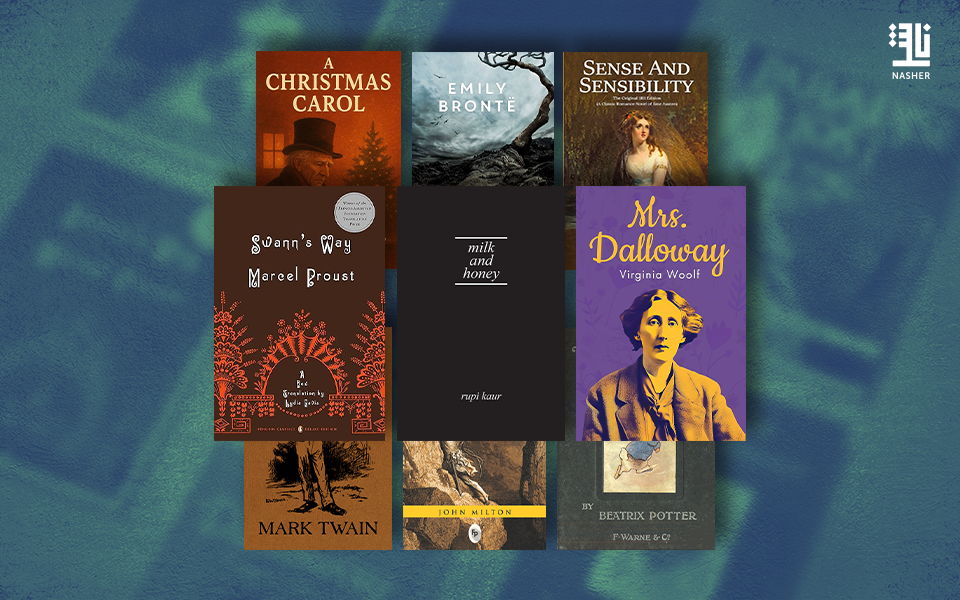
Wuthering Heights by Emily Brontë (1847)
It might shock many readers to learn that one of literature’s most haunting love stories was not welcomed by publishers at first. Emily Brontë, alongside her sisters Charlotte and Anne, pooled their savings to fund a joint volume under the gender-neutral pseudonyms Currer, Ellis, and Acton Bell in 1847. Emily published it under a masculine-sounding pen name so that her work would not be judged on the basis of her gender. The novel eventually found a commercial publisher, Thomas Cautley Newby, though on deeply unfavourable terms to the authors.
Her work was not generally admired at the time, and many critics felt that the characters in Wuthering Heights were coarse and immoral. In spite of this, the novel is now considered to be a classic of English literature.
Paradise Lost by John Milton (1667)
Paradise Lost, a Biblical epic written in verse, is considered one of the most important pieces of writing of recent times. The first edition of Paradise Lost was published by subscription. That is, Milton ran ads in local papers to describe his project in the hopes of garnering interest. Readers, or subscribers, then stood for the production costs (kind of like how crowdfunding works today).
The Adventures of Huckleberry Finn by Mark Twain (1884)
Mark Twain, the quintessential American author, faced numerous rejections on his path with this particular work. Despite having traditionally published several well-received volumes already, nobody seemed to want to publish what would later become his best-known work.
Frustrated by the traditional publishing industry, Twain took matters into his own hands and self-published The Adventures of Huckleberry Finn in 1884. Through his own imprint, Twain released two immensely successful books, including the widely renowned Adventures of Huckleberry Finn.
Despite the initial controversy and mixed critical reception, Twain’s novel went on to become one of the greatest works of American literature.
Swann’s Way by Marcel Proust (1913)
Deemed an unruly collection of memories and melancholic philosophizing, the first volume in Marcel Proust’s masterpiece In Search of Lost Time, Swann’s Way, was rejected by several French publishers before Proust managed to convince Grasset to publish it for him by footing the bill himself. The rejections were stinging, with one editor famously dismissing the book’s lengthy, introspective opening.
Proust had money, though, and paid publisher Editions Grasset to print the book. Ultimately, Swann’s Way established Proust as one of the most important voices of his time, and when he was later approached by the same publishers who had rejected him for rights to publish the remaining volumes, Proust stayed loyal to Grasset.
The book was so well-received and successful that André Gide himself wrote a letter of apology to Proust, calling the rejection of the book “the most serious mistake ever made” and one of the most stinging regrets of his life.
The Tale of Peter Rabbit by Beatrix Potter (1901)
Long before Beatrix Potter became synonymous with beloved children’s classics, she faced rejection after rejection from traditional publishers for her manuscript. Undeterred, Potter took matters into her own hands and self-published the book in 1901, printing 250 copies.
When publishers wanted her to make one too many alterations to the story, she decided that enough was enough and published it herself. It was a wise decision, as readers loved it just as much as five-year-old Noel Moore, the son of Potter’s governess, for whom she’d originally written the story.
The first run of 250 copies quickly sold out. , who had previously rejected the book, saw its potential and agreed to publish it commercially.
Warne’s publication of The Tale of Peter Rabbit became an instant success, and they went on to publish the subsequent 22 tales by Beatrix Potter. Traditional publishing would follow with an estimated 20,000 copies in the first year alone.
Sense and Sensibility by Jane Austen (1811)
Struggling to get her work published, in 1811, Jane Austen decided to take matters into her own hands with the finished manuscript of Sense and Sensibility. Commissioning a publisher to print the book for her, she paid for the production herself. In the end, she came away with a £140 profit (equivalent to £5,000 today) and, luckily for us, made sure that generations of readers could continue to enjoy her tale about the two Dashwood sisters.
After gaining some recognition and success with her writing, Austen went on to sell Emma(1815) to a publisher, but when he asked for the copyright to Mansfield Parkand Sense and Sensibility as well, she refused and went on to yet again pay for the publication herself.
Mrs Dalloway by Virginia Woolf (1925)
In an attempt to skirt the conventions and restrictions of her time, Virginia Woolf started a press of her own called Hogarth (today an imprint of Penguin) together with her husband Leonard Woolf. Running right out of their own living room, the pair used a handpress to publish both Mrs Dalloway — a stream of consciousness story about a housewife planning for a party — and To the Lighthouse(1927): a portrait of a family on holiday on the Isle of Skye.
Milk and Honey by Rupi Kaur (2014)
After gaining a following on her Instagram account where she would publish her poetry, Rupi Kaur self-published her first collection, milk and honey at the age of 21 to great success. Together with her second collection, she explores themes of diaspora identity, immigration, and femininity, and has become the face for the phenomenon of “Instagram poetry,” selling millions of copies of her work worldwide.
A Christmas Carol by Charles Dickens (1843)
Technically speaking, A Christmas Carol — the classic tale about an old miser who is visited by ghosts from his past on Christmas Eve so that he can learn the importance of gratitude and generosity — was published under Chapman and Hall, but after the less successful run of Martin Chuzzlewit, Dickens stood for the cost of publication himself, in exchange for a higher percentage of the profits. Agonizing over end-papers and struggling with production, the profits ended up being much lower than he had expected, yet A Christmas Carol remains a steady seller to this day. A good investment, all in all.