The prison cell is the perfect microcosm for a psychological novel. It raises issues of power and liberty, shame and repentance, memory and hope. Its claustrophobic walls can represent narrow-mindedness, social restrictions, the womb, the grave or the confined cubic centimetres of the human skull. No wonder, then, that so many great works of literature have been set inside prisons.
Springtime in a Broken Mirror by Mario Benedetti (1982)
After a brutal military coup, Santiago finds himself a political prisoner in Montevideo. We piece together his story through splintered glimpses of his cell in the ironically named Libertad jail, and of the lives of his family as they adjust to the terrors and temptations of exile in a distant country. Mario Benedetti was the literary editor of the newspaper Marcha in Uruguay until the military government closed the paper in 1973 and he himself went into exile, in Argentina, Peru, Cuba and Spain.
Falconer by John Cheever (1977)
Ezekiel Farragut, a college professor and heroin addict, is sent to Falconer Correctional Facility for the murder of his brother. In his filthy cell, he recalls his traumatic childhood and troubled marriage and finds himself falling in love with a fellow inmate. ‘It is rough, it is elegant, it is pure,’ said Saul Bellow. ‘It is also indispensable, if you earnestly desire to know what is happening to the human soul in the USA.’ Towards the end of his life, Cheever taught at Sing Sing maximum-security prison, New York State, which provided some of the material for this novel.
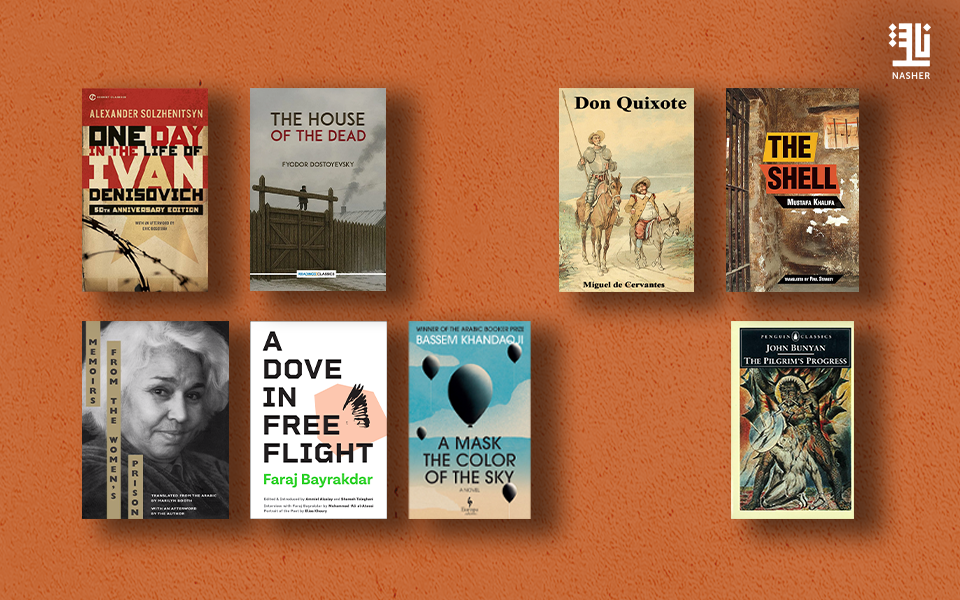
The House of the Dead by Fyodor Dostoyevsky (1861)
Dostoyevsky spent four years in a Siberian prison camp at Omsk in the 1850s, performing hard labour with his hands and feet shackled. The House of the Dead tells the fictional story of Aleksandr Petrovich Goryanchikov, who murdered his wife and experiences a spiritual awakening over the course of 10 years at a labour camp, but the novel is infused with Dostoyevsky’s first-hand experience: the wooden plank beds, the cabbage soup swimming with cockroaches and the strange ‘family’ of desperate convicts.
Darkness at Noon by Arthur Koestler (1940)
Rubashov is an indignant and ageing Soviet revolutionary, imprisoned during a political purge and awaiting his show trial and execution. Koestler’s novel is both a tense drama of prison psychology and a damning indictment of totalitarian government. “Brilliant as this book is as a novel, and a piece of prison literature,” wrote George Orwell, “it is probably most valuable as an interpretation of the Moscow ‘confessions’ by someone with an inner knowledge of totalitarian methods.” It was first published in English translation. Having arrived in Britain without an entry permit, however, Koestler was in prison himself when the book first appeared.
Invitation to a Beheading by Vladimir Nabokov (1935)
This is the nightmarish story of a teacher, Cincinnatus C., sentenced to death for obscure metaphysical reasons. He dances, watches spiders, writes down thoughts and repeatedly enquires about the date of his execution. Elements of the novel have been compared to Lewis Carroll’s Alice’s Adventures in Wonderland, Franz Kafka’s The Trial and James Joyce’s Ulysses; Nabokov himself called it “a violin in a void”. He wrote it in a single fortnight “of wonderful excitement and sustained inspiration”.
The Tunnel by Ernesto Sabato (1948)
In his prison cell, the deranged painter Juan Pablo Castel recalls his obsession with the fascinating María Iribarne, which ultimately led to her murder. He saw her for the first time at one of his own exhibitions and came to believe that she might be the only person capable of understanding him. This dark, existential novel was rejected by several editors before it was published in the avant-garde literary journal Sur. Albert Camus commissioned a translation for the French publisher Gallimard, and it was highly praised by Thomas Mann and Graham Greene.
The Room by Hubert Selby, Jr. (1971)
Selby takes us into the unhinged mind of an insane criminal, locked in a cramped remand cell, recalling his violent childhood and dreaming about the horrible revenge he will wreak on those who have imprisoned him. His brutally vivid fantasies involve rape, murder and torture. Selby called it “the most disturbing book ever written” and he could not bring himself to reread it for 20 years.
One Day in the Life of Ivan Denisovich by Aleksandr Solzhenitsyn (1962)
Based on Solzhenitsyn’s own experiences in a Soviet labour camp in Kazakhstan, this novel describes a day in the life of a prisoner serving a 10-year sentence: a gruelling regime of hard manual labour, freezing conditions and brutal punishment. “There were three thousand six hundred and fifty-three days like that in his stretch,” concludes the narrator. “[. . .] The three extra days were for leap years.” This was the first government-sanctioned account of the Gulag to be published within the USSR.
Le Morte d’Arthur, by Sir Thomas Malory
Malory’s collection of knightly yarns has served as a sourcebook for every Arthurian since. Imprisoned during the 1450s, perhaps for rape as well as theft, Malory filled the years he spent waiting for trial recalling the tales of chivalry that he then collected as one of Caxton’s first bestsellers.
Don Quixote, by Miguel de Cervantes
Cervantes was jailed two or three times, and he claims in his prologue to Don Quixote that his great mock-romance was “begotten in a prison”. Confined to a cell, the author’s imagination wanders with his crack-brained knight over the dusty roads of Spain.
Pilgrim’s Progress, by John Bunyan
Bunyan’s allegory, narrating Christian’s journey to the holy city, was written while he was incarcerated in Bedford jail for 12 years. He was imprisoned for refusing to cease public preaching. Where better than prison for a dissenting Protestant to write?
De Profundis, by Oscar Wilde
In Reading jail, where he spent two years after being found guilty of “gross indecency”, Wilde penned his apologia for his life and conduct. “I was a man who stood in symbolic relations to the art and culture of my age … I became the spendthrift of my own genius, and to waste an eternal youth gave me a curious joy”.
Justine , by the Marquis de Sade
The infamous libertine spent much of his adult life in prison and wrote most of his novels there. His sexually explicit narratives – including this account of a virtuous girl in a wicked world of sexual predators – were composed to fill the tedious hours and compensate for the absence of women. The first draft was written in the Bastille.
A Hymn to the Pillory , by Daniel Defoe
Defoe turned personal disaster into public relations triumph when he wrote this satire in Newgate prison while waiting to be put in the pillory. He had been sentenced for mocking high-church Tory intolerance of dissenters like himself. It was sold in the streets when he was eventually pilloried and made him the darling of the crowds who gathered to watch.
Memoirs from the Women’s Prison by Nawal El Saadawi
Nawal El Saadawi was arrested in September 1981 under Egyptian President Anwar Sadat for alleged “crimes against the state”, related to her feminist writings and activism.
She was held in Qanatir Women’s Prison and endured dehumanising conditions for around three months. She was released in late November, shortly after Sadat’s assassination.
Reduced to ‘Detainee No. 1536’, El Saadawi documents the psychological effects of the stripping of her name and personhood while facing severe overcrowding, sewage-filled toilets and lack of basic hygiene.
Written in secret during her imprisonment using an eyebrow pencil on toilet paper, the memoir is a powerful firsthand account of life in the women’s prison ward, detailing her experiences alongside other prisoners, as well as themes of resistance to state violence and solidarity among the women inmates.
A Dove in Free Flight by Faraj Bayrakdar
This is a powerful collection of prison poems by Syrian poet and journalist Faraj Bayrakdar, exploring themes of confinement, torture, mental freedom, resilience, and the defiant power of imagination under oppression — using vivid imagery, such as a dove in flight, to symbolise the unbound spirit.
Bayrakdar was arrested in April 1987 by Syrian military intelligence for his political activities and suspected membership in the Party for Communist Action, an unauthorised opposition group.
He endured brutal torture and solitary confinement, followed by years in prisons like Tadmur. He was released under an amnesty in November 2000.
He composed many of the poems while imprisoned, often keeping them in his memory. When able, he secretly penned them onto scarce cigarette papers using a thin wooden stick dipped in makeshift ink brewed from tea and onion peels.
The poems were smuggled out piecemeal through visitors. Supporters arranged for a Beirut edition to be published in 1997 while he remained imprisoned, helping draw international attention to his case.
The first formal, widely distributed Arabic edition appeared in 2002, which helped catalyse further international attention and translations.
Prison Notebook by Ibrahim El-Salahi
In 1975, while serving as Sudan’s Undersecretary of Culture under President Jaafar Nimeiri, Ibrahim El-Salahi was arrested without charge on suspicion of involvement in an anti-government plot.
He spent around six months in Khartoum’s notorious Kober Prison, enduring harsh conditions, isolation and uncertainty before being released into house arrest.
It was during this period of house arrest in 1976 that El-Salahi created Prison Notebook as a way to process the psychological trauma of his imprisonment.
A hybrid visual-literary work, the sketchbook combines delicate pen-and-ink drawings with his own Arabic prose, poetry, reflections and Quranic verses, transforming personal testimony into an act of artistic resistance.
Although created after his release, Prison Notebook remains one of the most powerful artistic responses to political imprisonment in modern Arabic literature and art, expanding the idea of prison into a metaphor for the broader structures of repression in Sudan at the time.
A Mask, the Colour of the Sky by Bassem Khandaqji
Written entirely in secret while serving three life sentences in Israeli high-security prisons, Khandaqji turned to imagination as both a survival tool and a literary method.
Khandaqji composed the novel under constant threat of cell raids and confiscation. The finished manuscript was systematically smuggled out of the prison gates, page by page, by family members and underground networks, eventually reaching his publisher in Beirut and winning the 2024 International Prize for Arabic Fiction.
Israeli prison authorities punished him with solitary confinement in retaliation for the international recognition. Khandaqji was released from prison in October 2025 as part of a ceasefire exchange deal and exiled to Cairo.
The Shell: Memoirs of a Hidden Observer by Mustafa Khalifa
This harrowing, autobiographical novel follows a young Syrian filmmaker who returns to his homeland in the 1980s, only to be swept into the state’s Kafkaesque security apparatus.
Suspected of political subversion against Hafez al-Assad, he is sent to the notorious Tadmor Military Prison for over a decade without formal charges.
Misidentified by guards as an Islamist activist, despite actually being an atheist, he is isolated by both his jailers and his highly religious cellmates. He copes by retreating into a metaphorical “shell”, becoming a silent, meticulous observer of the systemic torture and executions around him.
Because the discovery of a pen meant instant execution in Tadmor, Khalifa had to compose the entire book in his head. He relied on memory techniques shared by fellow inmates, committing his daily observations to mental journals.
Upon his release in 1994, he transcribed his memories onto paper. He later took the completed manuscript into exile with him in 2006, and it was published in Beirut in 2008.