Home 5 Articles and Reports 5 Yunus’s Vision: Transforming Bangladesh Through His Books

Yunus’s Vision: Transforming Bangladesh Through His Books

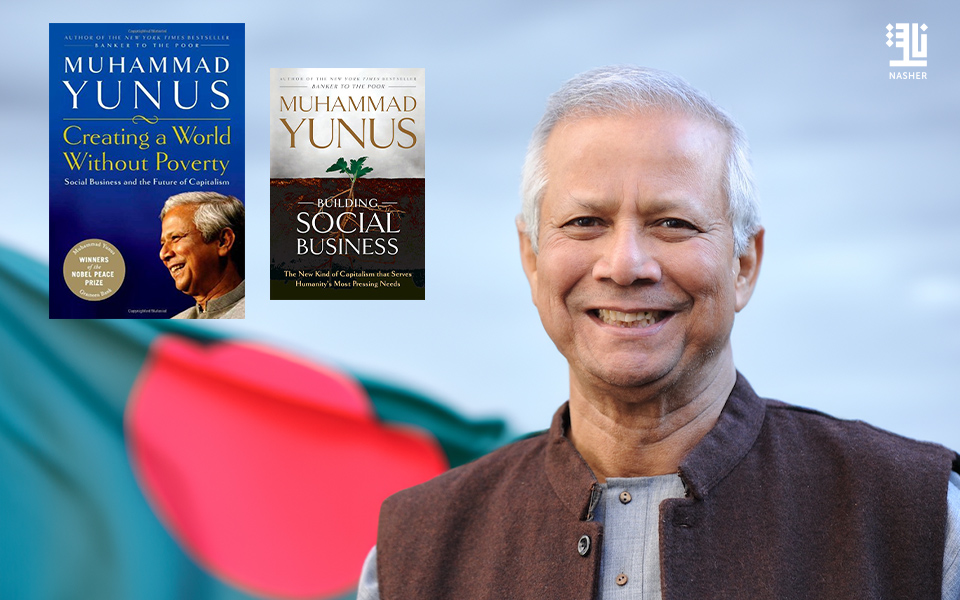
Muhammad Yunus, the Nobel laureate and pioneering economist from Bangladesh, has long been recognized for his groundbreaking work in microfinance and social business. His research and practical applications, notably through the establishment of Grameen Bank, have empowered millions of impoverished people worldwide. Yunus’s books, including “Banker to the Poor” and “Creating a World Without Poverty”, encapsulate his philosophy that financial independence and entrepreneurial opportunities are essential for sustainable development.


In light of recent political unrest in Bangladesh, there is speculation that Yunus could assume a pivotal role in a transitional government. Yunus’s potential involvement raises high expectations due to his reputation for integrity and his visionary approach to economic and social issues. His emphasis on social business as a means to address societal challenges could offer a new direction for the country, fostering an environment where economic empowerment and social justice are prioritized.


Yunus’s critique of traditional capitalism and his advocacy for a more inclusive economic system, as expressed in his books, resonate deeply in a nation grappling with political instability and economic disparity. As Bangladesh stands on the brink of significant political change, Yunus’s ideas present a hopeful alternative that emphasizes grassroots empowerment and ethical governance. His leadership could herald a transformative period for Bangladesh, aligning with his lifelong commitment to creating a world where poverty is a relic of the past.
 

Recent News

02Sep
Why is Global Publishing Turning to Sharjah?

Why is Global Publishing Turning to Sharjah?

Sharjah’s rise to the forefront of the global cultural landscape was neither a matter of chance nor the result of isolated achievements. It is the outcome of a far-reaching cultural vision founded on the belief that culture is not merely a complement to development, but one of its fundamental pillars. For decades, His Highness Sheikh […]

02Sep
Lisbon Asks What Reading’s Future Holds

Lisbon Asks What Reading’s Future Holds

Lisbon will become a meeting point for some of the most influential voices in publishing, culture and public life on September 15 and 16, 2026, as the fourth edition of BOOK 2.0 – The Future of Reading takes place at the Belém Cultural Centre. Under the theme “Back to Basics, Back to Books,” the conference […]

31Aug
PocketBook Puts an E-Reader in Your Pocket

PocketBook Puts an E-Reader in Your Pocket

Swiss e-book company PocketBook has unveiled its latest ‘phone sized’ e-book reader PocketBook Q.  The company says: “The new PocketBook Q combines a slim, smartphone-sized form factor with all the essential features for comfortable reading on the go. Its 5.84-inch E Ink Carta™ 1300 display has a resolution of 788 × 1,576 pixels and a […]

Related Posts

What’s Really Behind the “Bestseller” Label?

What’s Really Behind the “Bestseller” Label?

Sometimes, all it takes is the word “bestseller” on a book cover for its success to appear settled beyond question. The label compresses the choices of thousands of readers into a single claim and pushes the book to the forefront. Yet behind it lies a far more...

Did Borges Enter the Digital Labyrinth Before Us?

Did Borges Enter the Digital Labyrinth Before Us?

On 24 August 1899, a writer was born in Buenos Aires, the Argentine capital, who would spend his life among books, labyrinths, mirrors and questions without end. Jorge Luis Borges never knew the internet, never saw a smartphone screen or a search engine. Yet decades...

Mary Shelley Asked the AI Question First

Mary Shelley Asked the AI Question First

Mary Shelley was born in London on 30 August 1797, and would go on to give literature one of its most famous creations: Frankenstein. She was only eighteen when she began writing the novel, unaware that she was placing at its heart a question that would remain alive...

Previous Next
Close
Test Caption
Test Description goes like this