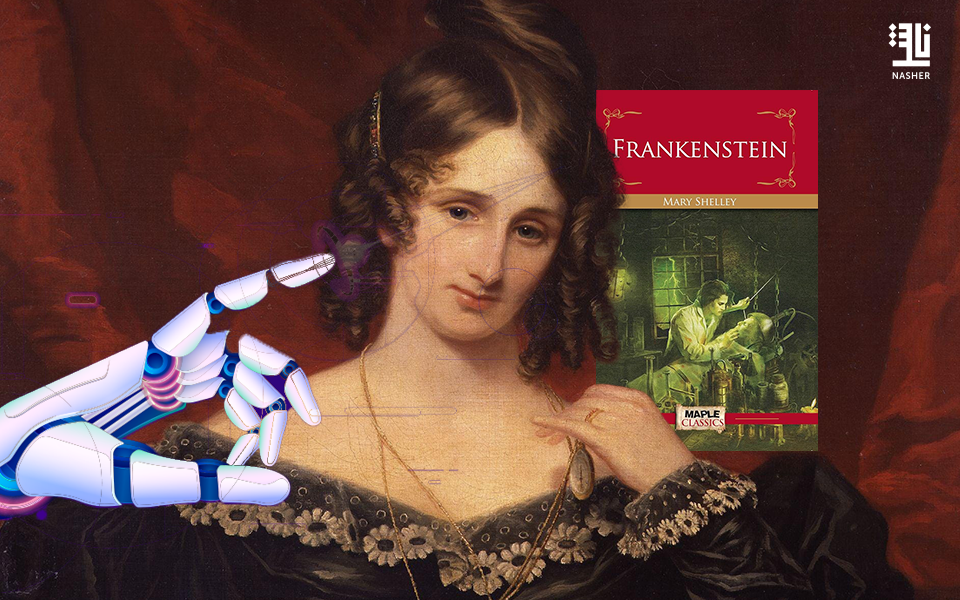
Mary Shelley was born in London on 30 August 1797, and would go on to give literature one of its most famous creations: Frankenstein. She was only eighteen when she began writing the novel, unaware that she was placing at its heart a question that would remain alive for more than two centuries: What happens when human beings succeed in creating something endowed with a life or will that exceeds what they intended? First published in 1818, at a time when electricity and new scientific experiments inspired both wonder and anxiety, the novel was never simply about a strange creature. At its core, it was an early meditation on the limits of science and on humanity’s responsibility for what it brings into being.
Popular culture has long reduced Frankenstein to the image of a hulking body stitched together from disparate parts, but Shelley’s novel is far more complex. Frankenstein is, in fact, the name of the scientist, Victor Frankenstein, not the creature, which remains nameless throughout the book. Victor achieves what seems an impossible dream: he gives life to dead matter. Yet the moment he sees the result of his experiment, he recoils in horror and abandons it. This is where the true tragedy begins. The problem lies not in humanity’s capacity to innovate, but in what happens when we create something and then refuse to accept responsibility for it.
More than two hundred years later, the novel feels strikingly close to the debates of our own age surrounding artificial intelligence, genetic engineering, robotics, and technologies capable of making decisions or generating new knowledge. Mary Shelley did not, of course, foresee computers or algorithms, but she grasped remarkably early the ethical dilemma that accompanies every major scientific leap: Is the fact that we can create something enough to mean that we should? And who bears responsibility when a technology we have created becomes a force that is difficult to control? Shelley’s question has only grown more urgent as humanity’s ability to reshape the world around it has expanded.
What is particularly striking is that the novel’s “monster” is not evil from the outset. He learns language, reads, observes human beings, and longs for acceptance and affection, yet he is met with fear and rejection because of his appearance. Gradually, society’s rejection hardens into anger and revenge. Here, Shelley overturns the conventional logic of horror: Who is the real monster, the creature that commits terrible acts, or the human being who creates life only to abandon it? Through this paradox, the novel moves far beyond the boundaries of horror fiction to become a work about isolation, responsibility, prejudice, and the need to belong, as well as the consequences of giving a creation power without extending to it care.
Perhaps this is why Frankenstein has never remained confined to its own time. It has moved from the page to the stage, cinema, television, and comics, while its name has become a metaphor for inventions that may ultimately turn against their creators. With every new technological revolution, the question posed by a young woman not yet twenty returns with renewed force: What do we owe to the things we create? At a time when the world is debating the limits of artificial intelligence, the responsibilities of its developers, and the future relationship between humans and machines, Mary Shelley seems to warn us that the greatest danger in innovation may lie not in what is created, but in how human beings choose to treat it.