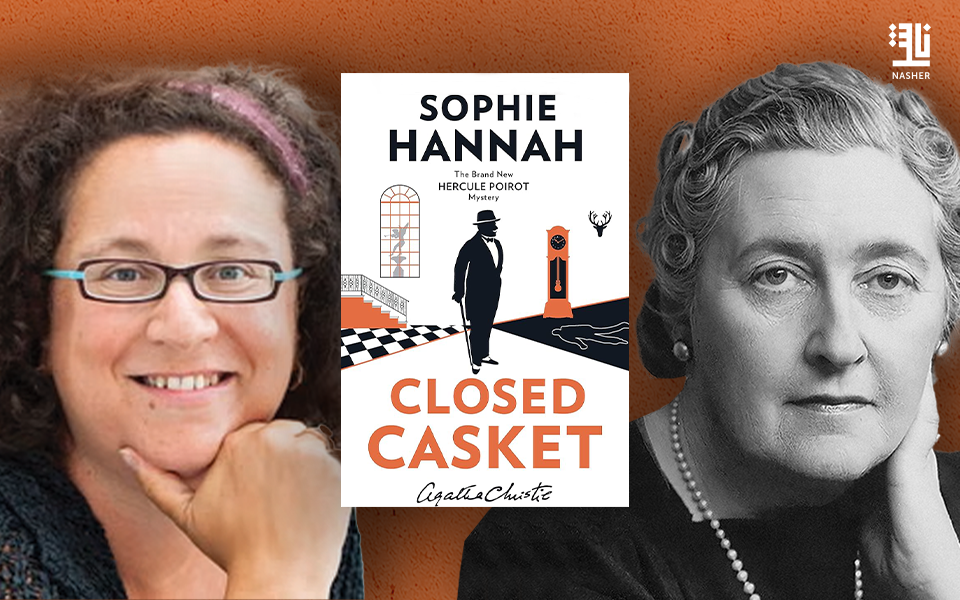
When the British author Sophie Hannah accepted the task of continuing the adventures of the famed Belgian detective Hercule Poirot, it was far more than a new installment in a successful series. It was a culturally charged moment that revived old questions in a new form. This character, created by the iconic novelist Agatha Christie and embedded in readers’ imaginations for decades, was no longer confined to its original time or to its creator’s pen. Instead, it entered a new phase under the stewardship of her literary estate. What we are witnessing here is not simply another novel, but a genuine test of an idea: can a literary voice endure beyond its creator, or does everything written thereafter remain only an echo?
Sophie Hannah’s experience belongs to a broader context in which continuing the works of deceased authors is no longer an exception, but a recurring phenomenon in the publishing world. For some heirs and cultural institutions, such continuations represent an act of fidelity, an effort to keep beloved characters alive in the memory of new generations. Yet the commercial dimension of these decisions cannot be ignored. Literary characters, in this light, begin to resemble cultural “brands,” their popularity strategically leveraged to secure renewed success in an increasingly competitive book market.
Readers, for their part, remain divided. Some welcome these works as an opportunity to revisit worlds they cherish, while others approach them with caution, if not outright resistance. A reader deeply attuned to Agatha Christie’s distinctive voice, her precise plotting, and her masterful construction of mystery, may find themselves facing a narrative that aspires to resemble the original without fully inhabiting it. While some believe Sophie Hannah has, to a certain extent, captured the spirit of Poirot, others argue that the character has lost something essential, and that any writing detached from the original creative experience inevitably exists in a gray area.
Critics, too, are far from unanimous. Some regard such works as legitimate extensions of literature, provided they are crafted with awareness and respect for the source, seeing them as proof of the enduring vitality of great characters and their ability to transcend time. Others, however, contend that literature cannot be inherited in this way, that every writer possesses a singular imprint that resists replication, regardless of the successor’s skill. For them, the risk lies not merely in weaker texts, but in reducing literature to a product that can be endlessly reproduced.
Ultimately, Sophie Hannah’s engagement with Hercule Poirot reveals a deeper dilemma that extends beyond the success or failure of any single work. It raises an open question about the boundaries of creative ownership: do literary characters belong to those who created them, or to those who loved them? Between fidelity to legacy and the impulse to capitalize on it, literature finds itself in a delicate space, where the balance between reverence and reinvention becomes the true challenge. Perhaps, in the end, the answer rests with the reader alone, the one who can decide whether this voice still rings authentic… or whether it is merely a retelling of a story that has already reached its final page.