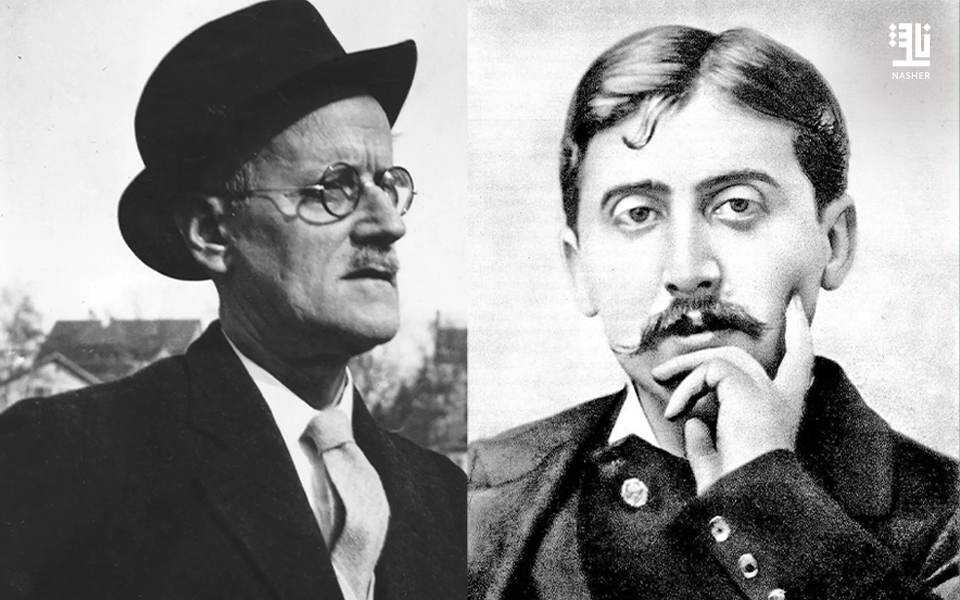
James Joyce and Marcel Proust are remembered as towering innovators of 20th-century fiction, but their only face-to-face encounter was less a meeting of geniuses than an awkward, late-night collision of temperaments. At a glittering Paris dinner attended by Picasso, Stravinsky, and other luminaries, the two writers arrived exhausted, unwell, and seemingly uninterested in one another’s work.
According to the IrishCentral contributors network the Irish author James Joyce and the French author Marcel Proust are regarded as two of the titans of 20th-century literature. Though quite different in style, Joyce and Proust revolutionized the portrayal of human consciousness in literature. Joyce is best known for his ground-breaking “Ulysses” (which takes place on June 16 – Bloomsday), and Proust is best known for his multivolume novel “In Search of Lost Time” (also known as “Remembrance of Things Past”).
Though they were active writers in Paris at about the same time, they only met once. This blockbuster of a literary meeting did not go well. While both men were great writers, their temperaments could not have been more different.
On May 18, 1922, Sydney and Violet Schiff, British patrons of the arts, held a dinner party attended by leading artists at the time: James Joyce, Marcel Proust, Pablo Picasso, and Igor Stravinsky.
Accounts of what happened that night differ. They do agree that by the time dinner was served (at about midnight), neither Proust nor Joyce had arrived. Sometime after coffee was served, Joyce arrived looking a little worse for wear. According to the Irish Times:
“In an obvious state of alcoholic alteration, he went straight to where the champagne was being served. He [Joyce]sat down next to Schiff and remained silent for what must have seemed an eternity. That was before he fell asleep and started snoring.”
A few hours later, Proust arrived. All accounts describe Proust as being elegantly dressed but looking pale and sickly. Interestingly, one of the accounts we rely on for this meeting of the literary titans is that of Italo Svevo, who was thought to have been the model for Leopold Bloom (the central character in “Ulysses”).
English novelist Ford Madox Ford reports that the dialogue between Proust and Joyce as follows:
“Proust: As I say, Monsieur, in Du Côté de chez Swann[the first volume of In Search of Lost Time], which without doubt you have – Joyce: No, Monsieur. (pause) Joyce: As Mr Bloom says in my Ulysses, which, Monsieur, you have doubtless read … Proust: But, no, Monsieur. (pause) Proust apologizes for his late arrival, ascribing it to malady, before going into the symptoms in some detail. Joyce: Well, Monsieur, I have almost exactly the same symptoms. Only in my case, the analysis …”
In none of the accounts of this meeting of the literary titans are there any reports of discussions of their work and what they were trying to achieve. As the evening ended, Joyce and Proust left the dinner party; dawn must have been breaking on that May morning.
Joyce reportedly did not like Proust’s In Search of Lost Time, but he was impressed with some of Proust’s earlier stories. As is the case with much of Joyce’s work, you must dive deeper to reveal the full meaning. Joyce paid Proust the ultimate compliment –mentioning him in his work. As the Irish Times reports:
“Joyce’s tribute to the him – and this is perhaps his best epitaph – is what he wrote in ‘Finnegans Wake’, recognising his colleague’s rightful claim to eternity: The Prouts who will invent a writing there ultimately is the poeta”, where Prouts (instead of Proust) is an Irish priest (Father Prout – Francis Sylvester Mahony), the author of ‘The Bells of Shandon’.”
While Joyce and Proust may not have realised or wanted to acknowledge it, they had much in common. Both men focused on the details of our daily lives, showing us that they are worth celebrating. Joyce saw the day of an ordinary Dubliner as a Homeric odyssey, and Proust saw how we can see our whole lives in a teacup.