In a world dominated by fictional success it is of no surprise that the literary field had its fair share of ‘fictional’ claims that were successful in fooling people, well, until they were exposed.
The Hitler Diaries
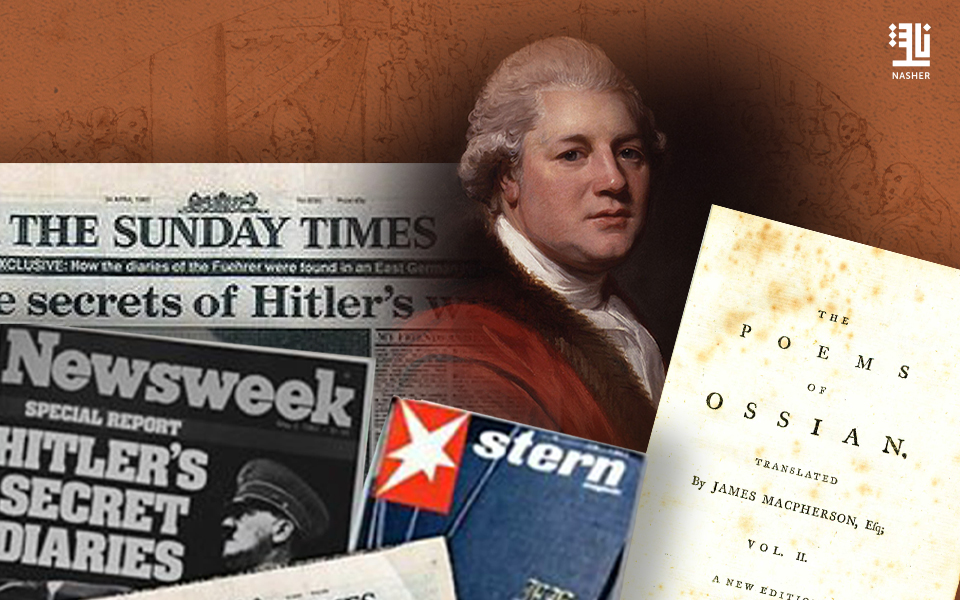
In 1983, the German magazine Stern shocked the world by announcing it had acquired Hitler’s lost diaries. The “diaries” were claimed to offer a unique window into the dictator’s private life, and the international press went wild.
Historians and handwriting experts were brought in, and for a brief moment, their authenticity was widely believed. But the bubble burst quickly—scientific tests on ink and paper revealed the diaries were forgeries, created by a German con artist named Konrad Kujau.
The scandal was massive: Stern’s reputation took a severe hit, and the world was left stunned by how easily so many experts were fooled. The case remains a classic lesson in how wishful thinking and sensationalism can override skepticism and fact-checking.
The Poems of Ossian
In the 1760s, Scottish poet James Macpherson published a collection of epic poems he claimed were translations of ancient works by a legendary bard named Ossian. Readers across Europe—including Napoleon and Goethe—were enchanted, believing them to be the “Celtic Homer.” Academics and historians debated the texts’ authenticity for decades.
Eventually, it became clear Macpherson had written most of the poems himself, perhaps using fragments of genuine folklore. The “Ossian” phenomenon helped shape romantic nationalism, but it also stands as a cautionary tale about the hunger for mythic origins.
Clifford Irving and the Howard Hughes Autobiography
In 1971, Clifford Irving convinced publisher McGraw-Hill that he had collaborated with the reclusive billionaire Howard Hughes on his autobiography. The publishing deal was reportedly worth $765,000, and anticipation soared.
But Hughes, who had not spoken publicly for years, broke his silence to denounce the book as a fraud. Irving’s hoax unraveled, and he was sentenced to prison.
The story became so legendary that it inspired the film “The Hoax,” starring Richard Gere.
The “Go Ask Alice” Diary
Released in 1971, “Go Ask Alice” purported to be the real diary of a teenage girl who spiraled into drug addiction and died tragically. The book became a staple in schools and libraries, sparking anti-drug campaigns.
Decades later, it was revealed that the diary was a work of fiction, written by Beatrice Sparks, who created several similar “real diaries.” The controversy over “Go Ask Alice” continues, with many arguing that the book misled generations of readers and educators.
The Sokal Affair
Physicist Alan Sokal pulled off one of academia’s most famous hoaxes in 1996. He submitted a deliberately nonsensical article, filled with jargon and absurd claims, to the cultural studies journal Social Text.
To Sokal’s shock—and delight—the journal published it. When he revealed the hoax, it sent shockwaves through the academic world, fueling debates about postmodernism, peer review, and intellectual rigor.
The Sokal Affair is now a touchstone in discussions about academic standards.
The Donation of Constantine
For centuries, the Donation of Constantine was accepted as proof that Emperor Constantine had granted vast temporal power to the Pope. Medieval popes cited the document to justify their authority.
In the 15th century, the scholar Lorenzo Valla demonstrated through linguistic analysis that the document was a forgery, written centuries after Constantine’s death. The exposure of the hoax altered church history and remains a landmark moment in the development of historical criticism.