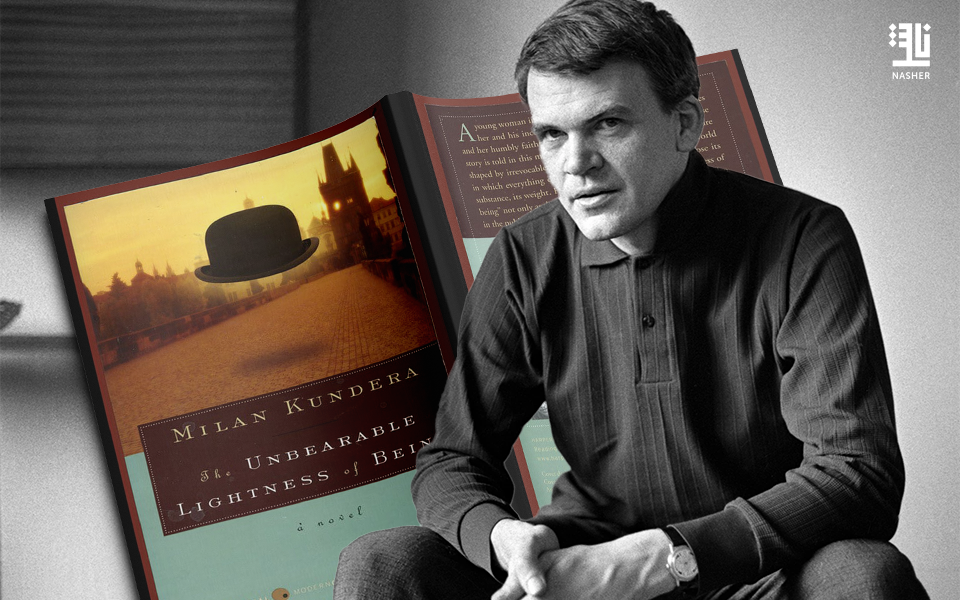
Since the publication of his most celebrated novel The Unbearable Lightness of Being in 1984, it has become impossible to view Milan Kundera as a traditional novelist. His work moves beyond the limits of storytelling into a wider universe where characters intersect with profound issues such as freedom, love, existence, and politics. He did not write the novel as a mere sequence of events but rather used it as an instrument of philosophical inquiry, until readers were left wondering: are we reading literature or philosophy clothed in narrative? Kundera transformed the novel into a space for reflection rather than entertainment, a quality that gave his works their unique blend of thought and art. Perhaps this is why his influence has long extended beyond casual readers to reach critics and philosophers alike.
What distinguishes Kundera is that he was never a philosopher writing in abstract language; he insisted that philosophy needed flesh and blood to come alive. His characters are not symbols alone, but beings confronting harsh existential dilemmas. In The Unbearable Lightness of Being, we see Tomas, Tereza, and Sabina navigating the tension between lightness and weight, freedom and commitment, body and soul. Through them, Kundera turns abstract questions into tangible human experiences, making the reader feel as if they are inside a living philosophical laboratory. This interplay between story and idea set him apart from his European contemporaries and gave his works an intensely human depth. Even readers with no philosophical background find themselves drawn into these questions as though they were living them.
Kundera, however, did not use philosophy merely to impress or posture. He believed the novel to be the only literary form capable of capturing the complexity of human existence. To him, philosophy alone could not convey the fragility of relationships, the delicacy of emotions, or the noise of everyday life. He therefore developed a dual approach: a story that grips the reader and ideas that open doors to reflection. This was the essence of his originality, blending the pleasures of narrative with the rigor of thought. And yet, his writing never lost its novelistic beauty, rich in detail and sensory experience. This balance between intellect and artistry enabled him to captivate a diverse readership, from casual readers to scholars.
Nor can one overlook the political dimension in his work, especially given his experience of exile after leaving Czechoslovakia. Exile was not a mere biographical backdrop but a central intellectual material reflected in his novels, where he explored questions of belonging, memory, and identity. In this sense, his works became mirrors of the individual facing the brutality of totalitarian regimes. Yet he avoided ideological directness, preferring a more universal, human approach. He made personal experience a tool to expose the contradictions of power and the meaning of freedom. Thus, his novels came to occupy a rare space between political writing and philosophical narrative, where politics appears as a tragic backdrop rather than rhetorical propaganda.
Through all this, Kundera emerges closer to a philosopher writing in the form of a novel than a novelist borrowing from philosophy. He turned the novel into a space for experimentation and questioning, so that his works became lessons in how to think about life rather than stories to consume. Perhaps this explains why his name remains as alive in intellectual debates as it does in lists of immortal novels. Readers turn to him not for a dramatic ending, but to leave with new questions about themselves and the world. This is the essence of his legacy: the power to unsettle certainties and reopen the gates of inquiry without end.
Milan Kundera wrote texts that defy categorization: novels infused with thought, and philosophy breathing with the spirit of literature. In each of his works, we find a relentless attempt to grasp both the fragility of human life and its quiet strength, as if storytelling were his chosen instrument to reveal the essence of existence. For this reason, his influence continues across generations, provoking wonder, stimulating reflection, and proving that when literature reaches its highest form, it becomes more than art. It becomes a way of understanding the world and reinventing it anew.