Among the names that never lose their allure across centuries, Maryam emerges as a cultural and literary icon that transcends the boundaries of language, religion, and geography. It is a name that fuses history with emotion, appearing in sacred texts as a symbol of purity, in poetry as an emblem of love and human sorrow, and in novels as a figure reflecting the struggles of women and society. Thus, Maryam is not merely a linguistic signifier but a text in itself: a symbol that opens doors of interpretation for writers and invites readers into spaces of serenity and nostalgia whenever it is invoked. Perhaps for this reason, the name has become one of the most recurring motifs in modern literature, carrying both the simplicity that draws us close and the depth that stirs reflection.
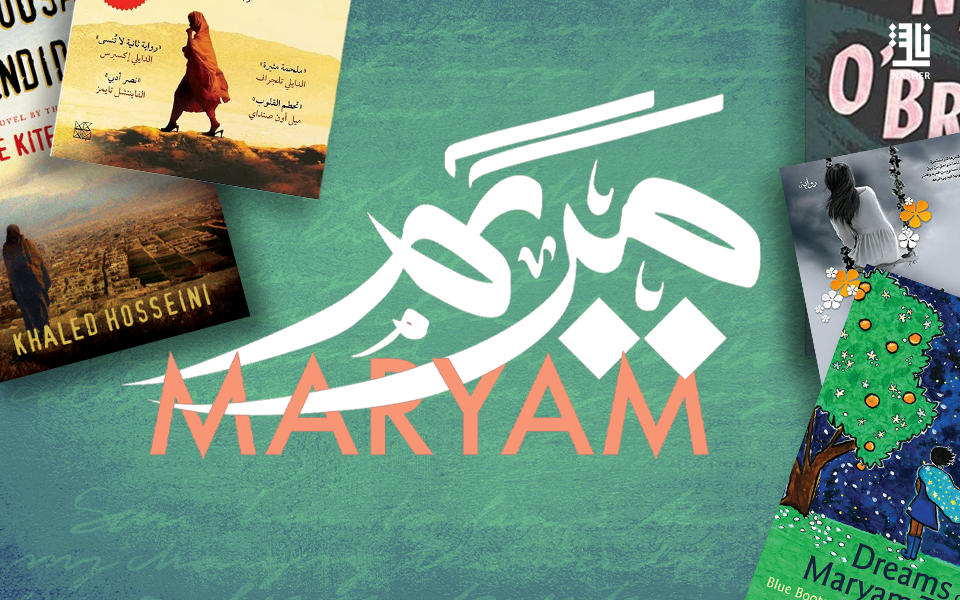
No exploration of the name’s presence in literature would be complete without Khaled Hosseini’s novel A Thousand Splendid Suns, where Maryam stands as one of the central characters embodying the suffering of women under the weight of war and social injustice. Maryam in Hosseini’s narrative is not merely an individual; she becomes the voice of thousands of women who lived on the margins. Yet she is also a testament to inner strength, capable of sacrifice and loyalty. In this way, the name evolves within the text into something like a long poem about patience and resilience. This ability to transform Maryam into a universal metaphor confirms that literature, when it borrows a name, does not stop at the personal identity but turns it into a mirror of the human condition as a whole.
In Dreams of Maryam Tair by author Mhani Alaoui, the name acquires a mythical dimension. Here, Maryam is not only a woman searching for herself, but a vessel of collective memory where family stories, folk symbols, and ancient legends converge. The novel weaves its threads between dream and reality, making Maryam a recurring heroine across generations, as though the name itself were a destiny passed down through time. This literary treatment reveals the name’s capacity to harbor multiple narratives, embodying both a flesh-and-blood woman and a mythical symbol that holds existential questions, granting it a distinctiveness unmatched by other names.
The name also surfaces in works inspired by contemporary tragedies. In Girl by Irish novelist Edna O’Brien, Maryam appears as a girl kidnapped by the Boko Haram group in Nigeria. Her story captures the brutality of violence and deprivation, yet simultaneously highlights her courage in facing a harsh reality. Here, the name Maryam becomes a symbol of human suffering while also embodying the seed of hope that grows at the heart of anguish. It takes on an almost documentary weight, as though literature chose the name to immortalize the voice of a woman who suffered but did not surrender.
Through all these works, it becomes clear that Maryam has long ceased to be confined to personal or local contexts. It has become a literary signifier that crosses borders, from East to West, from sacred scripture to contemporary novels, from poetry to song. The secret of its power may lie in the dualities it carries: purity and strength, tenderness and pain, individuality and universality. In the end, Maryam is not one character but an open text, rewritten anew with each generation, affirming that certain names are born to belong to literature just as they belong to life itself.