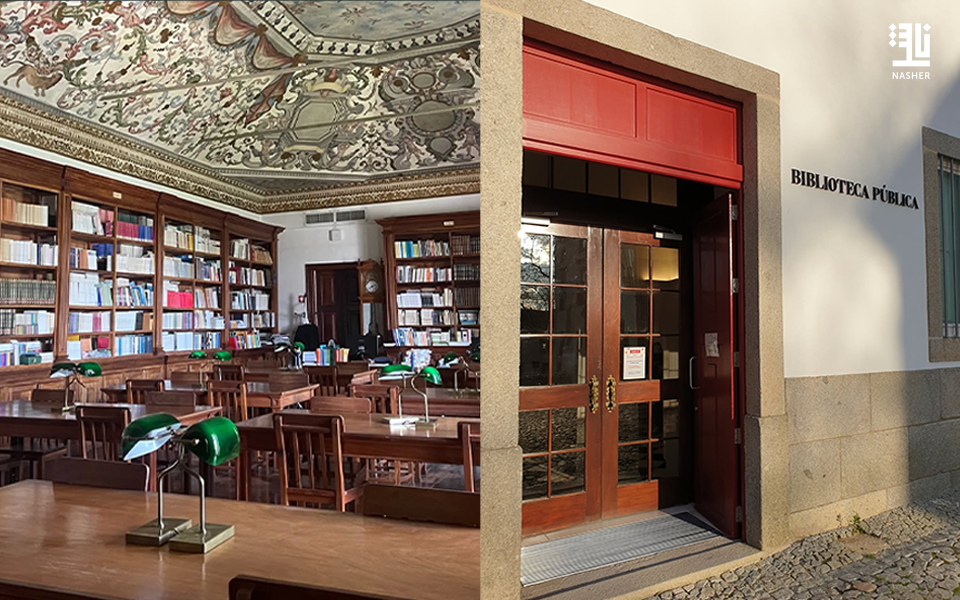
In the heart of the Portuguese city of Évora, a UNESCO World Heritage Site since 1986, the Évora Public Library stands as a testament to more than two centuries of intellectual and cultural history. As Portugal’s second-oldest public library after the University of Coimbra Library, it is also regarded as one of the Iberian Peninsula’s most significant historic libraries. Thanks to its exceptional collections and enduring scholarly value, the library has become an essential destination for researchers, historians, university students, and readers interested in the history of books and Europe’s rich cultural heritage, serving a mission that extends far beyond lending books to preserving the nation’s collective memory.
Founded in 1805 by the Portuguese bishop and scholar Friar Manuel do Cenáculo, one of the leading figures of Portugal’s Enlightenment, the library began with his personal collection, which he generously donated to establish a public institution open to all. Today, it houses more than 600,000 documents, including books printed as early as the fifteenth century, around 2,000 rare manuscripts, thousands of sixteenth-century publications, as well as historic maps, musical manuscripts, newspapers, periodicals, and archival records that trace the evolution of Portuguese and European thought across the centuries. These remarkable holdings have established it as one of Portugal’s richest research libraries.
The significance of the Évora Public Library extends well beyond its historical collections. It continues to play a vibrant role in the city’s cultural life by hosting year-round exhibitions of rare books and manuscripts, academic lectures, literary discussions, and educational workshops for visitors of all ages. Through reading initiatives aimed at children and young people, the library actively nurtures a lifelong love of books while providing a dynamic meeting place for scholars, writers, students, and visitors. In doing so, it demonstrates that historic libraries can embrace the present without losing the character that defines their past.
This cultural legacy has gained even greater international prominence following the European Union’s selection of Évora, alongside Liepāja, as one of the European Capital of Culture 2027. Since its launch in 1985, the initiative has celebrated the richness and diversity of Europe’s cultural landscape while strengthening connections between its communities through culture, the arts, and heritage. Throughout 2027, Évora will host hundreds of cultural, literary, and artistic events, with its public library expected to play a central role in presenting the city’s intellectual legacy to an international audience and highlighting the enduring importance of books and knowledge.
At a time when digital transformation continues to reshape reading habits, the Évora Public Library remains a bridge between the past and the future. Within its shelves, holding nearly five centuries of recorded knowledge, it preserves not only books and manuscripts, but also the memory of a society and the story of its civilisation. More than a repository of rare collections, it stands as a living example of how libraries can safeguard cultural heritage while embracing innovation, reaffirming that books remain the foundation of culture and that knowledge continues to be one of humanity’s most enduring and valuable investments.