
Home 5 Articles and Reports 5 Captain Tsubasa: When Imagination Reached the World Cup Before Reality

Captain Tsubasa: When Imagination Reached the World Cup Before Reality

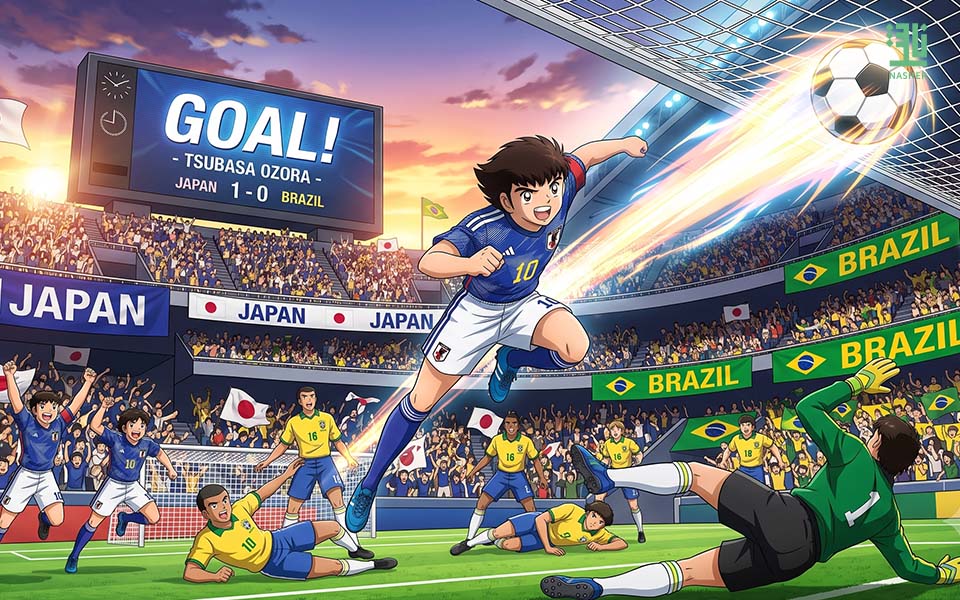
With every new FIFA World Cup, Captain Tsubasa returns to the spotlight, not merely as a celebrated anime and manga series, but as a cultural phenomenon that profoundly shaped generations’ relationship with football. Since its debut in the early 1980s, the story has transformed the football pitch into a stage for dreams and ambition, inspiring millions of children to believe that perseverance, discipline, and teamwork can overcome even the greatest obstacles. Many of those children would later become professional footballers, writers, journalists, and artists, carrying the series’ enduring influence into their own work.


The impact of Captain Tsubasa has stretched far beyond Japan, resonating across cultures and languages to become one of the most compelling examples of how manga and animation can transcend national borders. Throughout the Middle East and many other parts of the world, the series became embedded in the collective memory of an entire generation. It also influenced literary and cultural expression, encouraging writers to view football not simply as a sport, but as a metaphor for hope, resilience, identity, and the pursuit of impossible dreams.


Several of football’s greatest stars have acknowledged Captain Tsubasa as a formative influence during their childhood, including Spanish legends Andrés Iniesta and Fernando Torres, as well as French superstar Kylian Mbappé, among many others. Their testimonies illustrate how a work of illustrated fiction evolved beyond entertainment into a source of inspiration that instilled ambition, resilience, and a winning mindset in millions of young fans. In doing so, the series secured its place as a lasting part of global football culture, much like classic works of literature that continue to shape the imagination across generations.


As the world once again gathers to celebrate the FIFA World Cup, revisiting Captain Tsubasa is about far more than nostalgia. The values that defined the series, dreaming beyond limitations, embracing adversity, and striving relentlessly for excellence, continue to unfold on football’s grandest stage. Every breakthrough performance, every underdog story, and every young player chasing greatness echoes the spirit of a story that imagined football not only as a game, but as a universal language of hope, courage, and possibility.


 

Recent News

03Sep
The Delivery Rider Who Became a Prizewinner

The Delivery Rider Who Became a Prizewinner

A Chinese food delivery rider who turned the frustrations of gig work into poetry has won one of the country’s highest literary honours. Wang Jibing, 56, received the prestigious Lu Xun Literary Prize for Low Flight, a collection inspired by conversations with over 200 delivery riders and the everyday pressures of China’s vast gig economy. […]

02Sep
Why is Global Publishing Turning to Sharjah?

Why is Global Publishing Turning to Sharjah?

Sharjah’s rise to the forefront of the global cultural landscape was neither a matter of chance nor the result of isolated achievements. It is the outcome of a far-reaching cultural vision founded on the belief that culture is not merely a complement to development, but one of its fundamental pillars. For decades, His Highness Sheikh […]

02Sep
Lisbon Asks What Reading’s Future Holds

Lisbon Asks What Reading’s Future Holds

Lisbon will become a meeting point for some of the most influential voices in publishing, culture and public life on September 15 and 16, 2026, as the fourth edition of BOOK 2.0 – The Future of Reading takes place at the Belém Cultural Centre. Under the theme “Back to Basics, Back to Books,” the conference […]

Related Posts

What’s Really Behind the “Bestseller” Label?

What’s Really Behind the “Bestseller” Label?

Sometimes, all it takes is the word “bestseller” on a book cover for its success to appear settled beyond question. The label compresses the choices of thousands of readers into a single claim and pushes the book to the forefront. Yet behind it lies a far more...

Did Borges Enter the Digital Labyrinth Before Us?

Did Borges Enter the Digital Labyrinth Before Us?

On 24 August 1899, a writer was born in Buenos Aires, the Argentine capital, who would spend his life among books, labyrinths, mirrors and questions without end. Jorge Luis Borges never knew the internet, never saw a smartphone screen or a search engine. Yet decades...

Mary Shelley Asked the AI Question First

Mary Shelley Asked the AI Question First

Mary Shelley was born in London on 30 August 1797, and would go on to give literature one of its most famous creations: Frankenstein. She was only eighteen when she began writing the novel, unaware that she was placing at its heart a question that would remain alive...

Previous Next
Close
Test Caption
Test Description goes like this