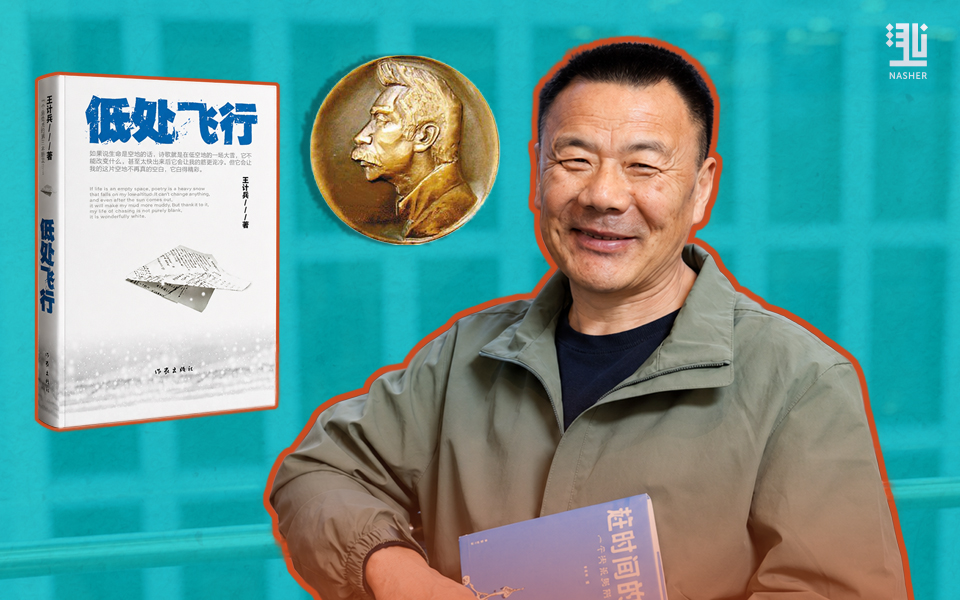
A Chinese food delivery rider who turned the frustrations of gig work into poetry has won one of the country’s highest literary honours.
Wang Jibing, 56, received the prestigious Lu Xun Literary Prize for Low Flight, a collection inspired by conversations with over 200 delivery riders and the everyday pressures of China’s vast gig economy.
Mr Wang won the prestigious award – named after a writer known as the father of modern Chinese literature – by drawing on the lives and struggles of fellow couriers to write about modern China.
When Wang Jibing wrote fiction as a young man, his despairing father thought he was insane and set fire to his notebooks. Wang stuck with it.
Born in Jiangsu province, Wang left school as a teenager due to financial hardship at home. He took on various jobs, from construction to scavenging for waste and selling things at a street stall, before becoming a food deliveryman.
But his love for reading persisted, and over the last decade he has been posting his own poems and essays on social media.
After becoming a food delivery rider, a job that gave him flexibility to write, Mr Wang began posting his work on social media. But a botched delivery in 2019 changed the course of Mr Wang’s life. Working in Kunshan, in China’s eastern Jiangsu province, he spent hours searching three residential buildings and climbing 18 flights of stairs after a customer entered the wrong address. When he finally reached the door, he was met not with understanding but with an angry tirade for being late. On the journey home, Mr Wang channelled his frustration into a poem, Man in a Hurry. It struck a chord online, quickly going viral and transforming him from a delivery rider into a writer.
Since then, he has drawn on the people he meets, the places he passes and the emotional toll of life as a delivery rider to shape his work.
In 2022, one of his poems, titled Man in a Hurry, went viral online. It was inspired by a incident in 2019, in which he spent hours on a frustrating delivery after a customer entered the wrong address.
In 2023 he published his first poetry collection, Man in a Hurry: Poems of a Food Delivery Rider.
Wang shared a short video on social media saying that the award has inspired him and awakened “even more determination and fighting spirit”.
“I also want everyone to believe in me: I am Wang Jibing, and I am a quietly flowing river,” he said, even as he acknowledged some “mental pressure” since the award.
The poet’s success is emblematic of the rising popularity of writing penned by migrant workers in China.
Despite winning the award, Wang told the outlet he had no intention of quitting his job, adding that he planned to work until he turns 60.
“Financially I don’t need this job to make a living, but I love the vibe of the work and it keeps me fit,” said the Global Times report. “I want a down-to-earth life and the award will never change who I am.”
Low Flight, published in 2024, is a collection of poems inspired by interviews and surveys that Wang conducted with around 200 delivery riders.
“Who says spreading your wings means flying high? Flying low is also flying,” goes one of the lines in his poems.
His win comes as a growing number of blue worker collars in China have in recent years been making their mark in the literary world.
I Deliver Parcels in Beijing, a 2023 memoir by former courier Hu Anyan, became a runaway bestseller in China and also captured media attention abroad. An English translation of the memoir was published last year.
Another title – I am Fan Yusu – an autobiographical essay about a migrant worker’s personal struggle, swept the Chinese internet in 2017. The response was so overwhelming that Fan had to temporarily leave her home amid endless media requests.
Lu Xun, whom the literary prize is named after, is widely considered one of China’s greatest 20th century writers, known for using satirical novels to critique traditional Chinese society.
Long remembered as one of China’s most important literary figures, Lu’s works have found renewed resonance among the younger generation today: A few years ago, Kong Yiji, a character from his novel became a meme symbolising disillusionment among the Chinese youth struggling to find jobs.