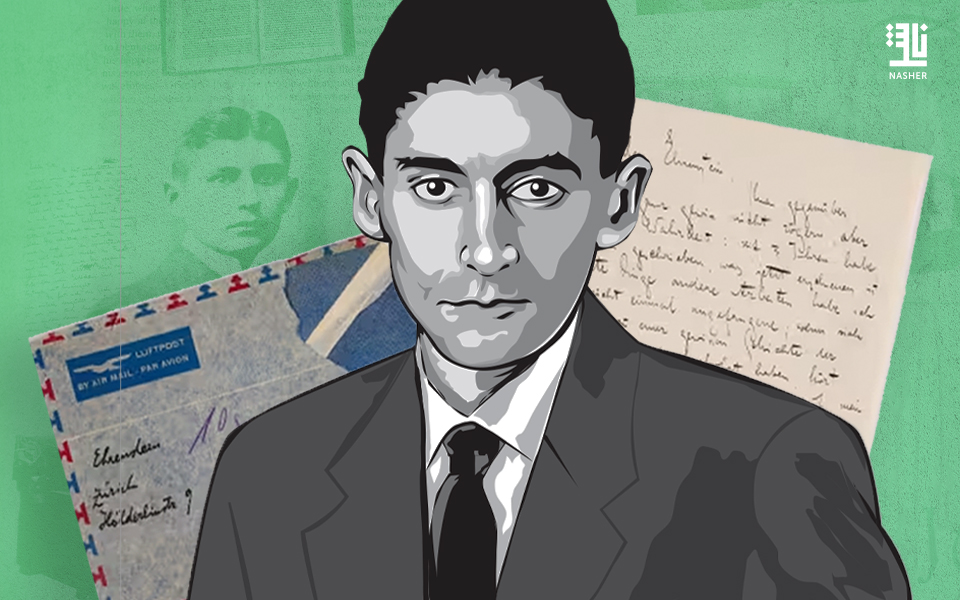
A personal letter written by Franz Kafka, who confesses to a friend about his struggles with writer’s block, will be up for sale later this month at Sotheby’s in London.
Best-known for the 1915 novella “The Metamorphosis,” the Prague-born writer struggled throughout his short life with anxiety, hopelessness and isolation – themes that came to define his work – but little has been known about his creative process.
The letter written by Franz Kafka to his publisher shows just how anguished a struggle it was for the Bohemian writer to put pen to paper, especially as his health deteriorated and coincided with Kafka’s diagnosis with tuberculosis, which would end up killing him and which, scholars say, very probably added to his sense of mental paralysis and helplessness.
“When worries have penetrated to a certain layer of existence, the writing and the complaining obviously stop,” he wrote to his friend and publisher, the Austrian poet Albert Ehrenstein. “My resistance was not all that strong either.”
Undated, the letter is believed by scholars to have been written between April and June 1920, when Kafka was being treated for his illness at a clinic in Merano, northern Italy. Writer’s block famously haunted Kafka throughout his life but was exacerbated by his poor physical condition.
Neatly handwritten in polite, legible German, the letter is thought to be Kafka’s response to Ehrenstein’s request for the established author to contribute to Die Gefährten (The Fellows), the expressionist literary journal he was editing at the time. He had recently seen new work by Kafka in print, possibly his short story collection Ein Landarzt (A Country Doctor), written in 1917 and published two years later. But Kafka quickly disabused him of the notion that he was actively writing. “I haven’t written anything for three years, what’s been published now are old things, I don’t have any other work, not even something I’ve started,” he wrote.
The one-page letter, which is expected to sell for £70,000 to £90,000 ($89,000 to $115,000) at Sotheby’s in London, is dated to spring 1920, according to the auction house.
Despite his melancholy tone, it was around this time that Kafka embarked on what was arguably the most intense love affair of his life, with the Czech journalist Milena Pollaková-Jesenská, who had just translated his work Der Heizer (The Stoker). She is said to have been instrumental in encouraging him to overcome his creative stagnation to write his final masterpieces, The Castle and A Hunger Artist.
Both these books were published posthumously, in 1924 and 1926, respectively – despite Kafka requesting that his unpublished manuscripts be destroyed upon his death.
Though he was sought out by avant-garde publishers during his life, Kafka’s greatest literary acclaim came posthumously.
His works, all written in German, were rediscovered in Germany and Austria after 1945, and he began to have a huge influence on German literature that extended globally by the 1960s. They have been widely adapted for the cinema, TV and theater.
The auction coincides with the centenary of Kafka’s death on 3 June, which has triggered a wave of new books, biopics and exhibitions.
Kafka died in 1924 aged 40. Ehrenstein kept the letter until 1948, when he sent it in his old age to the Czech-born artist Dolly Perutz, who had escaped Nazi-occupied Czechoslovakia in 1938, settling in Massachusetts. The letter is still in the airmail envelope in which she received it.