First impressions are everything, it is the force that makes one stop and turn away or carry on and discover a new venture; art is no different to life – the best opening lines in fiction grab the reader’s attention from the start.
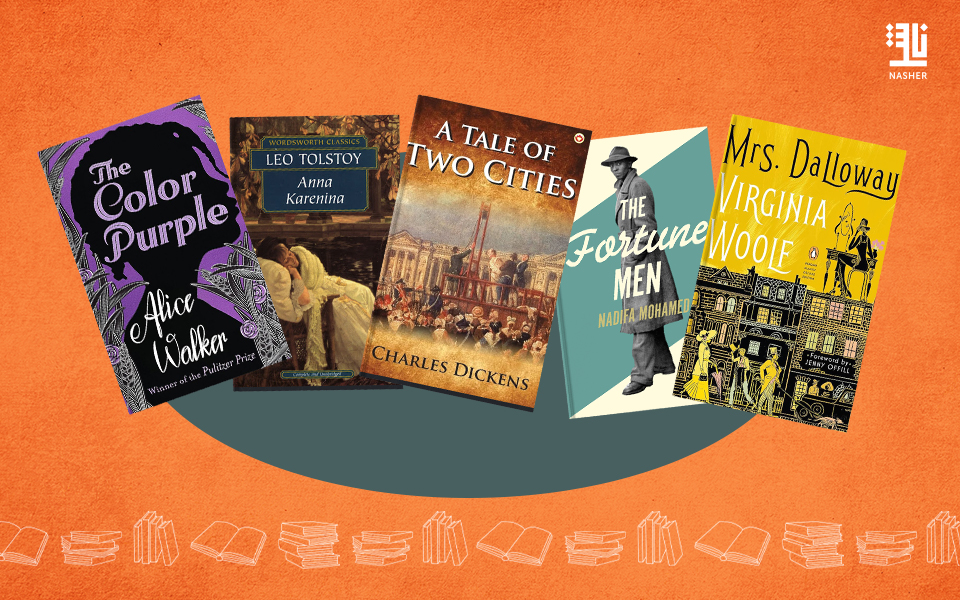
Anna Karenina by Leo Tolstoy
Happy families are all alike; every unhappy family is unhappy in its own way.
One of the most famous openings of all, this line offers a social theory, but also offers a promise: we are about to read about a very unhappy – and very uniquely unhappy – family. What follows is the tangled, doomed love affair between Anna Karenina and Count Vronsky.
Pride and Prejudice by Jane Austen
It is a truth universally acknowledged, that a single man in possession of a good fortune, must be in want of a wife.
A very famous and much riffed-on line, but then you’d expect no less from Pride and Prejudice, one of the all-time classic romances. What follows this universally acknowledged truth is altogether more complicated and nail-biting, though everything works out in the end.
The Fortune Men by Nadifa Mohamed
‘The King is dead. Long live the Queen.’ The announcer’s voice crackles from the wireless and winds around the rapt patrons of Berlin’s Milk Bar as sinuously as the fog curls around the mournful street lamps, their wan glow barely illuminating the cobblestones.
Death is at the centre of the Booker Prize-shortlisted The Fortune Men, and Nadifa Mohamed’s opening sentences signify that, while also painting a picture of the novel’s intriguing and little known about setting of Cardiff’s Tiger Bay.
The Bell Jar by Sylvia Plath
It was a queer, sultry summer, the summer they electrocuted the Rosenbergs, and I didn’t know what I was doing in New York.
So. Many. Questions. And you’ve only read the first line. Turns out, death-obsessed Esther Greenwood is a far-from-happy college girl on the brink of a breakdown.
The Color Purple by Alice Walker
You better not never tell nobody but God. It’d kill your mammy.
Words spoken by an abusive father to his daughter, this first line is one of the most sinister and haunting in all of fiction.
Nineteen Eighty-Four by George Orwell
It was a bright cold day in April, and the clocks were striking thirteen.
In Orwell’s dystopian future, nothing is certain; nothing is fixed. Even time itself can be manipulated when the government has toppled God. A haunting message that sets an eerie tone for the greatest novel of the 20th Century.
Mrs Dalloway by Virginia Woolf
Mrs. Dalloway said she would buy the flowers herself.
For Lucy had her work cut out for her. The doors would be taken off their hinges; Rumpelmayer’s men were coming. And then, thought Clarissa Dalloway, what a morning – fresh as if issued to children on a beach.
Virginia Woolf’s modernist masterpiece follows a well-to-do London housewife on the day of a grand party she’s hosting. The opening immediately establishes how Woolf wriggles her way into her characters’ heads to show how their stream of consciousness darts from thought to thought.
A Tale of Two Cities by Charles Dickens
It was the best of times, it was the worst of times, it was the age of wisdom, it was the age of foolishness, it was the epoch of belief, it was the epoch of incredulity, it was the season of Light, it was the season of Darkness, it was the spring of hope, it was the winter of despair, we had everything before us, we had nothing before us, we were all going direct to Heaven, we were all going direct the other way – in short, the period was so far like the present period, that some of its noisiest authorities insisted on its being received, for good or for evil, in the superlative degree of comparison only.
A very chunky first sentence from a very chunky novel. Charles Dickens is never shy and retiring, but the beginning of A Tale of Two Cities – the two cities being London and Paris during the French Revolution – makes clear that this sprawling book will be about Everything.
Bridget Jones’s Diary by Helen Fielding
January: An Exceptionally Bad Start. Sunday 1 January. 129 lbs (but post-Christmas), alcohol units 14 (but effectively covers 2 days as 4 hours of party was on New Year), cigarettes 22, calories 5424.
In 1996, Helen Fielding introduced the world to Bridget Jones: a neurotic, single, thirtysomething who chronicles her exploits in life and love in unflinching detail. With her first diary entry, she starts as she means to go on.