
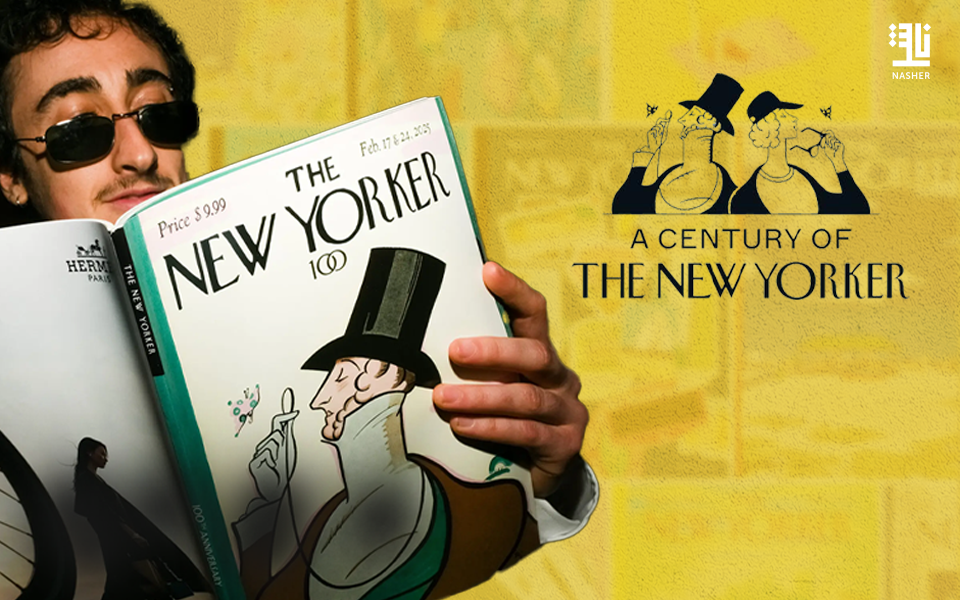
Some publications belong to their time; others become part of how that time is remembered. The New Yorker clearly belongs to the latter. Since its first issue appeared in February 1925, it has grown from a magazine rooted in the spirit and urban life of New York into one of the world’s most influential cultural and journalistic publications. A century later, its significance lies not simply in its longevity, but in its remarkable ability to preserve a distinctive identity, one that brings together rigorous journalism, criticism, culture, humor, and art.
From the outset, The New Yorker carried a certain air of elitism that would later become part of its image. Yet this elitism has always had more to do with the way the magazine regards its readers than with who actually reads it. Harold Ross, its founder and first editor, envisioned a publication that would stand apart from mass-market journalism and its tendency to simplify the world into something quick and easily consumed. Instead, he favored wit, intelligence, irony, and writing that assumed a reader willing to pause, reflect, and follow an idea wherever it might lead. The magazine was never primarily concerned with being the easiest or most effortless read. Over the decades, it helped establish the idea that respecting readers can sometimes mean asking something of them.
The magazine’s character is apparent even before a single word is read. At The New Yorker, the cover is more than a means of selling an issue, just as its cartoons are more than light interludes between articles. Both have been integral to the visual language the magazine has cultivated since its earliest years. Art editor Rea Irvin played a defining role in shaping its early visual identity and created the celebrated figure of Eustace Tilley, who appeared on the cover of the inaugural issue and went on to become one of the magazine’s most enduring symbols. Over time, its covers evolved into a distinctive form of commentary on politics, society, the city, and culture. Often, a single image has managed to convey what an entire article might take pages to explain, making art an extension of the magazine’s editorial voice rather than a merely decorative element.
That sense of prestige is inseparable from an editorial rigor that has itself become part of The New Yorker’s reputation. The magazine is renowned for its exceptional attention to detail and for a fact-checking system that has evolved over its history into one of the defining features of its journalism. Verification is not treated simply as a final step before publication, but as an integral part of the making of a piece. This has fostered the sense that writing published in the magazine passes through successive layers of reading, questioning, checking, and revision before it reaches the page. Perhaps this is also why the name The New Yorker carries such weight: not because the magazine is immune to error, something no publication can claim, but because it has built much of its standing on treating accuracy as an editorial value in its own right.
As journalism moved onto screens and reading habits changed, the greatest challenge for a publication with such a long history was ensuring that its traditions did not become a burden. The New Yorker responded by expanding its presence across digital publishing, podcasts, video, and film, while making available an archive stretching back to 1925, all without surrendering the central place of writing, imagery, and editing in its identity. Perhaps this is the clearest explanation for The New Yorker’s endurance beyond a century: it has preserved its standing not by remaining exactly as it was, but by understanding what could change and what needed to remain. In a world where words, images, and platforms multiply by the day, the real scarcity may no longer lie in the ability to publish, but in having a clear standard for what deserves to be published.