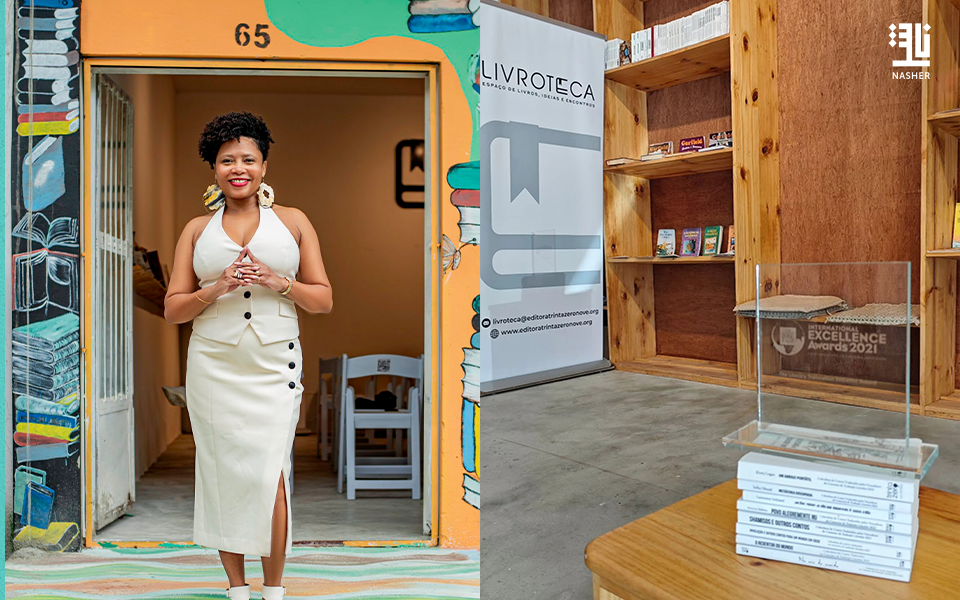
- Can you give us a brief introduction to who you are and your background?
My name is Sandra Tamele. I am a literary translator and the founder of Livroteca. Although my academic background is in architecture, translation is where I truly found my sense of purpose. Literature changed the course of my life, and it allowed me to imagine possibilities beyond my circumstances.
Through my work as a translator and publisher, I have tried to use my resources to support initiatives that expand access to books and reading. I am based in Marracuene, a small town about 26 kilometres from Maputo, the capital of Mozambique. Despite being so close to the capital, Marracuene still experiences significant inequalities in access to cultural infrastructure such as libraries and bookshops. My work has grown out of that reality and my desire to create opportunities for young people in my community.
- What inspired you to open a bookshop?
The inspiration was actually quite simple: books transformed my life, and I wanted to create the same opportunity for others.
When we opened Livroteca on 11 November 2025, it became the first bookshop in Marracuene. Many people thought opening a bookshop here was risky or even irrational because it is not seen as a profitable business. But I believe books are one of the most powerful and affordable tools for personal transformation.
A book may cost five dollars, but it can open your mind in ways that help you see beyond your circumstances. It helps you understand that where you come from does not determine what you are capable of becoming. For me, opening the bookshop was about giving young people in Marracuene — especially girls like my grandmothers and like my younger self — something to aspire to. I often think about my grandmothers when I talk about this. They were illiterate women who were married very young and became mothers at the ages of 12 and 15. Their lives were shaped by circumstances they had very little control over. I belong to the next generation — a curious girl who was largely self-taught and always searching for answers in books.
Opening Livroteca is, in many ways, a bridge between those two realities. It is about ensuring that girls growing up in Marracuene today have access to the possibilities that books opened for me. I want them to see that their circumstances are not the limit of their capabilities, and that knowledge can expand the horizons of their lives.
- Livroteca: what is the meaning and the story behind the name of the bookshop?
“Livroteca” is a compound word that combines livro (book) and biblioteca (library).
The idea was to create a hybrid space. Half of the space functions as a traditional bookshop where people can buy books. The other half works like a reading library where anyone can come in and read for free.
Because many people in our community do not have formal home addresses, lending books is complicated. Instead, we created a space where people can come, sit, and read with us. Our reading room currently has around 300 titles available for browsing, and the collection is constantly growing through donations and our publishing catalogue.
Here is a refined and expanded version that keeps your narrative strong, introduces the broader context of the book ecosystem, and naturally includes a call for support without sounding like a plea. It reads well for interviews or media profiles.
- Can you talk us through the process of starting a bookshop and the struggles that you endured?
Starting Livroteca was far from easy.
It took me almost two years to find the right space — somewhere affordable, visible, and accessible to the community. During that time, the book ecosystem in Mozambique was facing serious setbacks. The oldest and largest bookshop in the country, Minerva Central, went bankrupt, and many literacy projects that used to operate around the country were forced to downscale or close altogether. That moment made the idea of opening a bookshop feel both urgent and risky.
Before taking the plunge, I tried to learn as much as I could. I read widely about independent bookshops around the world. A manual from Brazil on how to set up a bookstore was particularly helpful, and I was inspired by community-based book initiatives in Kenya that showed how books can thrive when they are rooted in local communities.
Access to credit is almost impossible for small cultural entrepreneurs in Mozambique, particularly for women. So like many of the initiatives I have created, Livroteca was funded entirely from my own income. I work as a commercial translator, often on projects that do not necessarily bring me as much joy as literary work, but which provide the disposable income that allows me to invest in cultural initiatives.
Over the years, that income has supported a number of projects: since 2013 I have hosted Christmas celebrations and gifts for about 100 children in my community; since 2015 I have funded a literary translation competition; in 2018 I founded the publishing house Trinta Zero Nove; and in 2025 I opened Livroteca.
But building a bookshop here comes with many structural challenges. In Marracuene, many people had never entered a bookshop before. Even the concept of a library is unfamiliar. There are hundreds of schools in the area, but none of them have libraries. For many children, the word “book” is associated only with textbooks, not with reading for pleasure.
Changing that perception is one of our main missions. We want to show that reading can also be a source of joy, curiosity, and imagination.
Shortly after opening, however, we faced another major challenge. After only one month of operation, heavy rains caused severe flooding across the country. I lost a large part of my property, including infrastructure and a significant portion of the bookshop’s stock. Despite the loss, rebuilding Livroteca became my priority. With the little savings I had left, we repaired the roof, replaced the damaged materials, and reopened on 4 February.
The community response was incredibly encouraging. Even before we reopened, people were asking when the bookshop would return. That showed me that Livroteca already mattered to them.
However, the recent losses also mean that I can no longer sustain this work entirely on my own. If Livroteca is to continue growing — expanding its library, supporting reading programmes, and serving the community — we will need partners, donors, and friends of books who believe in the transformative power of reading.
Livroteca began as a personal investment in the future of my community. With the right support, it can become something much larger: a lasting home for readers in Marracuene.
- Independent bookshops rarely survive in a world dominated by digital marketing and large retailers. What keeps Livroteca going?
Livroteca survives because it is deeply connected to its community.
Large retailers sell books as products, but we offer something different: a cultural space where people can discover reading together. Our work is not only about selling books but about building a reading culture from the ground up.
We also focus on accessibility. Through my publishing house, we produce books in local languages, Braille editions, and audiobooks so that more people can access literature regardless of their circumstances. When a bookshop becomes part of the social fabric of a community, it creates a value that goes beyond commercial competition.
- What does a typical day at Livroteca entail?
Our official opening time is 10 a.m., but we typically arrive around 9 a.m. to clean the space, organize the books, and prepare for visitors.
We welcome readers throughout the day—children, students, parents, and curious passersby. The bookshop features a colorful façade painted with books, which naturally attracts attention. Initially, many people were hesitant to enter, thinking that such a beautiful place might not be meant for them. Part of our mission has been to make everyone feel welcome.
We also host book launches once a month and have attracted the interest of TV personalities who volunteer to come and read with us.
Currently, we are setting up several reading initiatives, including book clubs for children, teenagers, and adults. One of our programs encourages visitors to read a book at Livroteca and submit a short review. The best review wins books—lots of them!
Before opening the shop, we ran a reading club for vulnerable girls that met under a marula tree. Having a physical space now allows us to expand these activities regardless of the weather.
- What do you envisage for Livroteca in the future?
In the next five years, my goal is to prove that books can sustain both a business and a strong social mission.
I would like to open a second, larger Livroteca in the same area. Our current location is ideal — right in front of a bus stop — but the space is small. Expanding would allow us to increase the number of books, host more events, and strengthen our reading programmes.
Ultimately, Livroteca is about building a culture of reading in Marracuene. We publish books in local languages, produce accessible formats such as Braille and audiobooks, and support voices that are often underrepresented. If we continue building a community of readers, the long-term impact will extend far beyond the walls of the bookshop.