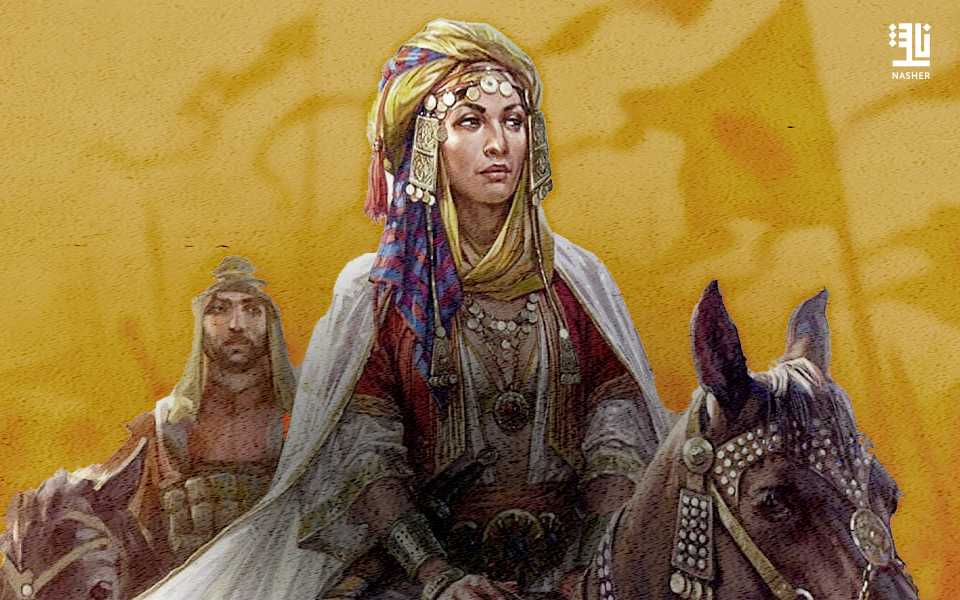
Queen Mavia (c. 375–425 CE) stands as one of the most prominent female figures in late pre-Islamic Arab history, a leader who played a decisive role in reshaping the relationship between Arab communities and political as well as religious authority in the fourth century CE. Rising as the head of Arab tribes along the frontiers of the Byzantine Empire, she led an organised revolt that went far beyond a mere military confrontation. It was a political project aimed at affirming the Arabs as an active force in their own right, rather than peripheral groups subordinate to an imperial centre.
The book Queens and Prophets: How Arabian Noblewomen and Holy Men Shaped Paganism, Christianity and Islam by historian and academic Imran Iqbal El-Badawi offers an analytical reading of Queen Mavia’s life within a broader framework that reconsiders Arab religious and political history in late antiquity. The book positions Mavia as a historical actor rather than a gendered exception, highlighting how she deployed religion as a tool of political negotiation. Her insistence on appointing an Arab bishop for her people revealed an early awareness of the role religious legitimacy played in consolidating power and sovereignty.
The book further notes that much of what is known about Mavia derives from early historical sources that were nearly contemporary with her lifetime, such as the writings of the historian and monk Rufinus, which are believed to have drawn on an even earlier source now lost, authored by Gelasius of Cyzicus. As these accounts passed into the hands of later writers, Mavia’s figure was increasingly reinterpreted through a Roman lens, portraying her as a Roman Christian. Yet the book stresses that she was Arab, and that she was most likely pagan in her early life, before her political strategies intersected with Christianity as a means of governance and negotiation rather than as an exclusive religious identity.
Through this reassessment, the book places Mavia among the foremost female leaders of ancient Arab history, regarding her as the most powerful woman of its final phase after Queen Zenobia. Contrary to narratives that confined women’s roles to the margins, Mavia’s experience reveals a leadership model that combined military strength, political acumen, and the capacity to impose negotiating terms on a major imperial power at a time marked by profound shifts in maps of influence and meaning.
This historical reading intersects with contemporary approaches to reclaiming Arab women from narrative erasure, as seen in Let Them Know She Is Here by Her Highness Sheikha Bodour Al Qasimi, which explores, among its themes, the search for the absent queen in memory and myth. In this work, the image of a woman excluded from written history yet enduring in consciousness and symbol opens a parallel horizon for reading Mavia’s life: a queen who never disappeared from action, but from narration, before being reclaimed as an integral part of the region’s deep history and identity.
Revisiting Mavia’s life thus exposes a long-standing gap in the writing of ancient Arab history, a gap not born of the absence of action, but of the absence of fair and balanced narration. Between early sources that distorted her image and modern readings that seek to restore her to her true context, Queen Mavia emerges today as a model of early Arab female leadership, marked by awareness, agency, and the ability to shape the trajectories of both politics and religion.