
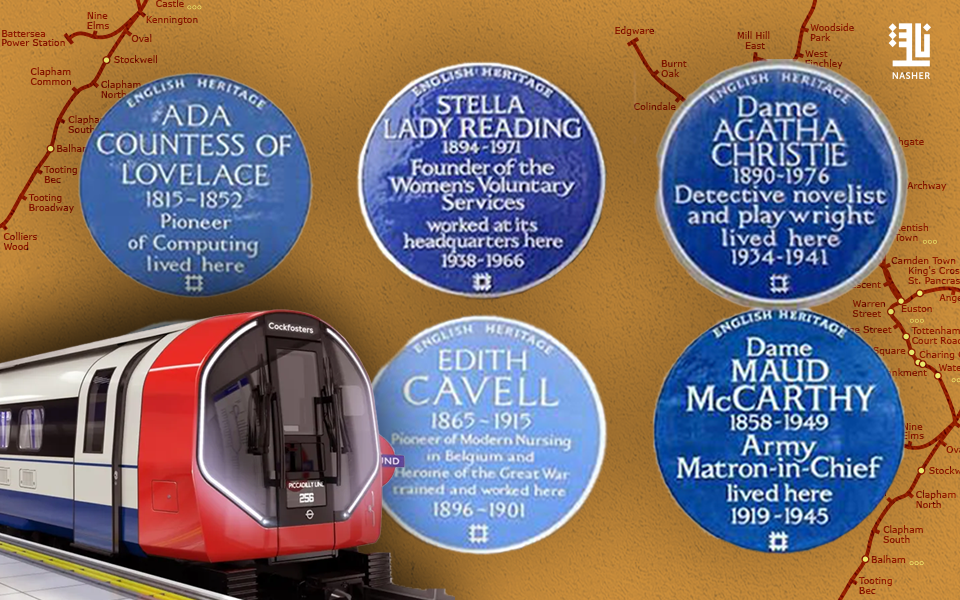
The Northern line underground has been crowned London’s most literary Tube line after new research mapped more than 1,000 blue plaques across the capital.
The English Heritage had installed earlier this year nine new blue plaques across London, celebrating figures who made outstanding contributions in fields ranging from literature to astronomy.
The scheme commemorates individuals by marking buildings where they lived or worked.
Matt Thompson, curatorial director at English Heritage, said: “This year’s new plaques represent an astonishing range of achievement – from scientific discovery and artistic innovation to activism and political campaigning.
“Each, in their own way, helped shape London as a place of ideas, creativity and reform, and their stories continue to resonate today.”
Typically, the plaques are installed on buildings where the individual lived or worked.
The scheme relies on public nominations.
Nominees must have been deceased for at least 20 years, have made an exceptional impact in their field, made a positive contribution to humanity, and lived in London for a significant period of time.
Additionally, at least one building in Greater London in which they lived or worked should survive with a substantially unaltered exterior.
The Northern line stands out as a haven for lovers of the written word, according to research from property company Barratt London.
The research looked at more than 1,000 blue plaques marking the homes of influential figures around London, from scientists to artists.
Literary hotspots
The study identified the “literary lines”, with both the Northern and Piccadilly lines having 68 blue plaques each connected to writers.
Each station was also ranked by the profession of the most commonly linked blue plaques.
Particular stations stood out, including Russell Square which was named as the most literary station on the underground by the number of blue plaques linked to writers near the station.
Russell Square station, in the heart of Bloomsbury, connects 18 plaques to famous writers in its proximity.
Russell Square is closely associated with historical literary figures like Christina Rossetti and Charles Dickens.
South Kensington was ranked as the most cultural station by overall blue plaque density.
In total, 72 cultural plaques are situated in the vicinity of South Kensington.
The research highlights the Northern and Piccadilly lines as being London’s top “literary lines”, making them the go-to for literature enthusiasts and history lovers alike.
Stations like Oxford Circus and Piccadilly Circus, celebrated for their cultural richness, also make it onto the list.
The data also suggests that a locale’s cultural attributes play a significant role in its appeal to people scouting for prospective neighbourhoods.
Nearly half of Britons (47per cent) mention a robust cultural identity as a major draw.
More than a third (36per cent) are particularly interested in residing in homes associated with famous individuals or icons of culture.
However, the research also found that a significant proportion of Britons – around 28 per cent – are reportedly unaware of the cultural history surrounding where they live.
This suggests there is room for improvement in connecting people with the heritage and stories embedded in their local area.
This trend of transforming underground stations into kennels of cultural relevance outlines the continuing dialogue between the past and the present.
The study also found that changes in culture are heavily influenced by the internet.
BookTok, a subcommunity on the social media platform TikTok, has seen more influence in how people discover books and share their reviews on them.
The internet has also been used to enhance the travelling experience of both natives and tourists, transforming the daily commute into an opportunity to experience the colourful spectrum of London’s cultural and historical roots.
The Northern and Piccadilly lines have solidified their roles not just as mere transit lines, but as cogs in the wheel of London’s evolving cultural fabric.
Carrying titans like George Orwell and D.H. Lawrence, these lines have not just shaped literature, but also the very way we perceive urban space.
The following is the full list of tube stations, with their overall blue plaque count:
South Kensington, 72
Hampstead, 68
Oxford Circus, 54
Russell Square, 49
Piccadilly Circus, 44
Leicester Square, 40
High Street Kensington, 38
Bond Street, 37
Sloane Square, 37
Covent Garden, 35