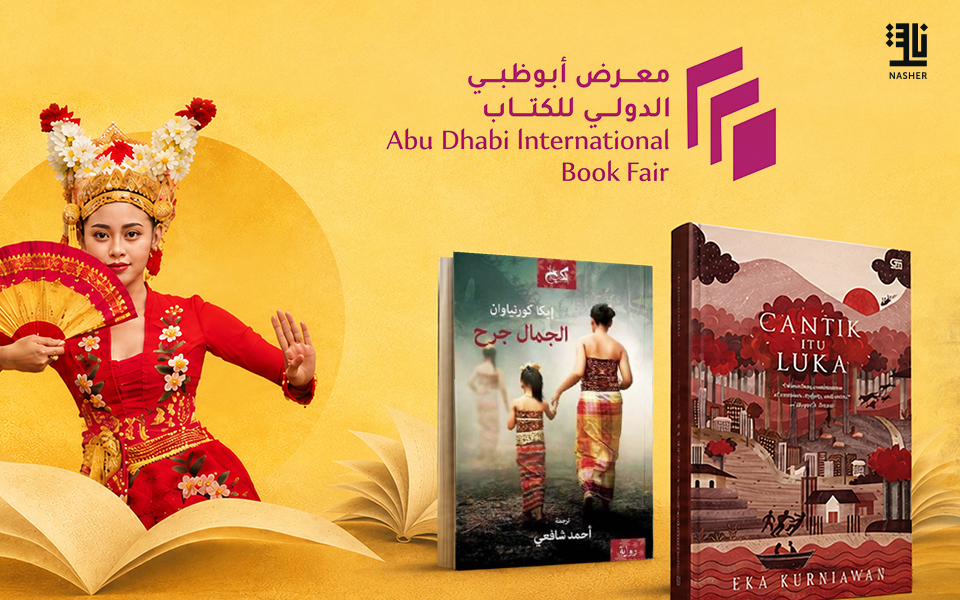
The UAE capital is preparing to welcome one of Asia’s most culturally diverse nations as the Republic of Indonesia takes centre stage as Guest of Honour at the 35th Abu Dhabi International Book Fair, running from 13 to 18 September 2026. Indonesia’s presence will extend well beyond a showcase of books and publishers, opening a wider window onto a culture shaped across thousands of islands and by a multitude of languages and traditions. Over the course of the fair, Arab readers will have an opportunity to encounter a literary landscape whose presence on Arabic bookshelves remains modest compared with its remarkable depth and diversity.
The Abu Dhabi Arabic Language Centre, which oversees the organisation of the fair, has reinforced this cultural focus through a memorandum of understanding with Indonesia’s Ministry of Culture to develop a comprehensive programme of literary, intellectual and artistic events. The programme will introduce audiences to Indonesia’s cultural landscape while highlighting the evolution of its publishing and translation sectors and encouraging stronger participation by Indonesian publishers. In doing so, the Guest of Honour programme moves beyond cultural presentation to create direct connections between writers, publishers and book professionals from both sides.
Perhaps the first thing a reader discovers about Indonesia is that the idea of a single “Indonesian culture” reveals only part of the picture. According to UNESCO, more than 700 languages are spoken across the country, while Bahasa Indonesia provides a shared national linguistic space. This diversity is not simply a statistic; it is part of the very fabric of Indonesian literature, where folk narratives, mythology and oral traditions coexist with the modern novel, short story and poetry, and where different islands have developed their own ways of telling the histories of their people and communities.
Modern Indonesian literature also offers readers a compelling route into the country’s history and transformations. Pramoedya Ananta Toer stands among the writers who did most to establish Indonesian literature on the international stage, particularly through his celebrated Buru Quartet. Set in the Dutch East Indies, the four novels trace, through the lives of their characters, the emergence of national consciousness under colonial rule. A later generation brought Indonesian fiction to new audiences, among them Eka Kurniawan, whose best-known works include Beauty Is a Wound, also published in Arabic, a novel that brings history into conversation with myth, satire and family tragedy.
This is where Indonesia’s presence as Guest of Honour acquires particular significance. It offers Arab readers a chance to move beyond the country’s most familiar images, its islands, landscapes and tourism heritage, and discover what Indonesians have written about themselves: colonialism and independence, cities and villages, religion and society, and the myths that continue to inhabit contemporary storytelling. It also gives publishers and translators an opportunity to engage with a vast literary and linguistic market whose visibility in Arabic has yet to reflect the richness of what it has to offer.
The points of connection between Indonesia and the Arab world need not be reduced to a search for perfect parallels between two distinct experiences. Their real value lies in the spaces where one culture can read and interpret the other. For centuries, people moved across the ocean, scripts and words passed between languages, and books and ideas travelled from port to port and city to city. At a book fair, translation becomes perhaps the clearest way of transforming these historical connections into a living cultural relationship, allowing books to continue their journeys long after the exhibition lights have dimmed and the conversations have ended.
Seen from this perspective, Indonesia’s participation is more than a celebration of another international Guest of Honour. It is an invitation to discover a literary archipelago that remains, in large part, unfamiliar to Arab readers. Over six days in September, Abu Dhabi will bring its literature, culture and multiplicity of voices to the foreground, reopening an old route between two regions connected for centuries, this time through publishers, translators, novelists and readers. And perhaps the most meaningful outcome will be an Indonesian book finding a new life in Arabic, or a reader leaving the fair knowing far more about Indonesia than when they first walked in.