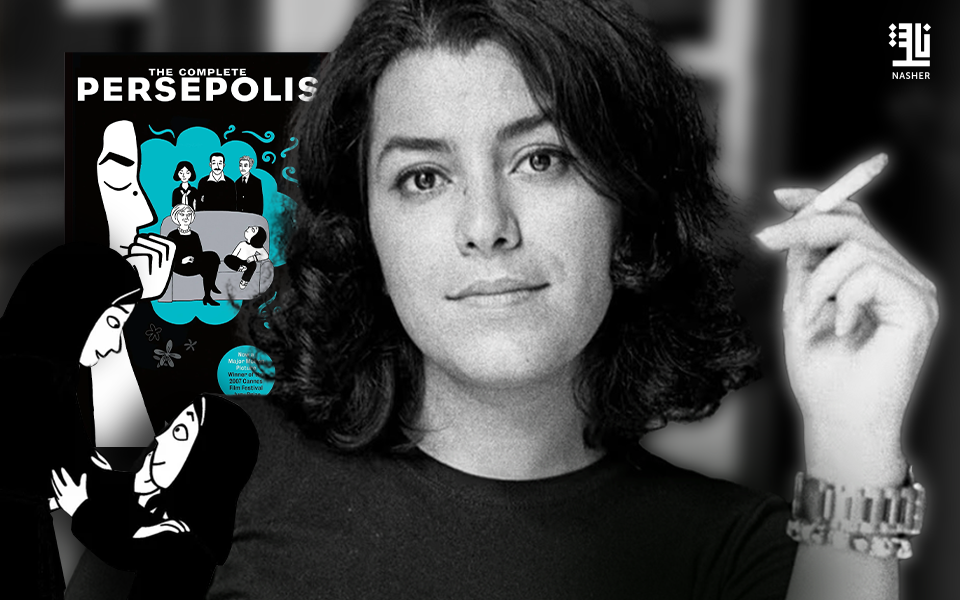
Marjane Satrapi, the French-Iranian artist, film-maker and graphic novelist whose acclaimed memoir Persepolis helped reshape international perceptions of Iran, has died at the age of 56.
In a statement provided to French news agency AFP, relatives said she had “died of sadness” after the death of her husband, the Swedish producer Mattias Ripa.
Ripa died on 8 April last year. Later that month, a series of messages posted on Satrapi’s Instagram account revealed the phrase: “For I lost the love of my life.”
Tributes have been paid to Satrapi from across French politics and culture following news of her death. President Emmanuel Macron said Satrapi was “a great artist who turned her Iranian childhood into a universal tale,” adding: “With her childlike perspective, her irony, her tenderness, her inner demons, the author created a moving world with which readers identified.”
The dissident writer and illustrator, born in 1969 in Rasht in northern Iran, was from a long line of Iranian aristocrats. In 1983, her parents – politically active Marxists who participated in demonstrations against the shah – sent her to Austria to finish her studies as the 1979 Iranian revolution brought Ayatollah Ruhollah Khomeini to power, along with growing religious fundamentalism.
She returned home due to homesickness and attended the University of Tehran, obtaining a degree in visual communications, which would lay the foundation for her artistic path, before leaving once more in 1994 for France. She eventually settled in France, arriving in 1994 and later becoming a French citizen in 2006.
Throughout her life, Satrapi was a vocal opponent of Iran’s clerical establishment.
She remained in her adopted country for much of her life, but remained deeply connected to her Iranian roots through her work.
In 2000 she published Persepolis, a comic book memoir that became an international publishing phenomenon. It told the story of a rebellious and outspoken young girl navigating the upheaval in Iran after the shah is overthrown in 1979 and the establishment of the Islamic Republic. The story follows the protagonist’s attempts to understand the country’s violence and ideological control before she is sent alone to Europe at the age of 14.
The memoir sold millions of copies, established Satrapi as one of the most widely read Iranian authors in the world, and its success challenged many western assumptions about Iranian society and culture.
Satrapi has described how she initially had little expectation that Persepolis would reach publication. At the time, she was still an arts student in Strasbourg and had relatively limited professional experience in comics. “With Persepolis, I didn’t even think I’d find a publisher,” she told El País in 2020. “I thought I’d make 50 photocopies for my friends to read.”
Satrapi later co-directed the animated film adaptation of Persepolis, which became an international hit and earned her a place in Oscar history as the first woman nominated for the Academy award for best animated feature.
She has said that the purpose of her comic books was to reassure young Iranians that they were being heard and supported by the outside world. “If they kill you and the whole world doesn’t care, how is that? This is the whole thing I’m asking: just recognise this.”
Of her choice of medium, she said in a 2012 interview that: “Drawing – it’s the first language of human beings, before writing, before even talking, before words.”
Satrapi went on to direct five feature films, including Radioactive (2019), starring Rosamund Pike as the pioneering scientist Marie Curie.
In 2024, she was offered France’s highest award, the Legion of Honour, but refused to accept it as she felt France hadn’t done enough to support the Iranian people fighting for democracy.
“Supporting the women’s revolution in Iran cannot be reduced to photos or speeches,” she wrote in a January 2025 letter to French authorities. “When people are fighting for democracy, we should support them.”
Satrapi had her critics, with some claiming her work was orientalist and simply reinforced Western stereotypes of Iran and of Muslim women. She would disagree, and instead highlighted the similarities between superficially different cultures.
“If I have one message to give to the secular American people, it’s that the world is not divided into countries,” she once said. “The world is not divided between East and West.
“You are American, I am Iranian, we don’t know each other, but we talk together and we understand each other perfectly. The difference between you and your government is much bigger than the difference between you and me. And the difference between me and my government is much bigger than the difference between me and you. And our governments are very much the same.”
Satrapi’s work added nuance and layers to the complex lives of Iranian women, while advocating for their autonomy and freedom.
“It overturned a lot of lazy, stereotypical, prejudiced thinking,” says Michael Walling, founder and artistic director of Border Crossings, an intercultural, multimedia theatre company.
“Europeans and Americans like to construct the woman as victim, and the institutional oppression of women under regimes like the Taliban, [Isis] and the Islamic Republic can easily compound that, leading to people talking about Islam as inherently sexist (which it is not), about Western Asia as a ‘backward’ or ‘barbaric’ place, about people ‘living in the Middle Ages’.