Writers, regardless of their languages or cultures, share one recurring question that emerges with every blank page: how does a story begin? Some view writing as a disciplined daily practice, closer to a profession that leaves little room for mood or whim. Others approach it as an emotional state that cannot be summoned until its inner conditions are fully formed. Between these two poles, multiple schools of writing take shape, each with its own philosophy, rituals, and understanding of the relationship between the writer and the text. From this perspective, the question “How do we write?” is not merely technical, but existential, deeply connected to how we see the world and understand ourselves.
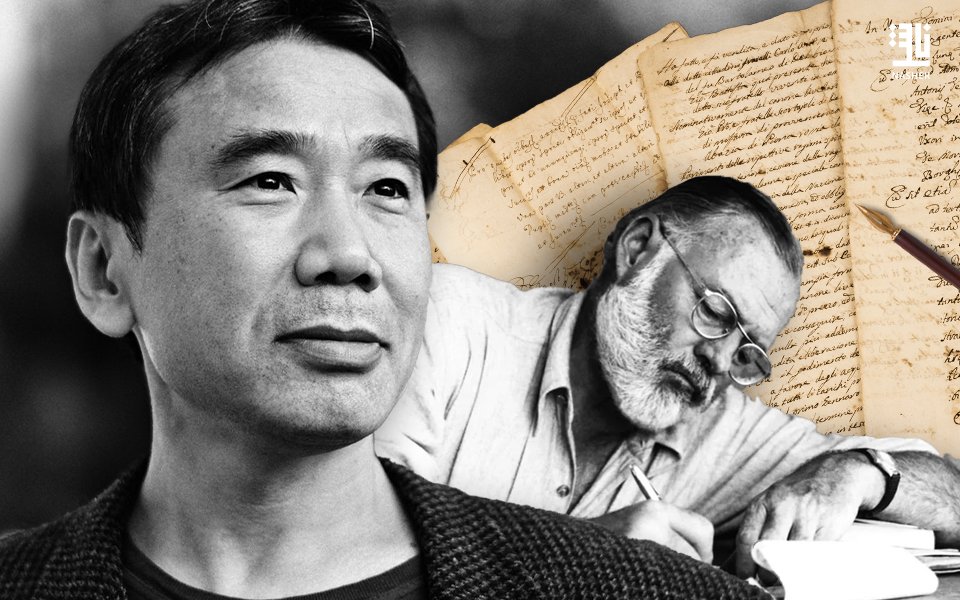
In the school represented by Ernest Hemingway, writing appears as an act of discipline taken to the edge of austerity. He believed that a good sentence must be clear, economical, and free of excess, and that what is removed from a text can be just as important as what remains. This philosophy turned silence into part of the narrative, and suggestion into a more powerful tool than direct explanation. Writing here resembles stone carving: daily effort, fixed hours, and unwavering commitment, even when results are not immediately satisfying. What matters most in this approach is persistence, because a text, in their view, is refined through accumulation rather than sudden inspiration.
On the other end of the spectrum lies a school more open to the unconscious and to intuition, exemplified by Haruki Murakami, where writing becomes an inner journey running parallel to everyday life. Murakami does not separate the body from the text; running, music, and solitude are essential elements of his writing process. The novel, therefore, is not built solely on planning, but on listening to what unexpectedly surfaces in the mind, even when it appears illogical. This school believes that a text sometimes knows its path better than the writer does, and that the writer’s role is not total control, but accompanying the story until it reaches its end.
Between these two models, other equally rich schools of writing unfold. Some writers plan every detail before they begin, while others discover the text as they write it. Some believe that characters drive the story, while others see the idea as the guiding compass. Some write at dawn, considering it the purest hour, while others find their voice only at night. These differences reflect more than technical variation; they reveal contrasting visions of what writing itself means. Is it a craft to be mastered, or an experience to be lived?
Ultimately, the secrets of writing do not lie in imitating rituals or replicating experiences, but in a writer’s awareness of their own nature. Wide reading, attentiveness to personal experience, and honesty with one’s inner voice are the shared foundations across all schools. Writing is not a ready-made formula, but a long dialogue between the writer and the self, between what is known and what is discovered through the act of writing. Perhaps that is precisely why writing remains an open-ended human act, never finished, endlessly compelling, each time the question is asked anew: how do writers write?