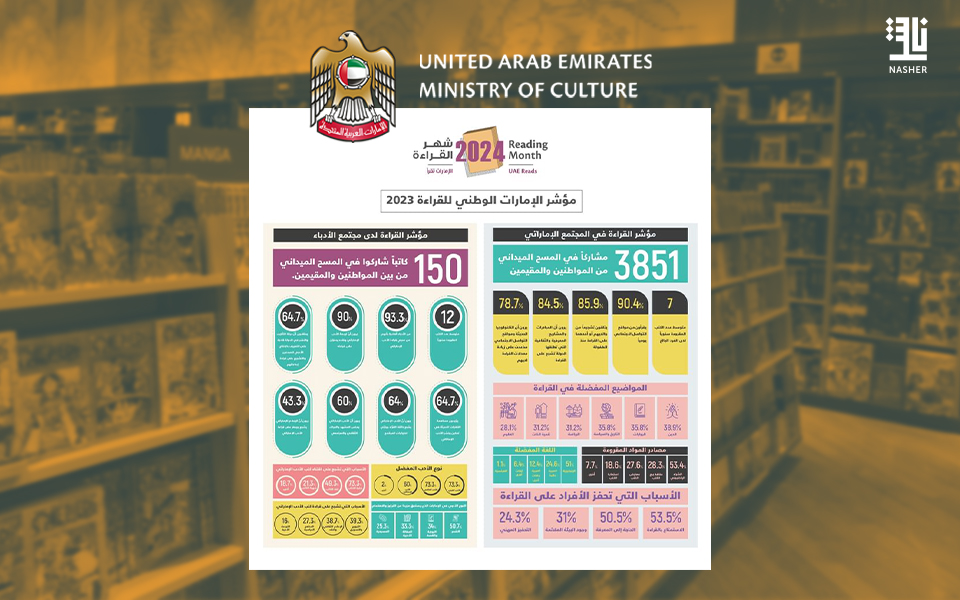
The Ministry of Culture has unveiled the results of 2023 UAE National Reading Index, which is a biennial survey that aims to assess the reading habits among the Emirati society aligning with the nation’s commitment to making reading a way of life by 2026. The initiative also supports the enhancement of development policies and plans in the realms of reading and knowledge.
The index’s target sample encompassed over 3,800 citizens and residents from across the UAE, 150 writers, more than 1,700 students, and over 3,900 teachers and parents. Their reading habits and preferences, both traditional and innovative, were examined in collaboration with the Federal Competitiveness and Statistics Centre.
The results also indicated that the average number of books read annually per individual increased to seven in 2023, up from six in 2021.
The percentage of readers using social media sites increased to 90.4 percent in 2023, up from 88.1 percent in 2021. In 2023, the sources for obtaining reading materials diversified: 53.4 percent from online purchases, 27.6 percent from book fairs, 28.3 percent from bookstores, 18.6 percent from borrowing books, and 7.7 percent from other sources. This compares to 2021 figures of 43.6 percent from electronic purchases, 37.6 percent from book fairs, 32.3 percent from sales outlets, 18.4 percent from borrowing books, and 8 percent from other sources.
In terms of reading language preferences, the proportions in 2023 were 51 percent for English, 24.6 percent for Arabic exclusively, 12.4 percent for Arabic and other languages, 1.1 percent for French, and 6.4 percent for other languages. In 2021, the figures stood at 47.7 percent for English, 26.6 percent for Arabic exclusively, 12.1 percent for Arabic and other languages, 1.2 percent for French, and 5.8 percent for other languages.
The 2023 index findings indicated that reading incentives included enjoyment, with 53.5 percent of participants, 50.5 percent for information needs, 24.3 percent for professional motivation, and 31 percent for the presence of a suitable environment. In contrast, the reasons motivating individuals to read in 2021 were: 55.1 percent for enjoyment, 47.6 percent for information needs, 21.8 percent for professional motivation, and 20.6 percent for the availability of a suitable environment.
When it comes to the position of Emirati literature, the annual average number of books read by writers and authors in 2023 increased to 12 books, up from 10 books in the 2021 index. Additionally, the proportion of literary enthusiasts who enjoy reading Emirati literature rose from 92.1 percent in 2021 to 93.3 percent in 2023.
The 2023 index unveiled that only 60 percent of writers and authors perceive Emirati literature as reflecting the cultural and societal landscape, a decrease from 80.1 percent in 2021. However, the results indicated that 90 percent of writers and authors endorse the notion that translating and critiquing Emirati literature encourage its readership, holding nearly the same percentage as in the 2021 index.
The index also showed that 64.7 percent of writers and authors in 2023 believe that the publishing industry in the UAE can introduce the literary works of creators and promote reading their creations, a decrease from the 72.8 percent reported in the 2021 index.
Regarding preferred literary genres, the 2023 results revealed that 60 percent of writers and authors favor Emirati literature, 73.3 percent prefer Arabic literature, 73.3 percent opt for world literature, and 2 percent prefer other genres. This is in contrast to the 2021 index, where 42.4 percent favoured Emirati literature, 58.3 percent chose Arabic literature, 60.9 percent leaned towards world literature, and 11.9 percent preferred other genres.
In terms of reasons driving the acquisition of Emirati books, the current index reveals that the book’s concept remains the primary motivator at 73.3 percent, followed by the book’s language at 49.3 percent, the author’s reputation at 21.3 percent, and other reasons at 18.7 percent. This contrasts with the 2021 index, where 53 percent of buyers cited the author’s language as the main reason, 18.5 percent mentioned the author’s fame, 70.9 percent were motivated by the book’s concept, and 15.9 percent had other reasons.
The 2021 index results indicated that novels and short stories were the Emirati literary genres deemed most deserving of increased focus and attention at 29.8 percent, followed by theatre at 23.8 percent, poetry at 20.5 percent, and literary essays at 10.6 percent. However, in the 2023 index, poetry took the lead at 50.7 percent, followed by novels and short stories at 34 percent, literary essays at 33.3 percent, and theater at 25.3 percent.
As per the index, the reasons that encourage reading Emirati literature in 2021 include literary translation at 23.8 percent, cultural media and criticism at 48.8 percent, promotion and marketing at 46.6 percent, and inclusion in educational curricula at 21.9 percent. In 2023, literary translation decreased to 16 percent, while cultural media and criticism stood at 38.7 percent, promotion and marketing at 39.3 percent, and inclusion in educational curricula at 27.3 percent.