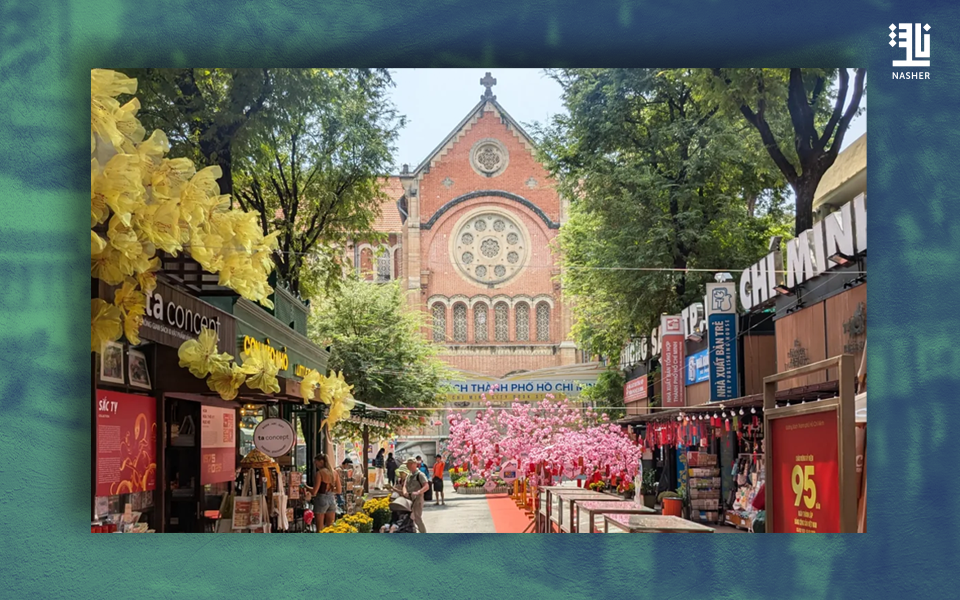
In the heart of Ho Chi Minh City, the largest city in Vietnam, and near two prominent heritage landmarks, Saigon Notre-Dame Cathedral and Saigon Central Post Office, Nguyen Van Binh Book Street stands out as one of the most compelling urban cultural models to have successfully embedded reading into everyday life. Over more than a decade, the street has evolved into what can be described as an “undercurrent” that nourishes intellectual culture and reinforces the city’s humanistic identity. No longer merely a space for selling books, it has become an interactive platform that embraces knowledge and redefines the relationship between people and books in an era of rapid digital transformation.
Launched on January 9, 2016, the project began as a modest 140-metre stretch, with limited expectations regarding its long-term impact. However, supported by local publishers and the city government, the initiative quickly demonstrated its ability to drive a qualitative shift in Vietnam’s publishing sector. As the country’s first dedicated book street, it introduced an innovative model that blends cultural vision with community investment, ultimately solidifying its position as a comprehensive knowledge destination.
The street has since experienced remarkable growth, expanding from 19 kiosks at its inception to 30 today, hosting more than 20 publishing houses and distributors from across the country. Over the past decade, it has welcomed millions of visitors, facilitated the circulation of nearly seven million books, and generated revenues exceeding 433 billion Vietnamese dong. According to Le Hoang, Director of the street, the initiative was never purely commercial in intent; rather, it was designed to build a sustainable knowledge ecosystem that serves as a cultural anchor for the community and strengthens the presence of books in daily life.
Despite the rapid rise of digital entertainment and e-reading, the street continues to assert its role as a “fortress” safeguarding the value of printed books. By hosting more than 3,000 cultural events annually, averaging nearly one activity per day, it has created a vibrant space that brings authors and readers closer together, revitalising the cultural scene. Its impact extends beyond the local sphere, as it has become a global cultural landmark attracting international visitors, reflecting the image of a modern city that celebrates knowledge and believes that books are not merely products, but bridges for human connection across cultures.