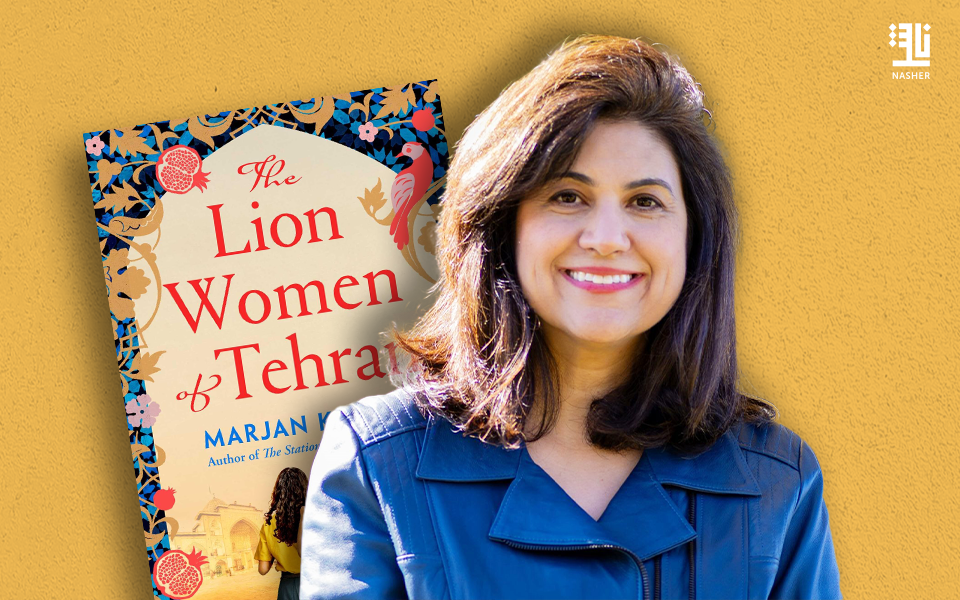
Title: The Lion Women of Tehran
Author: Marjan Kamali
Publisher: Simon & Schuster
Originally published: 2 July 2024
Marjan Kamali’s The Lion Women of Tehran is a captivating historical fiction novel that paints a vivid portrait of Iran in the mid-20th century. Through the lens of two young women, Ellie and Homa, the story explores themes of friendship, love, loss, and the tumultuous political landscape of the time.
The novel begins in 1950s Tehran, where Ellie and Homa form an unlikely bond. Despite their different social backgrounds, their friendship blossoms as they navigate the challenges of growing up in a society undergoing significant changes. Their bond is tested as Iran experiences political upheaval, culminating in the 1979 revolution.
In 1950s Tehran, seven-year-old Ellie lives in grand comfort until the untimely death of her father, forcing Ellie and her mother to move to a tiny home downtown. Lonely and bearing the brunt of her mother’s endless grievances, Ellie dreams of a friend to alleviate her isolation.
Luckily, on the first day of school, she meets Homa, a kind, passionate girl with a brave and irrepressible spirit. Together, the two girls play games, learn to cook in the stone kitchen of Homa’s warm home, wander through the colorful stalls of the Grand Bazaar, and share their ambitions for becoming “lion women.”
But their happiness is disrupted when Ellie and her mother are afforded the opportunity to return to their previous bourgeois life. Now a popular student at the best girls’ high school in Iran, Ellie’s memories of Homa begin to fade. Years later, however, her sudden reappearance in Ellie’s privileged world alters the course of both of their lives.
Together, the two young women come of age and pursue their own goals for meaningful futures. But as the political turmoil in Iran builds to a breaking point, one earth-shattering betrayal will have enormous consequences.
The book traces the life trajectory of these two women with very different dreams and ideologies, yet they retain the close friendship forged during their primary school days.
Though both Ellie and Homa are committed to the rights and freedoms of women, Ellie’s often immature approach clashes with Homa’s unrestrained fight against injustice, especially where women are targeted.
Even though the larger story centres around the unsettling politics playing out in the country and the surreptitious stripping of freedoms, the focus is firmly on the friendship between Ellie and Homa that threatens to collapse in the aftermath of an irredeemable mistake.
Ellie’s mother once tells her, “Even those who love you most can ruin your life… even the ones you trust the most,” never realising that her daughter would one day commit a mistake so grave which would change the course of Homa’s life.
Homa’s insistence on questioning the authorities perplexs Ellie and she cannot understand from her privileged point of view why one would want to upset the Shah’s government that allows women to study and grants them rights hitherto unseen in the country.
The advent of spring, Nowruz celebrations, the bustling bazaars with their busy craftspeople and fragrant spices, and house parties held in the homes of the upper class, bring alive the ethos of the land.
Descriptions of food appear at regular intervals, with references to fragrant saffron rice and kabab, the salty fizzy yoghurt drink called doogh, pomegranate molasses, salad Olivier sandwiches and much more.
The narrative is presented predominantly from Ellie’s perspective, though Homa’s perspective appears in the last section of the book.
At the heart of the narrative is the concept of shir zan or lion women, women who fight in every way possible to create better lives for themselves despite the obstacles.
This concept comes through in the stories of not only the main characters but also their mothers and friends — strong women from all sections of society who have had to fight battles and carve out acceptable spaces of life for themselves, sometimes making great personal sacrifices to ensure a better life for their children.
‘The Lion Women of Tehran’ is an important read especially in the current climate but there is slight difficulty in forming a connection with most of the characters and at some stage even liking them. The first half of the book is definitely more enjoyable than the latter half, and the ending was not what the start of the book indicated, hence a bit of a let down, we have given it 6 out of 10.
Marjan Kamali is the author of The Stationery Shop (Gallery Books/Simon & Schuster), a national bestseller, and Together Tea (EccoBooks/HarperCollins), a Massachusetts Book Award finalist. She is a 2022 recipient of the National Endowment for the Arts Creative Writing Fellowship. Kamali’s novels are published in translation in more than 25 languages. Her essays have appeared in The Wall Street Journal, Literary Hub, and the Los Angeles Review of Books. Kamali holds a bachelor’s degree in English literature from University of California, Berkeley, an MBA from Columbia University, and a Master of Fine Arts in creative writing from New York University. Born in Turkey to Iranian parents, Kamali spent her childhood in Turkey, Iran, Germany, Kenya, and the U.S. She now lives in the Boston area with her family.
Marjan’s novels are published in translation in more than 25 languages (22 languages for The Stationery Shop and 10 languages for Together Tea). Her essays have appeared in The Wall Street Journal, Literary Hub, and The Los Angeles Review of Books.
Quotes:
“It was books. I read and read. Went to the library as much as I could. And to bookstores. Lost myself in books. Did you know that books can heal you? They helped restore me.”
“Lionesses. Us. Can’t you just see it Ellie? Someday, you and me — we’ll do great things. We’ll live life for ourselves. And we will help others. We are cubs now, maybe. But we will grow to be lionesses. Strong women who will make things happen.”
“You skipped our country’s slide back into medieval times. Women have lost decades, no, centuries, of rights in this country.”
“My baba says the only society worth living in is one where everyone has access to food, shelter, clean water, and health services.”
“But the truth is I so prefer the bravery of your generation of women. That’s what I admire. You’re not afraid. You’re fierce. You and your friends are shir zan!” The Persian phrase that translates to “lion women”.”
“Doesn’t matter who owns the rug workshops,” Homa went on. “It’s the women who do the knotting. It’s women doing the weaving. The art of Iranian women is scattered throughout the world. Their work is everywhere.”
“And yet. Ours was a friendship worth saving. Worth keeping. Worth protecting. For I knew Homa’s heart was pure. I admired her inability to ever be fake. She was the most authentic person I knew. And I valued our friendship too much to let this recent argument stymie us.”
“Homa wanted to pour her life into politics. I wanted to enjoy a life devoid of it. Even though I knew that was an impossibility in Iran.”
“For you to think of not attending university is unbelievable. Education is the only way we can create change.”