Home 5 News 5 T.S. Eliot Prize Shortlist Announced for 2026

T.S. Eliot Prize Shortlist Announced for 2026

by | Oct 10, 2025 | News

Ten poets, including Tom Paulin and Sarah Howe, appear on the shortlist for the £25,000 award, which judges described as offering ‘something for everyone’

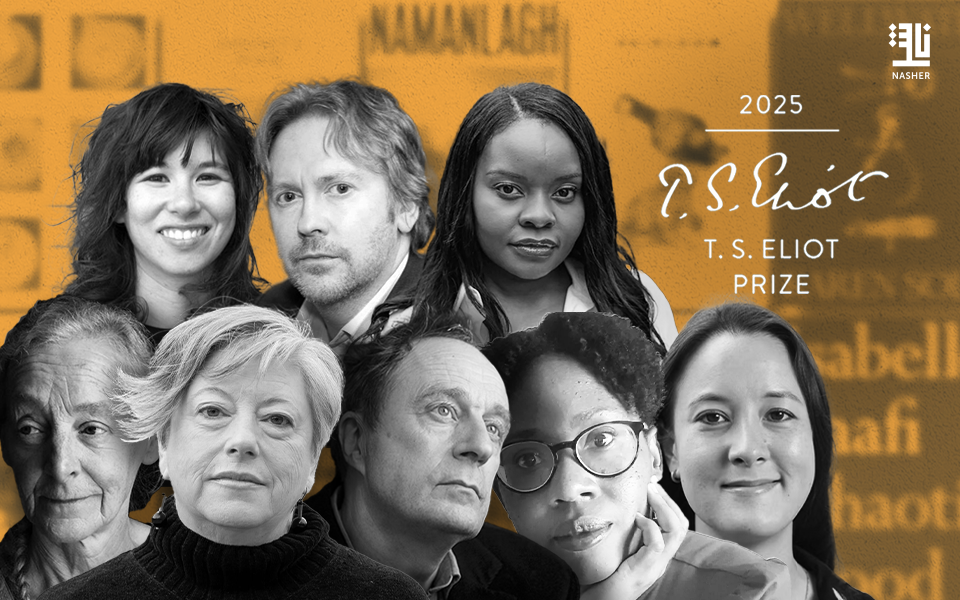
Tom Paulin and Sarah Howe are among the poets shortlisted for this year’s £25,000 TS Eliot prize, the UK and Ireland’s most prestigious award for a single volume of poetry.

The shortlist features 10 collections from established names and new voices, ranging from meditations on illness and inheritance to explorations of ecological collapse and exile.

Howe, who won the prize in 2015 with her debut Loop of Jade, is this time nominated for Foretokens. Meanwhile, Paulin returns to the shortlist for the fourth time with his first collection in a decade, Namanlagh, described by Andrew O’Hagan in the Guardian as “a tone-perfect meditation on illness and recovery, partnership and writing, violence and historical neglect”.

Chair of judges, the poet and translator Michael Hofmann, praised the “great range, suggestiveness and power” of the shortlist. “From Entebbe to Manitoba, from blocks of text to threads of voice, there is something here for everyone.”

Joining Paulin and Howe on the list are Gillian Allnutt, Isabelle Baafi, Catherine-Esther Cowie, Paul Farley, Vona Groarke, Nick Makoha, Natalie Shapero and Karen Solie.

From the postwar reflections of Allnutt’s Lode to Baafi’s Chaotic Good, a debut praised in the Guardian for its “fierce critique of a toxic marriage and a redemptive vision through poetry,” the shortlist responds to personal and global histories, spanning continents and centuries.

Makoha’s The New Carthaginians uses the 1976 hijacking of Air France flight 139 to explore the entangled histories of empire, migration and memory, moving from Entebbe to New York, and from Icarus to Basquiat.

Meanwhile, American poet Shapero is shortlisted for Stay Dead, a darkly witty meditation on mortality.

The shortlist readings will take place on 18 January 2026 at the Southbank Centre’s Royal Festival Hall, with the winner announced the following evening. The shortlist was selected from a record 177 submissions by 64 publishers.

Alongside Hofmann on the judging panel for this year’s prize are the poets Patience Agbabi and Niall Campbell.

The most recent winner of the prize, now in its 32nd year, was Peter Gizzi for Fierce Elegy.
 

Recent News

20Dec
When Dia Mirza Writes for Children

When Dia Mirza Writes for Children

Indian actor Dia Mirza is embarking on a new creative journey as she develops a five-book children’s series inspired by her personal experiences, values, and long-standing love for storytelling. The project marks a significant shift in her artistic path, allowing her to channel her worldview into stories crafted to spark curiosity, nurture imagination, and offer […]

18Dec
Born With a Library Card

Born With a Library Card

UK think tank the Cultural Policy Unit (CPU) has proposed giving all UK newborns a lifelong library card to boost literacy rates among children and into adulthood.   Its proposal means that membership would be linked directly to registrations of birth, meaning library cards would be waiting for newborns at their local library. Currently, parents have […]

18Dec
Epistolary Literature Reclaim its Literary Power

Epistolary Literature Reclaim its Literary Power

In an age where words rush past like lightning and messages are reduced to quick taps on glowing screens, epistolary literature returns to remind us that writing was once a slow, deep, emotion-laden act. This form of literature offers more than a topic, it reveals its writer as they truly are: fragile, sincere, or brimming […]

Related Posts

Born With a Library Card

Born With a Library Card

UK think tank the Cultural Policy Unit (CPU) has proposed giving all UK newborns a lifelong library card to boost literacy rates among children and into adulthood.   Its proposal means that membership would be linked directly to registrations of birth, meaning library...

Epistolary Literature Reclaim its Literary Power

Epistolary Literature Reclaim its Literary Power

In an age where words rush past like lightning and messages are reduced to quick taps on glowing screens, epistolary literature returns to remind us that writing was once a slow, deep, emotion-laden act. This form of literature offers more than a topic, it reveals its...

Waterstones Sets Limits on AI Content

Waterstones Sets Limits on AI Content

Waterstones’ CEO James Daunt has said it will do everything it can to keep AI generated content out of its stores.  He told the BBC’s Big Boss podcast: “We use it in a limited way. It helps our customer service operation become more efficient. It helps us in logistics...

Previous Next
Close
Test Caption
Test Description goes like this