Scandinavian and Nordic literature has become very popular around the world, known for its exciting stories, unique settings, and interesting characters. Whether you enjoy crime stories, social issues, or personal memoirs, we have provided a list of suggestions for you to explore.
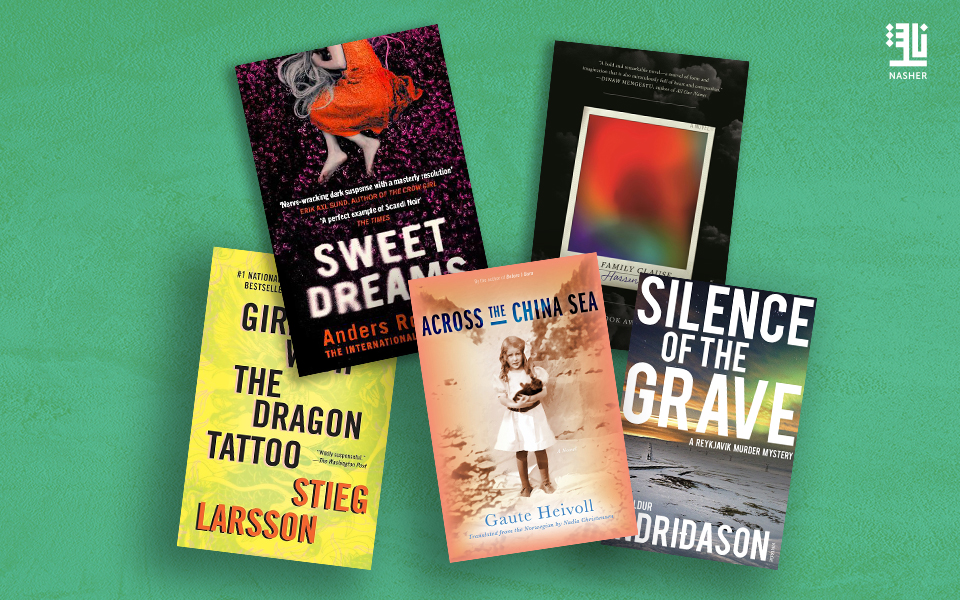
The Girl With The Dragon Tattoo by Stieg Larsson
Stieg Larsson’s “The Girl With The Dragon Tattoo” is a cornerstone of Scandinavian crime fiction. The novel introduces readers to Lisbeth Salander, a brilliant but troubled hacker, and Mikael Blomkvist, an investigative journalist. Together, they unravel a dark and twisted mystery involving the disappearance of a young woman from a wealthy family.
Across the China Sea by Gaute Heivoll
Set against the backdrop of the waning German occupation of Norway, Across the China Sea follows Karin and her family as they move to a small southern village, where they plan to care for those who can’t care for themselves. Their rooms are soon filled with three psychologically unstable men – including Karin’s own uncle – and five siblings whose parents are deemed unfit to raise them, and they all play a part in this new, unconventional family.
Sweet Dreams by Anders Roslund
In this harrowing thriller by Anders Roslund, a chance discovery puts Detective Ewert Grens back on the trail of a cold case.
Five years ago, two little girls went missing on the same day in Stockholm. Their disappearances were never explained; in time, the investigations abandoned. Until now. Grens’ search leads him into the recesses of the dark web and the discovery of a paedophile ring that can only be cracked from the inside. He is forced to call upon his retired partner, Piet Hoffman, the best undercover operative he knows, to try to infiltrate the group.
Only Human by Kristine Naess
One of Norway’s most acclaimed writers intertwines the stories of three women who have been emotionally scarred by the behaviour of the men in their lives and find it difficult to form meaningful relationships.
They are Bea Britt, a novelist who becomes preoccupied with the disappearance of a local 12-year-old girl; her friend’s daughter Beate, a student; and – in a parallel narrative set in the 1930s – Bea’s grandmother Cecilie, who leads such a constrained life that ‘on the inside she is a solitary scream’.
Eventually all three lives reach crisis point in this haunting study of the ripple effect of abuse and cruelty.
The Family Clause by Jonas Hassen Khemiri
A multi-award-winning Swedish author offers an original exploration of a dysfunctional family in this blackly comic tale. It begins with a Swedish man and his sister awaiting the arrival of their father – a demanding bigot who makes Scrooge look generous – who lives abroad but has to make periodic visits to Stockholm for tax reasons.
The visit follows the usual pattern, with the son being denounced by his father as a failure – but can he pluck up the courage to stand up to him?
Shyness and Dignity by Dag Solstad
This modern Norwegian classic – a homage to an older one, Ibsen’s The Wild Duck – begins with middle-aged teacher Elias Rukla vainly trying to interest his students in his insights into Ibsen, and is provoked by their indifference into a humiliating public meltdown that signals ‘goodbye to his entire social existence’.
As Elias wanders around Oslo trying to come to terms with his actions, he reflects on the degeneration of Norwegian culture and the opportunities he has missed in life through pursuing high ideals.
Lillelord by Johan Borgen
The first in a trilogy (but perfectly fine as a standalone), Lillelord follows the well-behaved and sweet Wilfred Sagen, nicknamed “Lillelord” by his family, who sees him as a “Little Lord Fauntleroy.” To his teachers and some of Oslo’s street boys, however, Wilfred is nothing but a force of disruptiveness and danger. Aware of his split personality, the protagonist longs for control but quickly realises that this might not be possible.
This Should Be Written in the Present Tense by Helle Helle
This should be written in the present tense, but it isn’t. Dorte, the book’s narrator, should probably go to her classes at the University of Copenhagen, stop sleeping with her neighbour’s boyfriend, and start doing something, but she doesn’t. Using Dorte’s random, stream-of-consciousness scribbles to move through the narrative, which is efficient in making the reader painfully aware of how unsure the protagonist is about the big picture of her life.
Smilla’s Sense of Snow by Peter Hoeg
Peter Hoeg’s “Smilla’s Sense of Snow” is a literary thriller that combines elements of mystery, science fiction, and social commentary. The novel follows Smilla Jaspersen, a Greenlandic Inuit woman living in Copenhagen, as she investigates the mysterious death of a young boy.
The Boy in the Suitcase by Lene Kaaberbol and Agnete Friis
“The Boy in the Suitcase” by Lene Kaaberbol and Agnete Friis is a gripping psychological thriller that begins with the discovery of a young boy in a suitcase at a Copenhagen train station. The protagonist, Nina Borg, a Red Cross nurse, is drawn into a dangerous web of human trafficking and corruption as she tries to uncover the boy’s identity and origins.
Silence of the Grave by Arnaldur Indridason
“Silence of the Grave” by Icelandic author Arnaldur Indridason is a haunting mystery that delves into Iceland’s past. Detective Erlendur Sveinsson investigates the discovery of human bones at a construction site, leading him to uncover a decades-old crime.