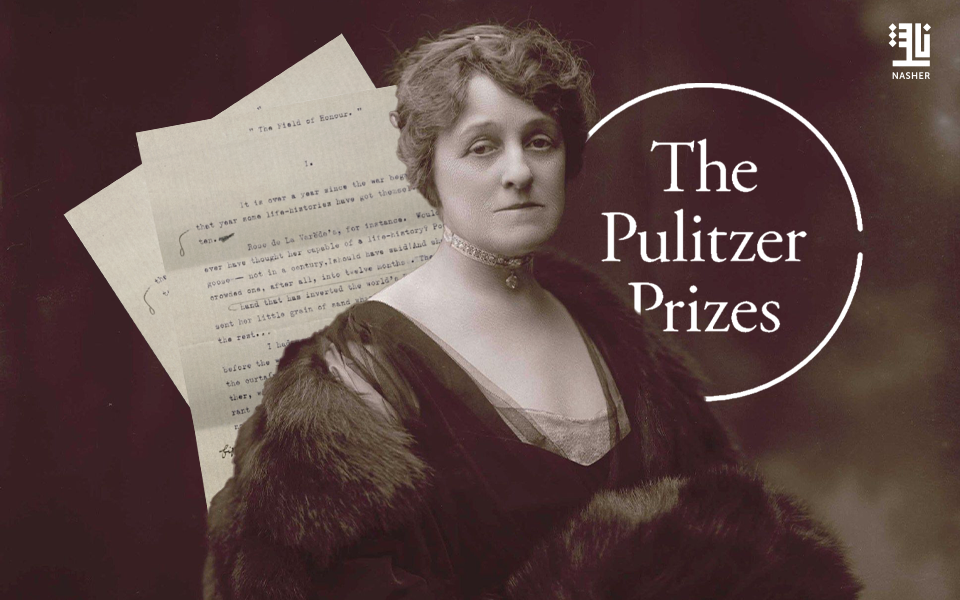
A never-before-published short story by Edith Wharton, the first female Pulitzer prize winner, who encapsulated the so-called gilded age of US society in bestselling novels including The Age of Innocence, received a first public airing on Friday.
The Men Who Saved the World, discovered in the author’s archives at Yale University, appears in the Strand, a quarterly magazine that has previously turned up lost or previously unknown works by literary luminaries such as Raymond Chandler, Graham Greene and Tennessee Williams.
The story, believed to have been written no earlier than July 1918, is a significant find for scholars and fans of Wharton’s works. It was spread across two corrected but undated typescripts, found “incomplete and unpublished” in the Edith Wharton Collection at Yale’s Beinecke Rare Book and Manuscript Library.
Set during a dinner party in a French chateau towards the end of the first world war, it tells of the country’s wealthiest residents attempting to move on from the conflict that recently scarred them, even as guns are heard still booming and soldiers dying only miles away.
The tale is punctuated by the meal being served on a grand dining room table that was used as an operating table for amputations only months before when the chateau was used as a field hospital.
A main character is a young American nurse called Milly Arden, who observes the household’s easy return to its privileged prewar days as she wrestles with the horrors of war and the injuries she has seen and treated.
Arden’s character appears to be at least in part autobiographical: Wharton, who died in 1937 aged 75, had extensive experience of field hospitals during the conflict also known as the Great War, and helped set up medical care and facilities for affected women and children. Many of her observations appeared in Fighting France, a series of articles published by Penn State University’s digital archive.
Andrew Gulli, editor-in-chief of the Strand, said the story from more than a century ago has parallels in global events of today.
“We live in a time where we’re very far away from a lot of horrific events that are happening around the world, and this story sort of encapsulates that mood where there’s this beautiful chateau, and people are trying to go back to the old prewar era with the chandeliers and this wonderful dancing, and a dinner party, and not far away the war’s still happening,” he said.
“Wharton is just wonderful with contrast. There’s the table where there were amputations going on, and then it’s serving as a dinner table. And also in a generational way, there’s the older lady trying for business as usual, trying to go back to the prewar era, almost in denial about what is really happening.
“Then you have Milly, the nurse from the younger generation, who has great knowledge of a lot of the suffering, the fear, the horror of the war; and a young soldier, who I wouldn’t say is shell-shocked, but you can feel beneath the surface his great unease, that he’s seen the trauma and the horrors of war as well.”
Gulli said to the best of his knowledge the story has never been published, although it was analysed by Isabelle Parsons, a British Open University professor, Wharton scholar and author who first uncovered the manuscripts, for Johns Hopkins University’s Edith Wharton Review in 2023.
“In the past decade, news of fresh archival discoveries has frequently thrilled Wharton’s casual and critical readers,” she wrote in the article, referring to the 2017 unearthing in Texas of an unseen 1901 play called The Shadow of Doubt.
The short story, Parsons said, “casts a satirical eye over the volunteer efforts of privileged women. Perhaps most remarkably The Men Who Saved the World reads like an experimental attempt – ultimately abandoned by Wharton – at confronting the traumatic effects of warfare through its explicit references to amputation as medical care at the front.”
Gulli said he hoped the story would appeal to a new generation of Wharton readers.
Wharton, celebrated for her incisive portrayals of New York society in novels such as The House of Mirth and The Custom of the Country, was residing in Paris when the Great War erupted in 1914.
Her initial response transcended mere literary observation; she became an active humanitarian.
She established workrooms for those who had lost their livelihoods, set up hostels to aid thousands of refugees, and even reported from the trenches in a series of dispatches published in the American periodical Scribner’s Magazine.
Inevitably, these profound experiences permeated her fiction. She authored the post-war novel A Son at the Front, and later embarked on The Men Who Saved the World.