Kalimat: Completion of ARA’s 1st phase of distributing 30,000 books
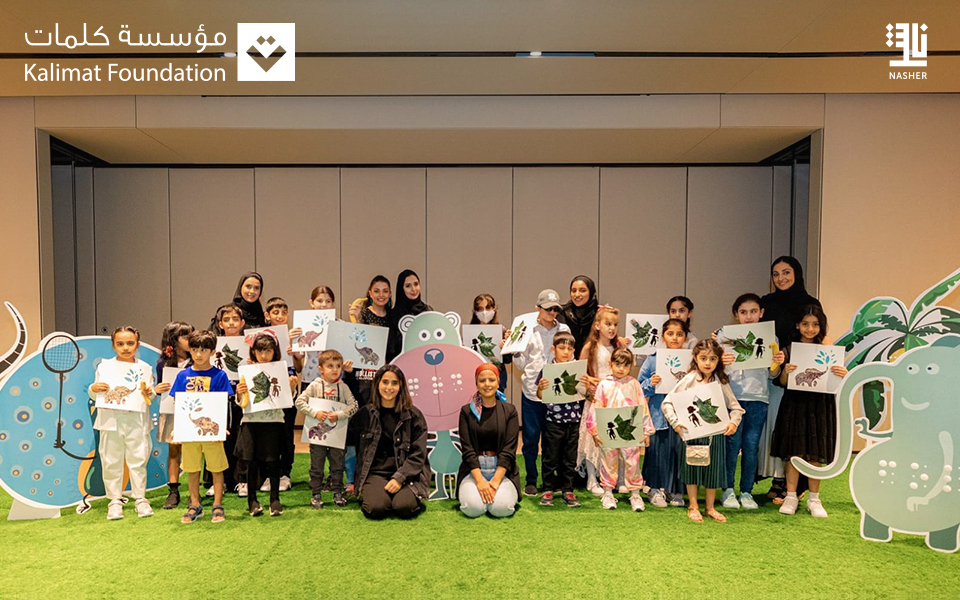
As the very first initiative to conduct surveys of children with blindness, visual impairment, or other print disabilities in the Middle East, North and East Africa, the Kalimat Foundation’s “ARA” initiative has become a global role model for empowering blind and visually impaired children and ensuring their right to knowledge resources.
In response to the surveys, which indicated that accessible books are scarce in the Arab world and most blind children don’t have access to them, the initiative’s exceptional efforts were launched in response to this finding. Moreover, blind children are not offered equal opportunities to sighted peers in a troubling way. The initiative produced 30,000 accessible books in braille, large print, and audio format. In 11 countries, these books are available to more than 45 public and private institutions.
Countries across three continents, namely; Asia, Africa and North America benefited from the ARA Initiative, including the UAE, the KSA, Bahrain, Kuwait, Jordan, Egypt, Palestine, Morocco, Oman, Algeria, and the USA.
The ground-breaking success is the first phase of the initiative’s adjectives that seek to support blind and visually-disabled children, help them develop their capabilities in literacy by providing reading content in accessible formats, highlight the efforts aimed at helping them to integrate better into society, as well as educate publishers about technologies and tools used to produce and publish accessible books.
The initiative did not stop at those local and international milestones, but also produced more than 100 EPUB3 titles, giving visually-impaired children the opportunity to access a library of books whose text size and colour can be easily modified according to their needs.
Amna Al Mazmi, Manager of Kalimat Foundation (KF), said: “Today, we celebrate the distribution of the first batch of accessible-book production. We were able to achieve this remarkable success thanks to the vision of Sheikha Bodour Al Qasimi, Founder and Chairperson of KF, and her full support to blind and visually-disabled children, in life with her firm belief in their right to access sources of knowledge, and bolster their presence and participation in social and creative life on par with their peers.”
“Our future plans comprise the production of new titles of accessible books. We will also offer training to more publishing houses on the production of EPUB3 books to further enhance the integration of visually-impaired children with their sighted peers, and bridge the critical shortage gap in the public libraries across the Arab world in terms of accessible Arabic books,” she added.
Over the past six years, KF achieved tangible accomplishments in forging international treaties and opening collaboration channels with like-minded entities as well as offering education and training opportunities to elevate the accessible-book ecosystem. In 2018, it signed off a cooperation agreement with ABC to produce accessible Arabic ebooks. In 2019, it offered training to 10 MENA-based publishing houses about the mechanism of accessible EPUB3 book production. ARA also organised a series of workshops to raise awareness about the importance of blind children’s integration in their communities in the Middle East, North and East Africa.
Through the ARA initiative, KF became UAE’s first non-profit to secure publishing rights under the Marrakesh Treaty, administered by the World Intellectual Property Organisation (WIPO). The UAE Ministry of Economy authorised KF to facilitate access of the visually-impaired and print-disabled to published works in line with the terms of the treaty, to reproduce, distribute, and make copies of published works available in accessible formats for the blind, visually-impaired, and otherwise print-disabled.