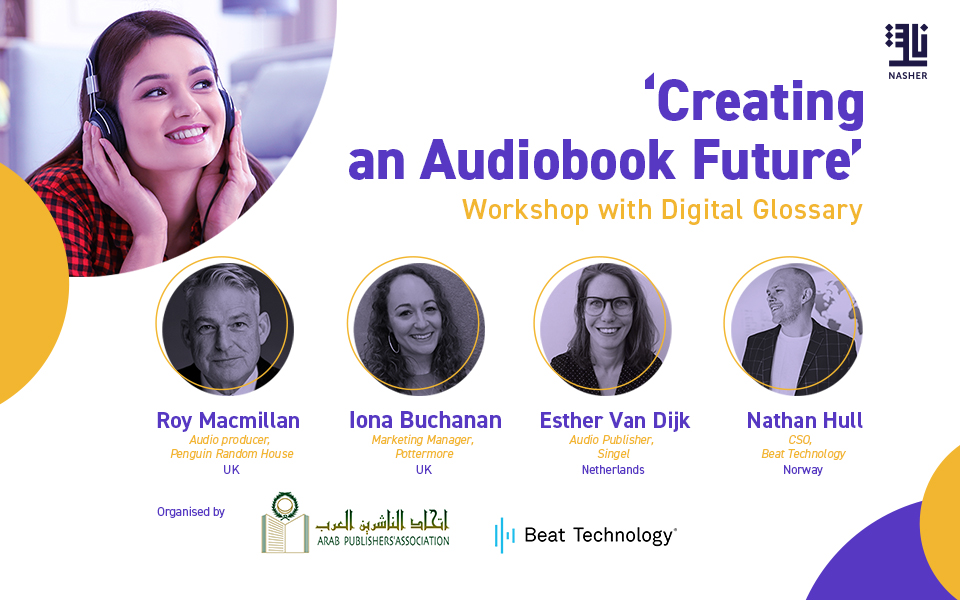
June 10th saw the Arab Publishers Association and Norway’s Beat Technology host an audiobook workshop and Q&A dedicated to publishers from the MENA region.
Publishers, voice actors, start-ups, agents, and studios from Lebanon, Palestine, Egypt, Tunisia, Algeria, Jordan, UAE, Qatar, Saudi Arabia, Morocco, Kuwait, Iraq, and Libya tuned in to listen and pose questions to a panel of international guests.
Beat’s Chief Strategy Officer, Nathan Hull, who also chaired the event, described the workshop as “an attempt to provide publishers with more knowledge about the audiobook format, consumer behaviour, business models, marketing ideas, how to decide what to publish in audio and how to choose that perfect voice to read the stories.” He stressed the core aim was for publishers to “walk away from the session more confident around the terminology and armed with a better set of questions, having stronger opinions and ideas to take back to their publishing houses.”
Beat had brought with them a stellar cast of presenters including Penguin Random House UK’s audio producer Roy Macmillan – who was making a rare speaking appearance and had broken away from recording specifically for the event, Iona Buchanan dialed in from Scotland to represent the Harry Potter digital franchise, and Esther van Dijk called from Amsterdam to share insights in choosing what to commission in audio for the Netherlands’ Singel Publishers group.
In the opening session from Esther van Dijk discussed how to decide what to record and how to build a catalogue of audio titles, she emphasised the importance of “analysing your audience, retail platforms, and the competition.” She encouraged publishers to focus on quality saying, “you have one chance to introduce a consumer to an audiobook for the first time, so make sure it’s a good experience.”
The next session saw Nathan Hull tackle business modeling and the variety of options in other parts of the world. He stressed the need “to experiment wisely, to not undervalue the catalogue and to build for a longer-term future and not just sign your rights away.” Later in his segment, he stressed that “the opportunity is vast for the Arabic publisher or group of publishers that dare to go first with a direct-to-consumer proposition instead of being at the mercy of the retailer.” He also went into detail on the importance of the data the retailers hold back from the publishers citing a number of examples and encouraged the publishers to push for access to that data as part of their contracts.
In the section from Pottermore’s, Iona Buchanan shared all manner of tangible, affordable tips and tricks for marketing audiobooks. Iona explored how audiobooks are vying for attention against other entertainment formats such as movies and tv and asked publishers, “what do you have that they don’t have? And where are you better than them?” Near the end of her session, Iona discussed the importance of reviews of content on platforms citing that 90% of people read reviews before purchasing so you need really engage you listeners in this activity.
Closing out the individual sections, Penguin Random House’s Roy Macmillan passionately enthused on the importance of the voice, the need to prepare in advance, “If you’re going to do an audiobook, you need time to prepare. The narrator needs to have read the book in advance and to have prepped it, marked it up, read it aloud, and researched it.” Comparing a book to an audiobook, Roy cited choices around a printed book include the design, the cover, the font, the typeface inside to give a sense of the book, and then the language affects you. He continued that from this, “the narrator needs to get a sense of the book, “what kind of book is it?” to really get a feel for the book.”
Digital Glossary
During the workshop Nathan Hull referred to a digital glossary of terms relating to audiobook subscription as a quick guide to the space, this glossary is presented here:
The terminology used around subscriptions and audio business models, in particular, has become very muddy. The words and phrases are often interchanged incorrectly, frequently leading to misinterpretations and poor decision-making. Here’s a simple guide:
A la carte (or download) services – services and platform will allow the user to download a file at a fixed price for that file. A copy of the file is transmitted fully from the service’s server to reside on the user’s device of choice.
Subscription services – services and platforms which allow users or family groups to pay an agreed monthly/quarterly/annual fee in return for streaming access to content. The user is at liberty to choose files to play at will with no additional payment or obligation to complete a title.
All-you-can-eat – a subscription service normally comprising a vast collection of titles to consume for the user’s regular subscription payment. This has no caps and allows unlimited usage.
Credit-based – whilst the service may consist of a huge choice of titles, the user’s payment (usually monthly) is for a credit that they use against a title of their choice each month.
Streaming – streaming is the term describing access to a collection of files that the user can access in return for a payment. No files reside on the user’s device. The file streams from the platform’s server to the user to listen to via their mobile data or wifi connection.
Download to own – the actual file is downloadable to a user’s device where the user is at liberty to play at will.
Revenue share model – typically this remuneration model towards the publisher looks at how many times a file has been listened to proportionately from the total pool of titles available. In effect, this means an audiobook has no fixed value but a fluctuating value based on its popularity within the pool in a given timeframe.
Pay-per-book model – this remuneration model sees the platform pay the publisher against a pre-agreed price for any given title. Often the publisher would grant the platform a discount against this DLP (digital list price).
Time-based model – this relatively new model (which is popular in Scandinavia) sees the publisher remunerated based on the amount of an audiobook that has been consumed. Typically, this is based on the number of hours listened to.