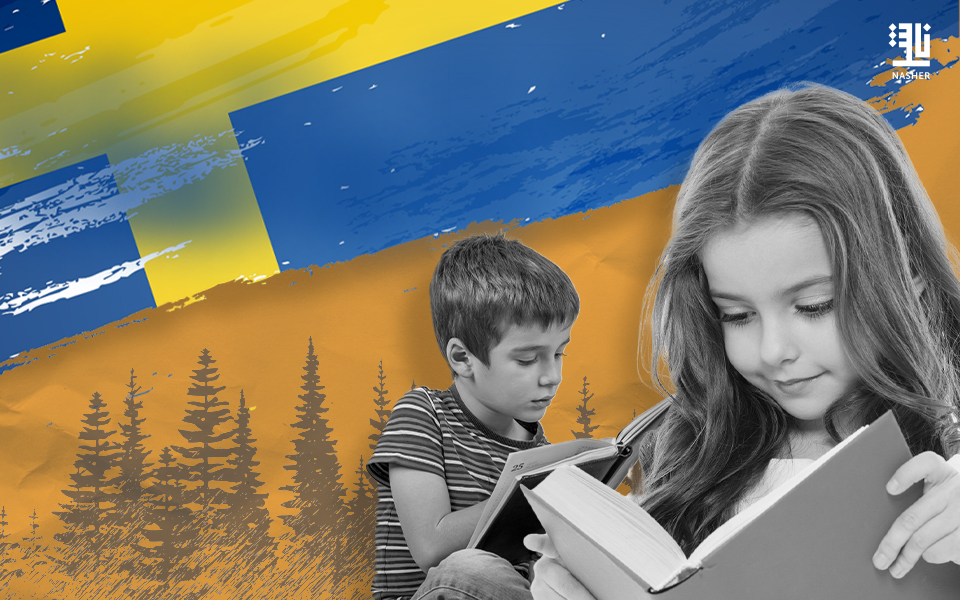
Sweden continues to strengthen its growing position as a leader in children’s book publishing and the development of literature for young readers through a variety of initiatives and projects. Local publishers are highly active, increasingly releasing works in languages beyond Swedish to serve large communities speaking Arabic, Finnish, and Romanian. For decades, the Scandinavian country has embraced a cultural policy that treats books as a core tool for upbringing, building an integrated system that supports the book from the spark of an idea to reaching the reader. The result: children who read regularly, publishers investing in picture books and educational stories, and authors shaping the minds of new generations with writing that is simple yet profound.
Children’s books receive generous government support through publishing and translation grants, along with large-scale purchases of thousands of copies for distribution to schools and public libraries. Institutions such as the Swedish Arts Council actively evaluate new releases and include them in official reading lists, providing strong financial and distribution incentives for publishers. This system not only guarantees quality content but also fosters a competitive environment that pushes writers and illustrators to deliver their best work.
In this context, it is impossible to overlook icons like Astrid Lindgren, author of Pippi Longstocking, who established a literary tradition celebrating the child’s imagination and sense of rebellion. She was followed by a generation of authors unafraid to address complex topics. such as divorce, death, and gender identity, using language appropriate for children without shielding them from the realities of the world. This approach has helped make Swedish children’s literature one of the most exported and translated genres in Europe and beyond.
Despite Sweden’s advancements in digital technology, print books remain especially appealing in the realm of children’s publishing. Parents and educators value the tactile and visual engagement of picture books, which are often preferred over screens in early childhood. At the same time, this reading experience is complemented by carefully designed digital platforms offering audiobooks and interactive stories, creating a multi-sensory reading journey that enriches, rather than replaces, the essence of print.
The Swedish publishing model is more than just an economic or creative success, it reflects a philosophy that views reading as an essential part of public health and social justice. In Sweden, books are considered a child’s right, and reading is seen as a practice that nurtures both mind and conscience, preparing citizens for conscious participation in society. In this way, the publishing industry grows on a foundation of trust, culture, and long-term vision.