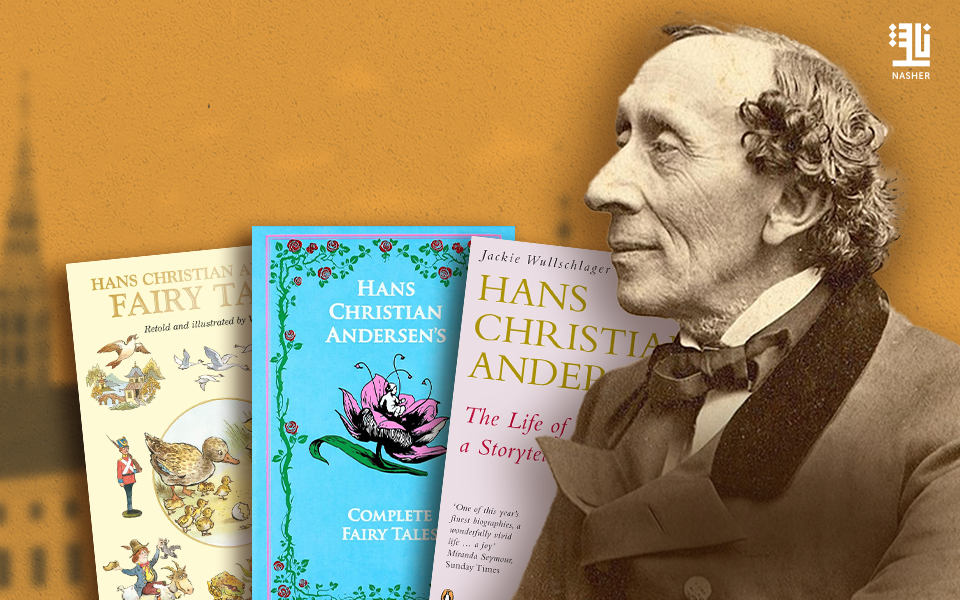
On April 2 each year, the world returns to the memory of childhood, evoking the name of the Danish writer Hans Christian Andersen, whose life story became inseparable from a body of literary work that transcended borders and languages. Andersen was not merely a teller of children’s tales; he was a creator of entire worlds alive with emotion and human experience. With a style that was at once simple and profound, he wove together imagination and reality. His stories emerged as reflections of a difficult childhood, transforming pain into narratives of hope, and reshaping suffering into a form of beauty that resonates with readers of all ages.
Andersen’s works stand out for moving far beyond the notion of simple entertainment, offering instead texts rich in philosophical and human depth. In stories such as The Little Mermaid, “The Ugly Duckling,” and “The Emperor’s New Clothes,” symbolism intertwines with seemingly simple narration to convey themes of identity, difference, honesty, and self-worth. In his literary universe, the child is not a passive reader but an active participant in discovering meaning. His texts open spaces for interpretation and invite reflection, marking a qualitative shift in children’s literature, from straightforward tales with predictable endings to layered narratives that speak simultaneously to children and adults.
Perhaps Andersen’s most profound contribution lies in how he redefined the very function of storytelling. In his hands, the story became a means of understanding the world, rather than merely escaping it. He drew upon humble characters, often marginalized or fragile, and gave them voice and presence, affirming that true value resides within, not in outward appearances. This approach helped anchor universal human values such as empathy and acceptance, transforming children’s literature into a subtle educational space that instills values without resorting to didacticism or direct instruction.
Andersen’s influence extended well beyond the written word to shape the very structure of children’s literature on a global scale. He inspired generations of writers and illustrators to create works grounded in imaginative freedom and emotional depth, elevating children’s books into cultural artifacts of enduring significance, equal in value to literature for adults. His stories also proved fertile ground for adaptation into theatre, cinema, and visual arts, reinforcing their presence in collective memory across diverse media. Over time, these tales have not faded; instead, they have continually renewed themselves in new contexts, demonstrating that authentic literature possesses the power to transcend time.
On International Children’s Book Day, Andersen’s legacy feels more relevant than ever, standing as a model of literature that respects the child and trusts in their capacity to understand and imagine. Celebrating him is not merely an act of remembrance, but a renewed affirmation of the importance of investing in children’s literature as a pathway to shaping more aware and empathetic human beings. As reading mediums evolve and diversify, the power of a well-told story endures, just as Andersen’s tales continue to find their way into hearts, gently reminding us that beauty can emerge from the simplest things, and that every story begins with a dream.