
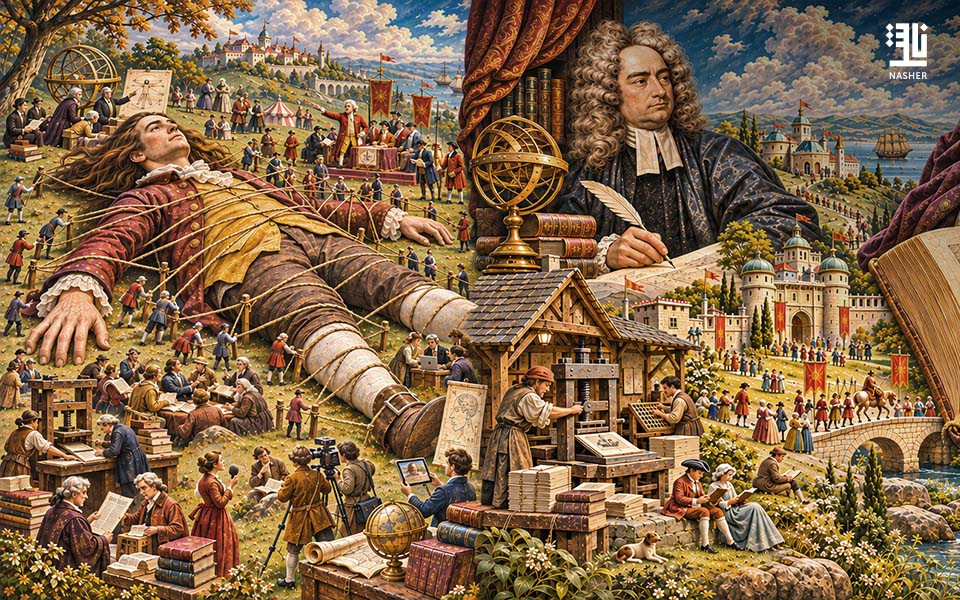
In March 1726, an Irish clergyman visited London and arranged for a courier to deliver a manuscript to a publisher under cover of night. The dean of St Patrick’s Cathedral in Dublin knew his novel would cause trouble and wanted to publish it anonymously.
His name was Jonathan Swift and the story was called Travels into Several Remote Nations of the World. The satirical work was published that October and is better known 300 years on as Gulliver’s Travels.
The moment that Jonathan Swift’s Gulliver’s Travels was published in 1726 it became an overnight sensation in Britain and Ireland. The Travels were serialised within weeks of publication. The Penny London Post on 25 November 1726 wrote that the book ‘bore so considerable a share in almost every conversation’.
Dozens of translations followed with unprecedented speed. Mikhail Lomonosov, a Russian scientist and founder of Moscow State University, was already comparing Swift to Aesop in his works as early as 1730s, praising it as an example of ‘pure fiction’, a story that didn’t take place and was composed primarily for ‘moral purposes’ while being highly entertaining.
The anniversary is now being celebrated at Swift’s alma mater, Trinity College Dublin, and at events around Ireland. Exhibitions, festivals, seminars, art competitions and workshops are exploring the origins of Swift’s masterpiece, its retelling through a feminist lens, and its prophetic depiction of a society in thrall to a form of artificial intelligence.
The exhibition, which runs until December and is available online, draws on the university’s collection of hundreds of editions and popularisations of Gulliver’s Travels, including engraved illustrations, pop-up versions, a 1976 Marvel comic and the only known surviving copy of an abridgement printed in 1761.
Born in 1667, Swift combined posts in the Church of Ireland with pamphlets and essays that pioneered deadpan, savage satire, including A Modest Proposal, which suggested alleviating the plight of the Irish poor by selling their children as food to the wealthy.
He wrote Gulliver’s Travels in Dublin and at an estate in County Meath, where it is said that some very tall and very small farm workers inspired the storytelling.
When shipwrecked on Lilliput, Gulliver discovers diminutive inhabitants who are waging war against a rival kingdom in a dispute over which end of a boiled egg should be cracked – a satire on Europe’s sectarian conflicts. Gulliver captures the Blefuscudian fleet and douses a fire at a Lilliputian palace by urinating on it.
Marooned among giants in Brobdingnag, Gulliver’s stories about his “own dear native country” inadvertently reveal its corruption and cruelty, prompting the Brobdingnagian ruler to pillory humanity as “the most pernicious race of little odious vermin that nature ever suffered to crawl upon the surface of the earth”.
Swift’s publisher, Benjamin Motte, did not know his author’s identity but the book’s success, and Swift’s literary record, enabled many to guess, said Douglas. “People sort of knew it was him.”