
Roger Tagholm
The ongoing threat of piracy, the need to build capacity among African publishers, the lack of national book policies from respective governments, ongoing distribution and infrastructure problems, and a shortage of books reaching children were among issues discussed at the first International Publishers Association (IPA) Seminar on ‘Publishing for Sustainable Development – The Role of Publishers in Africa’, organised by the IPA and the Nigerian Publishers Association (NPA), held in Lagos, Nigeria on 9 May.
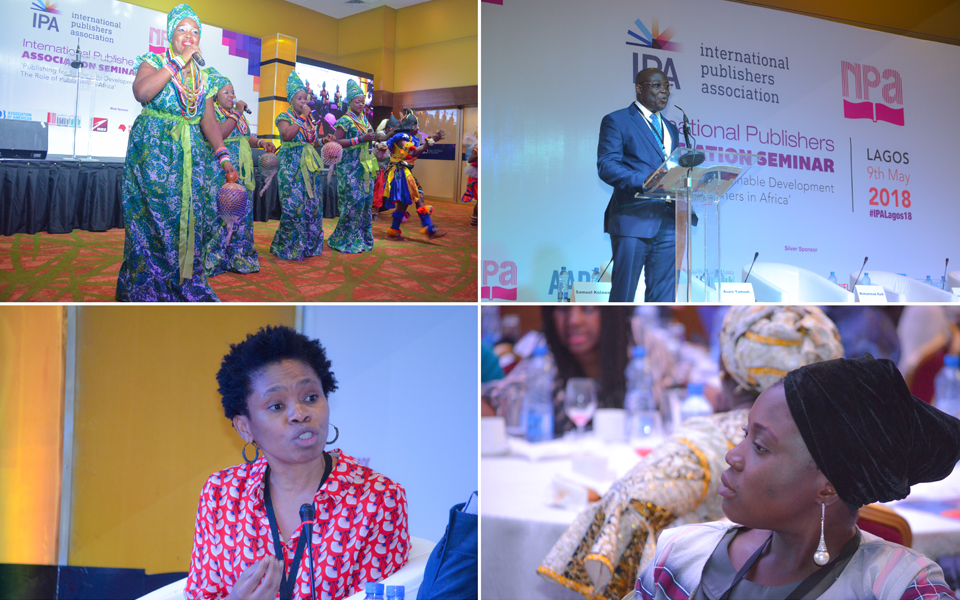
The Seminar, which ended with a blaze of African dancing and singing, was attended by some 200 delegates from more than 20 African countries and nearly 30 publishers, including the presidents of the publishers associations of Ghana, Mauritania and South Africa.
In opening remarks, IPA president Michiel Kolman, referred to the ongoing threat to copyright posed by “big tech” – in particular Google – whose desire to boost exemptions in areas like education “directly undermines your efforts in building a sustainable market for African publishers”. He believes that rather than being about some altruistic aim of providing free knowledge, the intention is really about “boosting clicks and advertising revenue”.
Gbadega Adedapo, president of the NPA, echoed the title of the country’s most famous novel in his remarks on piracy. “If we don’t tackle the scourge of piracy, ‘things fall apart’,” he said. “When authors’ works are unprotected, when pirated copies are everywhere, when booksellers themselves are acting as pirates, then authors to do not receive royalties and publishers do not receive sales revenue.”
But the Nigerian government is making moves to tackle the problem. Afam Ezekude, director general of the Nigeria Copyright Commission, said action was being taken and that it had a zero-tolerance approach to piracy. “Since January we’ve carried out more than 340 raids and seized nine million items with a market value of 9bn Naira,” he said. “We also work closely with the Nigerian Customs Service and in January intercepted 28 containers from China, 20 of which contained pirated books.”
John Asein, executive director of Nigeria’s Reproduction Rights Society, put forward the idea of “safe corridors” for books printed overseas, with reliable entry points that publishers trust, so that pirated books cannot come in. “We did this successfully some years back with pharmaceuticals,” he observed.
There were numerous calls for national book policies and numerous statements on the importance of books and literacy. Elliot Agyare, president of the Ghana Publishers Association, said: “You cannot have a literate society without books. We have to enrich our culture and take control of our own narrative in order to build the new Africa. But we lack some capacity – we need to improve editorial capacity, improve production capacity. We need to develop our skills and we must look at our distribution networks too.”
Distribution was raised by Lola Shoneyin, founder of Lagos pubisher Ouida Books. In the session on bringing the voice of African writers to the world, she said that she was more worried about the spread of titles within Africa itself. “I think we need to ensure that when a book is published in Nigeria it can be read in Ghana and Uganda. There is a growing number of readers in our continent – we should look at Africa as a huge opportunity. And when it comes to distribution we could start with NiPost [the Nigerian postal service] which fails everyone. The government needs to make sure it works properly.”
The need to respect indigenous languages was raised by Bibi Bakare-Yusuf, co-founder of Cassava Republic Press. She said the government should provide grants to enable publishing in local languages, “otherwise you are simply strengthening European languages the whole time”. Walter Bgoya, Chairman of the International African Books Collective, agreed, saying “every language has the right to exist, no matter how small”.
One of the most popular speakers was Okechukwu Ofili of Nigeria’s Okada Books, a platform for self-published writers named after the motorbike taxis that weave in and out of the traffic on Lagos’ famously congested roads. To demonstrate how poor distribution is in Africa, he said: “Right now, it is easier to buy a copy of Chinua Achebe’s Things Fall Apart in Germany than it is in Nigeria. The way to reach people across Africa is digital. I think we need to forget about the government – they’re too busy with the roads and with NEPA [the former National Electric Power Authority, whose initials Nigerian say stand for ‘Never Expect Power Always’].
“People are reading in Africa. Our platform sees 100,000 monthly active users, and we are taking material from people who traditional publishers might ignore – so we have a fruit seller at a market in the north who is writing romantic fiction for us, and we are looking at publishing in Pidgin too. I think for too long we have been writing books for the west – Adichie’s feminism needs to be read more here than in America.”
Closing remarks were made by Sheikha Bodour al Qasimi of Sharjah’s Kalimat publishers. “It is heart warming to witness the momentum created by your efforts which is contributing to the progress of the publishing industry in Nigeria and Africa. Despite the challenges we heard from some of the speakers today, there are clearly plenty of opportunities for cross-cultural exchange and for publishers in Nigeria and Africa to be at the forefront of social and economic change and to contribute to sustainable development.”
The IPA’s Secretary General José Borghino called for publishers to provide data about their industry to their governments “because without accurate data, all our stories are just anecdotes”. He said that accurate data would help publishers make their case when they are looking for support.