
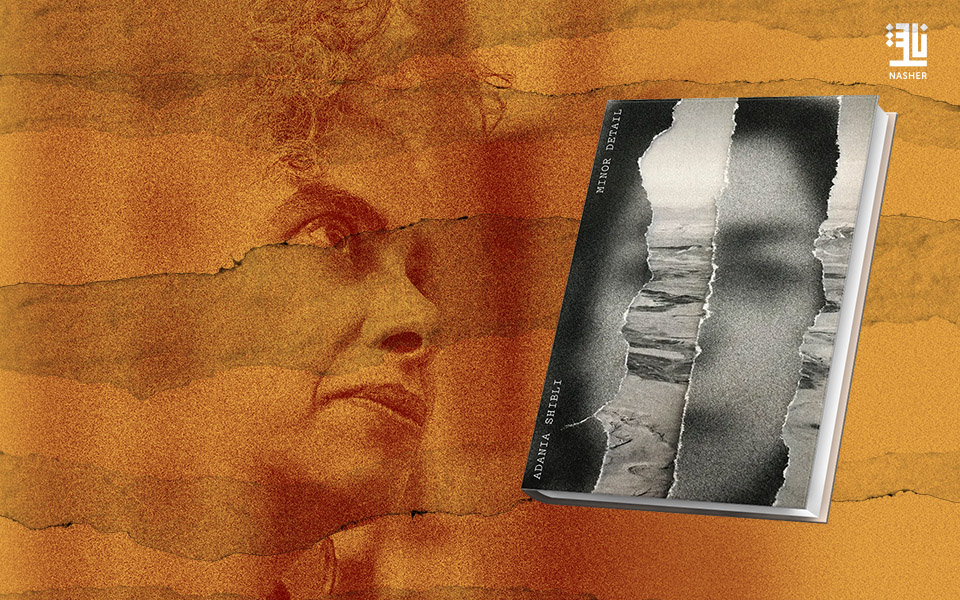
Although published more than three years ago Adania Shiblis Minor Detail is the perfect read during this turbulent time that the Palestinians are experiencing right now. Despite the fact the book is just over one hundred pages, it took twelve years to writeand it shows in the novels sharp prose. Divided into two halves of equal length, the first section of Minor Detail begins in the summer of 1949, one year into the Nakba. The novel is bound by both minor and major details: a brutal gang rape and murder, the punishing heat, the eerie presence of a dog in distress and two nameless characters. The first is a quietly malevolent Israeli platoon commander who organises the gang rape and murder of a young Bedouin. The second is a woman in Ramallah who stumbles upon the story in a newspaper decades later and becomes haunted by one minor detail the fact that the girls assault happened 25 years to the day before she was born.
The first section unfolds over four days in 1949 as the commander leads his men on sweeping patrols of the Negev, or Naqab, desert overseeing the clearing of the land, carried out in preparation of establishing the new states border with Egypt. While on patrol, the soldiers encounter a tribe of Bedouins, killing nearly all of them. They take hostage the sole survivors: a young woman and her dog. Over the course of the next two days, the soldiers take turns raping the teenager, before they murder her and bury her body in the desert.
The commanders speech to the other soldiers sets the tone of not only the book but the reality of an occupation and the intention of any invasion force The south is still in danger, and we must do everything we can to stand our ground and remain here, otherwise we will lose territory. We must not hesitate to devote all the strength and vigour of spirit that we have to building this part of our infant state, and protecting and preserving it for future generations. This requires that we go after the enemy, instead of waiting for him to appear, for If someone comes to kill you, rise and kill him first.
Focusing on action, with no room for thoughts or feelings, or even names, the novels third-person narration sticks to the viewpoint of the officer in charge, with barely any speech, and none that isnt his.
The Negev gang rape at the heart of Minor Detail is a true story, carried out by Israeli soldiers in 1949. Another minor detail: according to declassified documents, the real-life commander answered his superiors question on whether the girl was eventually returned to her village by reporting that his soldiers killed her because it was a shame to waste the petrol.
Halfway through, the novel loosens up to give us the first-person testimony of a nervy insomniac (also unnamed) in present-day Ramallah. Minor Detail does not tell us much about the woman, neither her job nor her name, All we know from the book is that she was born on August 13, exactly twenty-five years after the murder of the Bedouin girl, another minor detail that sparks her growing obsession. Using old maps as a guide, she travels from Ramallah to the Negev desert, and there meets a fate that is as ironic as it is chilling.
While this more conversational segment generates suspense about the novels wider purpose, interest also lies in its portrait of everyday life under occupation: what its like, say, when soldiers blow up the building next to your office to get at targets hiding inside, and you find yourself bothered most of all by the dust blowing on to your desk. The road trip meanders from detour to false trail before juddering to a shockingly abrupt halt; with a key role played by a pack of chewing gum, the title takes on the air of a cruel joke, in a climax that only underlines further how swiftly and cheaply life can be taken in the name of self-defence.
From one point of view, you might see the narrators fate as a lesson in how trying to tell stories of suffering boils down to privilege she doesnt have. Her recognition of how little the history of Palestine and its people matter to the rest of the world, is evident when she tries to belittle the incident And the situation has been like this for such a long time that there arent many people alive today who remember little details about what life was like before all this, like the detail about the wilting lettuce in an otherwise closed vegetable market, for example.
At one point, the narrator tries to talk herself out of her search, thinking theres no point in me feeling responsible for [the victim], like shes a nobody, and will forever remain a nobody whose voice nobody will hear. That isnt a comfortable place to be left, but Minor Detail suggests anything else might be little more than wish fulfilment.
Shibli leads the reader to imagine the thousands of such minor details that have been erased from the historical record. As the woman in the present-day narrative explains: Focusing intently on the most minor details, like dust on the desk or fly shit on a painting, is the only way to arrive at the truth and definitive proof of its existence.
What ought to be an ordinary search visiting two museum archives becomes a logistical nightmare for someone living under occupation. Palestinians are forbidden free movement. Millions are confined to controlled zones, with a draconian permit system if they wish to travel from one zone to another. The unnamed woman is a resident of Area A and must travel into Area C, an impossible idea even for those who live in Area B. The divisions are absurd and Shiblis amateur sleuth professes an inability to properly identify borders even as she navigates their suffocating restrictions. She persuades a colleague to give her their Area C identity card and someone else to rent her a car with the correct colour licence plate, and sets off on her mission. Shiblis own minor details the water pressure in a settlement guesthouse, the bored and vindictive teenage soldiers at a checkpoint, villages that appear and disappear depending on whose map youre reading glitter with meaning throughout the text.
The womans determination to continue her search even when she discovers that the map has been redrawn, just like the rewriting of history as we soon discover, Well, no going back now, not after crossing so many borders, military ones, geographical ones, physical ones, psychological ones, mental ones. I look back at the Israeli map, searching for the first location I wish to head to.
All novels are political and Minor Detail, like the best of them, transcends the authors own identity and geography. Shiblis writing is subtle and sharply observed. The settlers and soldiers she describes in the second half of the novel are rendered with no malice or artifice; she writes of an elderly settlers veined hands with tenderness, and as an author is never judgmental or didactic.
Minor Detail doesnt offer much in the way of redemption. Patterns repeat themselves, injustices continue, and loss is only magnified and re-perpetrated over time. As the unnamed woman states Besides, sometimes its inevitable for the past to be forgotten, especially if the present is no less horrific; Ironically her own story is another horrific incident like the Bedouin woman be it of a different circumstance, yet the same end result.
We have given Minor Detail a rating of 10/10.
Minor Detail, by Adania Shibli, translated by Elisabeth Jaquette. New Directions, 105 pages.