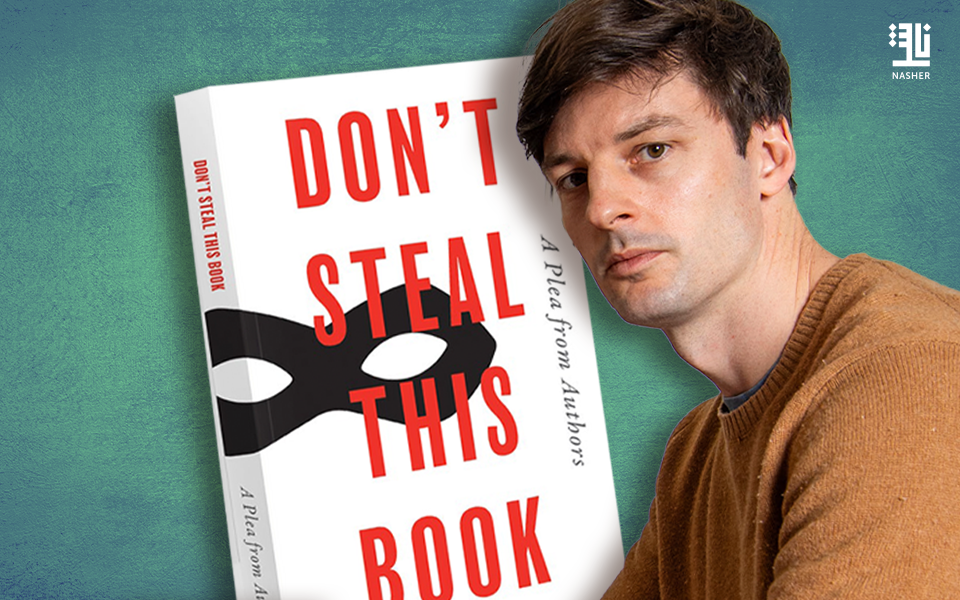
Thousands of authors including Kazuo Ishiguro, Philippa Gregory and Richard Osman have published an “empty” book to protest against AI firms using their work without permission.
About 10,000 writers have contributed to Don’t Steal This Book, in which the only content is a list of their names. Copies of the work are being distributed to attenders at the London book fair on Tuesday, a week before the UK government is due to issue an assessment on the economic cost of proposed changes in copyright law.
By 18 March ministers must deliver an economic impact assessment as well as a progress update on a consultation about the legal overhaul, against a backdrop of anger among creative professionals about how their work is being used by AI firms.
The organiser of the book, Ed Newton-Rex, a composer and campaigner for protecting artists’ copyright, said the AI industry was “built on stolen work … taken without permission or payment”.
He added: “This is not a victimless crime – generative AI competes with the people whose work it is trained on, robbing them of their livelihoods. The government must protect the UK’s creatives, and refuse to legalise the theft of creative work by AI companies.”
Other authors who have contributed their names to the book include the Slow Horses author, Mick Herron; the author Marian Keyes; the historian David Olusoga; and Malorie Blackman, the writer of Noughts and Crosses.
“It is not in any way unreasonable to expect AI companies to pay for the use of authors’ books,” said Blackman.
The books’s back cover says: “The UK government must not legalise book theft to benefit AI companies.”
Publishers will also launch an AI licensing initiative at the London book fair. Publishers’ Licensing Services, a non-profit industry body, is setting up a collective licensing scheme and has invited the sector to sign up to it in the expectation it will give legal access to published works.
AI requires vast amounts of data, including copyright-protected work taken from the open web, to develop tools such as chatbots and image generators. This has caused consternation among creative professionals and companies worldwide, triggering lawsuits on both sides of the Atlantic.
Last year Anthropic, a leading AI firm and the developer of the Claude chatbot, agreed to pay $1.5bn (£1.1bn) to settle a class-action lawsuit by book authors who said the startup took pirated copies of their works to train its flagship product.
British artists have responded with outrage at the main government proposal in the consultation. It proposes letting AI firms use copyright-protected work without the owner’s permission – unless the owner has signalled that they want to opt out of the process. Elton John is among the artists to have protested over the prospect of a relaxation in copyright law, calling the government “absolute losers”.
The Society of Authors (SoA) has launched a scheme to help identify works written by humans in a market increasingly flooded by AI-generated books.
The scheme is the first of its kind launched by a UK trade association, and allows authors to register their books and download a “Human Authored” logo to display on their back cover.
The SoA said the absence of any government measure to compel tech companies to label AI-generated output meant readers were struggling to distinguish between books written by a human, and machine-generated work based on AI models trained on copyrighted work without permission or payment.
It mirrors a similar scheme launched by the Authors Guild in the US at the beginning of 2025.
Mary Beard, the classicist, is one of several high-profile authors who have backed the scheme and plan to register their works on the Human Authored website. “It’s only going to be human authored books on my desert island,” she said.
Malorie Blackman, the children’s author, said the scheme “seeks to highlight the imagination, commitment, craft and care taken to produce stories and books which can be enjoyed by everyone.