An Unlasting Home Book Review
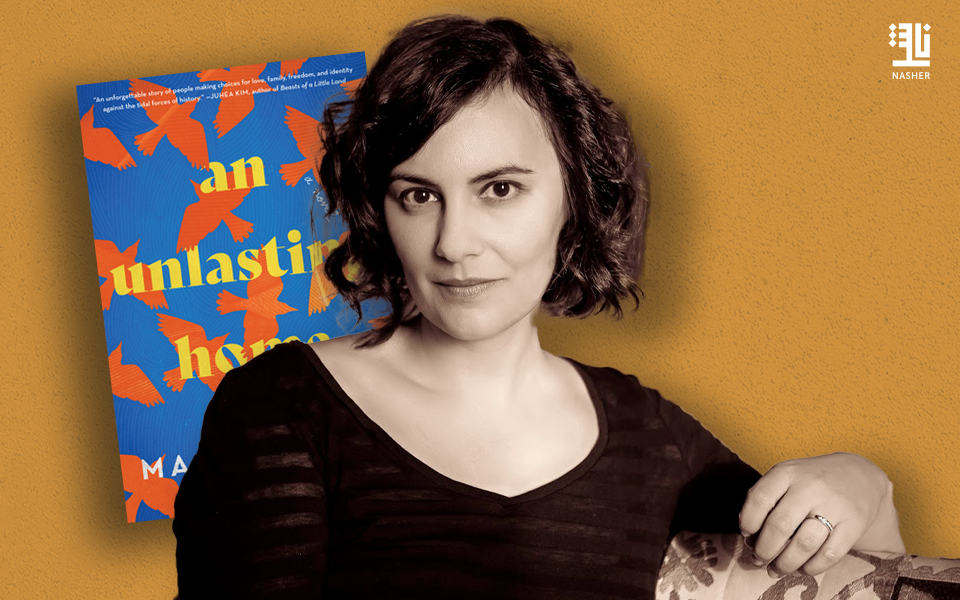
An Unlasting Home by Mai Al-Nakib
Published by Mariner Books
Publication date: April 12, 2022
The debut novel from an award-winning short story writer: a multigenerational saga spanning Lebanon, Iraq, India, the United States, and Kuwait that brings to life the triumphs and failures of three generations of Arab women.
When Sara’s mother was 8 months pregnant, she lied to the airlines and flew from Missouri back to Kuwait, determined that her daughter be born in the country of her ancestors. This is just the first of many miles and countries crossed by the indomitable women in Mai Al-Nakib’s sweeping novel, An Unlasting Home.
An Unlasting Home spins out and back to her mother and her grandmothers. Each woman is from a different country with a very different upbringing, but had a drive to succeed and the brains to do so. Fate and family ultimately derailed each of them. They accede to the traditional role of wife, daughter, and mother, leaving behind personal goals. Only Sara is able to fulfill her professional dreams. For her grandmothers, Yasmine and Lulwa, love and war meant being uprooting to new countries with new languages and customs; leaving behind family and personal goals. Her mother, Noura goes the furthest when her husband gets a job in America, allowing her to complete a degree, but then he wants to return to Kuwait to help rebuild it after the Gulf War.
Al-Nakib goes even further with the importance of women in Sara’s life by including Maria, an Indian woman, hired by Noura as a nursemaid. Despite her paid position she is a part of the family, having known Sara her entire life. She’s a poignant reminder of the women displaced by being forced to work abroad in an effort to support the children they leave behind.
Part 1 rotates between Sara’s point of view, in the present, and her maternal and paternal grandmothers’ point of view in the 1920s and ’30s, both part of an Arab diaspora. Sara’s maternal grandmother, Lulwa, was born in Kuwait and married a pearl merchant. From a poor family of fisherman, Lulwa is married off at a very young age and moves to India with her husband in the 1920s. However, with “the changing winds of Indian independence,” the Al-Mustafas move back to Kuwait in the 1950s. The children, fluent in Hindi and English but with broken Arabic, feel displaced when they move to Kuwait. Her mother, Noura’s, alienation as a child is echoed in the life of her daughter.
Exploring the problems of those in diaspora, especially an Arab diaspora, is fresh territory—and gives one a sense of just how emotionally difficult it is to juggle more than one cultural identity and language. Al-Nakib’s novel is also structured in a way that reflects a more circular idea of time: “time in motion, in flux, [refuses] to persist along any given line, gliding out of the past into the present and the future.” Although the grandmothers and mothers are dead, their presence still “glides out of the past into the present.”
Sara’s paternal grandmother, Yasmine, also must reconcile a mixed cultural identity with a Turkish mother and a Lebanese father. When her father suddenly dies, the family is impoverished. She falls in love with a boy from a wealthy family, but the romance is squashed by his mother. Yasmine, who dreamed of going to the American University in Beirut, instead goes to Iraq to teach Arabic. On the rebound, she meets Marwan, the son of a “fervent nationalist” in Baghdad. In the struggle for independence from the Ottomans, the British considered him a “wild card.” His father was arrested and soon after died, from what appeared to be poison. Her Turkish mother, aware that her daughter feels under pressure to marry to save the impoverished family, is not enthusiastic about Marwan. Her hunch proves to be right as he insists Yasmine give up her career as a teacher. Unlike grandmother Lulwa, whose marriage was generally happy, grandmother Yasmine is tethered to a spoiled, selfish man who turns out to be a womaniser.
In part 2, the point of view rotates between Sara, her mother, Noura, and her Indian ayah, or nanny, Maria, a surrogate mother figure. Her mother, Noura, now dead, Sara is comforted by Maria as she faces the charges of blasphemy, but only briefly. In her eighties, Maria collapses and dies of heart failure. While not a blood relative, Maria takes care of Sara from a young age and in some ways is closer to Sara than her mother. Maria also tells her touching story: from a poor Christian family in Goa, she is forced to find work to support her children when her husband breaks his neck in a fall from a palm tree. A chance encounter with the Al-Mustafas in India brings her to Kuwait. She secures her children’s futures economically but is not present as they are growing up and pays the price emotionally. Eventually, with the help of the Al-Mustafas, she brings her children to Kuwait for better opportunities. But she, like Sara and many of the other characters in this novel, lives in the space between two cultural worlds.
Part 3 is told entirely from Sara’s point of view, and she flies alone, mourning the past and a Kuwait that no longer feels like home. This section of the novel is divided by past time, set in Kuwait and the United States, with 2013, focusing on the dangerous court case of blasphemy that she must face. From 1989 to 1992, she follows her brother to Berkeley. While at college, she learns of the tragic death of her father and uncle from her mother in a clipped, brief call on a satellite phone. A poignant scene in the novel is the description of the murder of her father, and his brother, as they are “accidentally” killed by overzealous Kuwaiti soldiers because of their Iraqi accents. Ironically, her father sacrificed a lucrative career to develop the national health system of Kuwait but is killed because he is considered “the enemy.” Their corpses were later recovered by the neighbourhood resistance, who apologised for the “irreversible mistake.”
Al-Nakib exposes the challenges that often come with state formation and national identity. The title, borrowed from Irish writer James Joyce’s novel, A Portrait of the Artist as a Young Man, speaks to the impermanence of home “under the eaves of men’s houses,” as Joyce puts it. The roof could easily collapse at any moment.
In An Unlasting Home, there is no separation between personal and political. The novel gestures to Kuwait’s national history and its encounters with others — the oil consortiums, the Indians, the Palestinians and the Kuwaitis themselves — as they negotiate their national identity. Yet Sara, in the wake of her trial (her charges were eventually dropped), concludes that she is only half Kuwaiti at best, part Lebanese, part Turkish and perhaps half Indian and American. The complicated history leads the protagonist to contend with her own limits as she reconciles with a personal ultimatum: to exist beyond Kuwait, no matter what that may look like.
Although the novel started strongly and grips the reader from the first page but further along the novel there is a strong sense that this book is addressing or catering for western audience with plots and incidents that don’t fully represent arab culture and particularly Kuwaiti culture. We have given it a rating of 6/10.
Mai Al-Nakib was born in Kuwait and spent the first six years of her life in London, Edinburgh, and St. Louis, Missouri. She holds a PhD in English from Brown University and is an associate professor of English and comparative literature at Kuwait University. In addition to her novel, ‘An Unlasting Home’, published by Mariner Books in 2022, Al-Nakib’s short story collection, The Hidden Light of Objects, was published by Bloomsbury in 2014. It won the Edinburgh International Book Festival’s First Book Award. Al-Nakib’s occasional essays have appeared in numerous international publications, including: World Literature Today; New Lines Magazine; BLARB: Blog of the LA Review of Books; The Markaz Review; and the BBC World Service; among others.