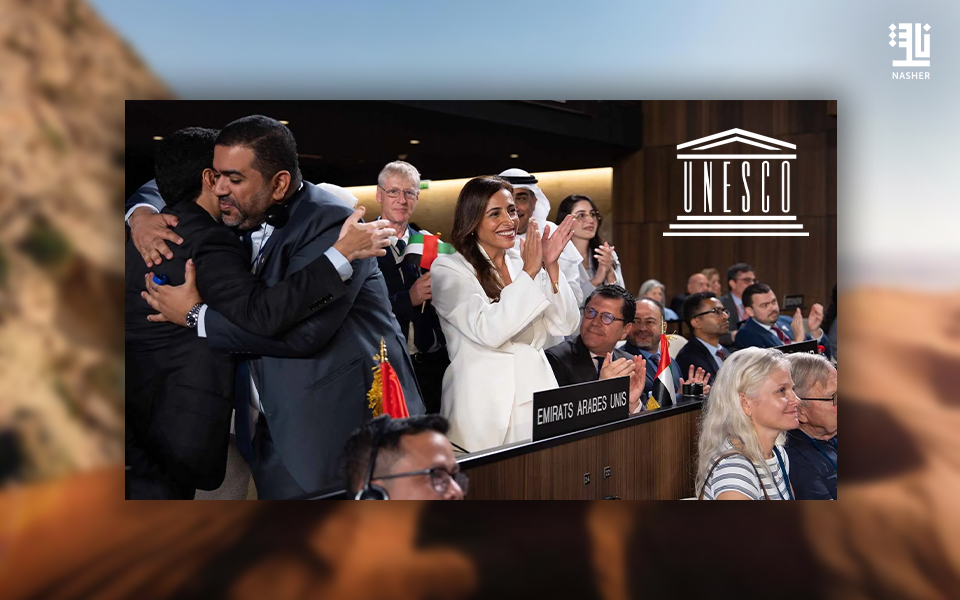
In a timeless moment etched into the memory of human heritage, the sun of Sharjah rose once again on the map of the world, this time through the gateway of deep history. At its recently concluded 47th session in Paris, the UNESCO World Heritage Committee officially inscribed the “Cultural Landscape of Prehistoric Faya” on the World Heritage List. This achievement is far more than recognition of an archaeological site; it is a new birth certificate for humanity’s first story, when our ancestors began their earliest footsteps on the sands of the Arabian Gulf over 200,000 years ago.
What sets Al Faya apart is not only its antiquity but its uniqueness as the first desert site to offer uninterrupted, well-preserved evidence of human settlement during the Stone Age. In the heart of Sharjah’s desert, archaeologists uncovered 18 successive geological layers, each narrating a chapter in the evolution of humankind. Al Faya reads like a novel carved in stone, its lines etched in ancient tools and buried relics, speaking the silent language of civilizations. The site exemplifies humanity’s ability to adapt and settle in arid environments, which, despite their harsh and unforgiving conditions, served as crucial waypoints in our evolutionary journey. This is what gives Al Faya’s inscription such rare scientific and human significance.
This international recognition crowns the efforts of the United Arab Emirates and the Emirate of Sharjah, under the leadership of His Highness Sheikh Dr. Sultan bin Mohammed Al Qasimi, Member of the Supreme Council and Ruler of Sharjah, who has long believed that cultural identity begins at its roots. Over more than three decades, the nomination file for Al Faya was meticulously prepared through a scientific vision and prestigious international partnerships, led by Sheikha Bodour bint Sultan Al Qasimi, official ambassador of the Faya Palaeolandscape World Heritage Nomination, who affirmed: “This site, whose history has been intertwined with that of humankind for more than 200,000 years, not only reinforces Sharjah’s position as a global centre of knowledge and culture, but also reflects our steadfast belief that heritage is a bridge connecting the past to the present, granting communities a renewed identity and a living memory”.
The UAE and Sharjah have reaffirmed their commitment to a comprehensive management and conservation plan for the site running from 2024 to 2030, focused on safeguarding its Outstanding Universal Value and promoting research, education, and sustainable tourism. The plan reflects a holistic model that integrates heritage preservation with scientific exploration and community engagement, all in line with UNESCO’s criteria for World Heritage Sites.
With Al Faya now inscribed, the total number of World Heritage Sites rises to 1,226 across 168 countries, including 96 sites in the Arab world. Yet what distinguishes Al Faya is that it does not merely recount a distant past, it tells the story of origins, of humanity’s first written chapter in the sand. The concept of World Heritage is unique in its inclusivity and humanistic vision. These sites belong not only to nations but to all people of the world, regardless of geography.