
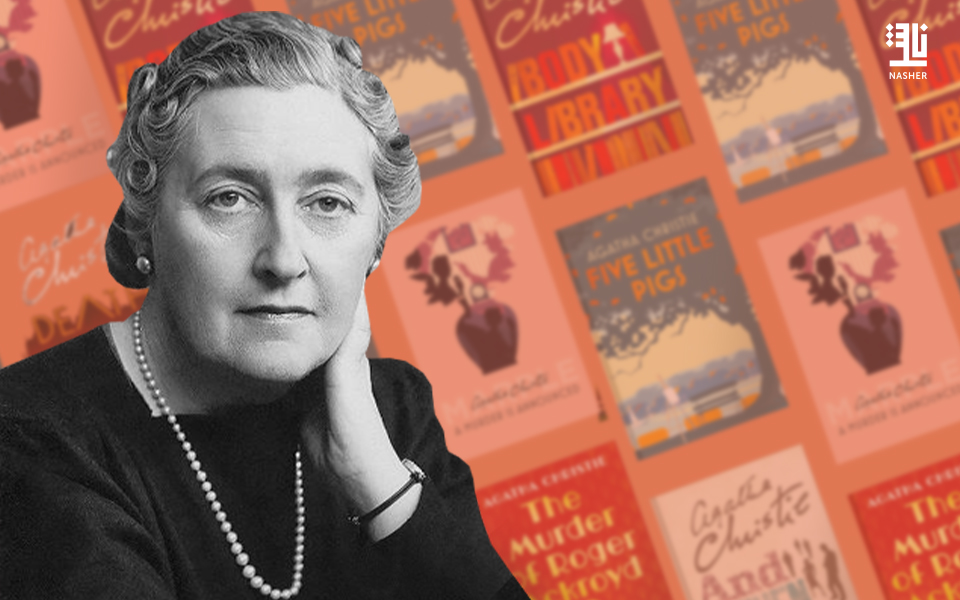
British writer Agatha Christie has published more classic novels since the First World War, certainly not 74 of them, 66 of which were detective novels. Christie published her first novel, The Mysterious Affair at Styles, in 1920, featuring the fan-favourite character Hercule Poirot, a detective whose sharp intellect would make him one of the most iconic and recurring characters in Christie’s repertoire.
Although she began writing as a second career while working as a volunteer nurse during the First World War, her career as a writer quickly took off and the Torquay-born author forayed into romance, poetry, children’s books, autobiographies and playwriting. All these contributed to her repertoire, which includes over 130 published pieces.
With over 66 detective novels under her belt, this ranking highlights 10 of Christie’s best books based on commercial success, critical acclaim and the impact of her work on the mystery genre.
- Five Little Pigs, 1942
The plot revolves around the reopening of a murder case that had been closed 16 years prior. Although Caroline Crale was convicted of poisoning her husband, her daughter believes she is innocent and she is determined to get to the bottom of it. To determine the truth, Hercule Poirot must get creative by gathering psychological evidence, rather than physical evidence that was destroyed years prior. Just like the nursery rhyme “five little pigs,” when Caroline was accused of killing her husband, there were five other suspects who may have potentially committed the crime, but it is up to Poirot to find the real culprit.
- Endless Night, 1967
Christie’s Endless Night centres around the life of impoverished 20-year-old Michael Rogers, who believes he has hit the jackpot when he stumbles upon Gypsy’s Acre, a piece of land that is later acquired by Fenella (Ellie) Guteman, a wealthy heiress who he falls in love with and marries, much to the chagrin of Ellie’s well-to-do family. The couple disregards this disapproval and continues to build their home on Gypsy’s Acre together, regardless. Michael believes that he has found an idyllic life and even shakes off the sinister warnings of an old local who states that Gypsy’s Acre is cursed. Soon, Michael begins to observe a string of ongoing and eerie events, which prove to be only the beginning of a sequence of strangely ominous and mysterious events.
- The Body in the Library, 1942
In Christie’s second Miss Marple mystery, The Body in the Library, the Bantry family finds the dead bodies of two young women in their home. The first woman is dressed up in fancy clothes for a night out, and the other is all but burned to char in their quarry. The Body in the Library is rife with plot twists, gory details and her primary ingredient: mystery.
- The ABC Murders, 1936
In Christie’s The ABC Murders, the Belgian detective Hercule Poirot emerges yet again, this time on a unique mission to catch a serial killer who is assassinating people in alphabetical order; gifts in hand, the self-possessed serial murderer is aware that Poirot is trying to identify him, and places clues in his trail to bait the detective.
- Death on the Nile, 1937
In Death on the Nile, a murder shatters what is supposed to be a peaceful vacation through North Africa for the detective Hercule Poirot. Instead, readers learn that a beautiful young woman has been killed — shot in the head with a single bullet. Linnet Ridgeway, as the murdered woman is called, seemed to have a perfect life until she was abruptly murdered.
- A Murder Is Announced, 1950
When it comes to turning the buzz of everyday life into something eerie, no one can match Christie. In A Murder is Announced, the quaint English village of Chipping Cleghorn becomes the crime scene for a gutsy experiment in murder. After the local paper prints an advertisement announcing that a murder will take place “on Friday, October 29th, at Little Paddocks at 6:30 p.m.,” villagers are surprised, yet curious. As the hour draws near, the village crowd assembles awaiting a game or a joke. The hour approaches, the lights go out, there is a sound of a gun, and the entire place is plunged into darkness. When the lights come back on, there is a body and a puzzling conundrum that seems too fictional to be true.
- The Murder of Roger Ackroyd, 1926
In The Murder of Roger Ackroyd, Christie breaks the rules of the mystery genre and challenges her readers to reimagine their preconceived ideas about the genre. When the widow Mrs Ferrars dies of a self-inflicted overdose, residents of King’s Abbot are stunned. Shortly after her death, however, Roger Ackroyd, her fiancé, is murdered, and this further rattles the community.
- The Murder at the Vicarage, 1930
The Murder at the Vicarage introduces readers to the feisty and quick-witted Miss Marple, who finds a murder to investigate in St Mary Mead, where beneath the seeming simplicity of small-town living reveals lies crime, guilt, deceit and murder. Colonel Protheroe, a tyrannical magistrate and village landowner, is widely disliked in the village and has many enemies; when he is finally murdered, Miss Marple is faced with weeding out multiple suspects.
- Murder on the Orient Express, 1934
On the Orient Express railcar, snowbound in luxury, Hercule Poirot is faced with a murder committed by one of the train’s passengers, whose locked bedroom seems to be the only possible place from which the crime could have been committed
- And Then There Were None, 1939
The plot of the book kicks off with 10 strangers, each invited — for different reasons — to a place called Soldier Island, a rock off the coast of England. On arrival, they are greeted by a gramophone recording that accuses each guest of a specific murder: a crime for which he or she had escaped justice. The guests discover that none of them know the person who supposedly invited them, and the host himself is no longer there. A frenzy ensues after one of the guests dies at dinner and then another in the middle of the night. The body count rises forcing the remaining guests to grow ever more paranoid of each other.