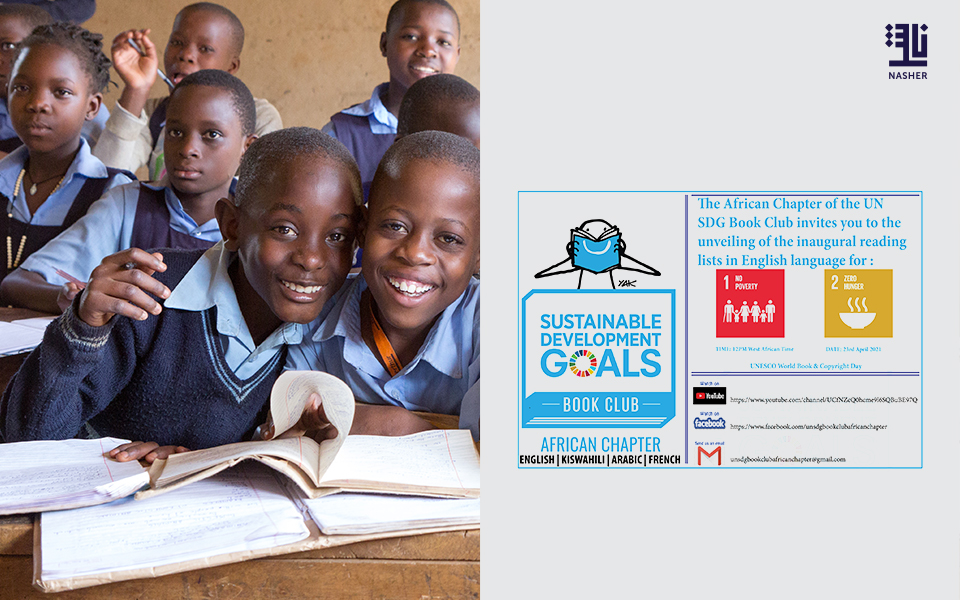
World Book and Copyright Day on 23 April saw the launch of the African chapter of the UN’s Sustainable Development Goals Book Club with 17 African books related to the first two Sustainable Development Goals: No Poverty and Zero Hunger. The lists in the African chapter are aimed at children age 6-12, to teach them about the importance of the Sustainable Development Goals (SDGs) in Arabic, English, French, Kiswahili and in an honorary indigenous African language.
The United Nations Sustainable Development Goals Book Club was launched at Bologna International Children’s Book Fair in 2019 and aims to use books as a tool to encourage children ages 6-12 to interact with the principles of the Sustainable Development Goals (SDGs) through a curated reading list of books from around the world related to each of the 17 SDGs in all six official UN languages—Arabic, Chinese, English, French, Russian, and Spanish.
The 17 Sustainable Development Goals were adopted by world leaders at the historic Sustainable Development Summit in New York in September 2015. Encompassing everything from health, to gender equality, and education, the aim is for the Goals to mobilize efforts around the world to end all forms of poverty, fight inequalities and tackle climate change, while ensuring that no one is left behind.
The United Nations Information Centre (UNIC) in Namibia, together with leading African organisations representing publishers, libraries, booksellers, authors and the promotion of books for youth, launched the African SDG Book Club which now joins similar book clubs in Norway, Indonesia, Portugal and Brazil. It says: “The world’s publishing community through the International Publishers Association supports the SDGs as an investment in future generations of leaders, innovators and agents of change.”
Anthea Basson, National Information Officer at UNIC in Windhoek, Nambia, says: “Children carry a great responsibility to achieve the Sustainable Development Goals (SDGs) because they inherit both our reality and the world we hope to create. We promote the SDGs in children’s books so they feel inspired to bring about a better future for all. From ending poverty and ensuring zero hunger to justice and climate change, we hope to encourage children to make a difference.”
The founding partners for the African chapter of the book club are: Pan African Writers’ Association, Pan African Booksellers Association, Association for the Development of Education in Africa, African Publishers Network (APNET), African Library & Information Associations & Institutions, Borders Literature for all Nations and the United Nations Information Centre Windhoek.
Samuel Kolawole, Chairman of APNET said: “At long last, selection of good quality books for African children has materialised and will go a long way to promote literacy and ensure that the continent of Africa makes good progress towards achieving the SDGs.”
Every two months the African SDG Book Club will release a book list related to each of the SDGs. In June, the African SDG Book Club will address the issue of Goal 3: Good health & Well-Being.