Cairo in the Twenties was wild – a multi-cultural kaleidoscope of dancing, singing, and acting; of cabaret performers and jazz musicians, writers, and idealists, all sashaying in and out of bars and dancehalls, hash dens, and brothels as the city embraced the new and the carefree. It was a pulsating demi-monde that made the city one of the most exciting to visit or to inhabit– and some of its most captivating figures were women, many of whose stories have been forgotten or are not known to a western audience.
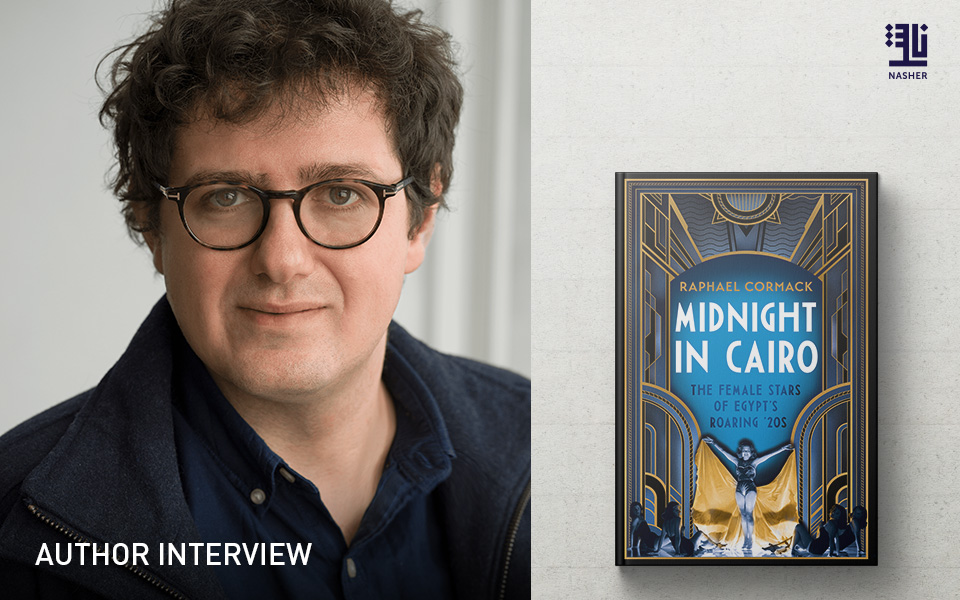
Now a meticulously researched book by British writer and Arabist Raphael Cormack draws back the curtains on this glittering world and brings it richly and fabulously to life. In Midnight in Cairo, we walk the streets of Ezbekiyya, Cairo’s entertainment quarter, and the dancers dance again, the singers sing again and the cabaret artists strut their barbed stuff and it is once again an eternal, music-filled midnight.
Midnight in Cairo has been praised by leading Arab authors such as Adhaf Soueif and Alaa Al Aswany. Aswany described it as “an important, insightful and fascinating book [that] focuses on the leading female dancers, actresses, and singers in Egypt to reveal the birth of the women’s movement in the country. Raphael Cormack highlights an important period in Egypt’s modern history – almost unknown in the west – when its cosmopolitan culture was characterised by a tolerance of all races and religions. He shows the extent to which Egyptian culture has been distorted by authoritarianism and religious extremism in the decades since. This is a must-read”.
Cormack is the editor of The Book of Cairo and the co-editor of The Book of Khartoum. His writing on Arabic literature, culture, and history has appeared in a wide variety of publications including the London Review of Books and the Times Literary Supplement. He spoke to Nasher from Athens where he is working on some translation from Arabic to English and writing a book on the global history of Spiritualism in the late 19th and early 20th century.
What made you want to write the book – was there a particular moment?
There were two main things that started me thinking about writing this book. The first was living in Cairo and walking around the old downtown. It is such an evocative area and one that is so full of stories I wanted to find them out.
The second is more prosaic. I was studying for a Ph.D. in Egyptian theatre, on 20th century Arabic adaptations of Sophocles’ Oedipus Rex. During the research I stumbled across a wealth of memoirs and newspaper articles, telling the story of Cairo’s vibrant nightlife scene in the 1920s and 1930s. There was clearly a whole world to be explored but there were no books about it in English. So I started to write one.
One of the personalities is famous for ‘chandelier dancing’. It sounds dangerous! Can you tell us more?
Chandelier Dancing is still famous in Cairo today and part of many shows. It essentially involves a dancer balancing a large candelabrum on their head as they dance to the audience. Its legendary inventor was Shafiqa al-Qibtiyya who owned her own nightclub in 1890s Cairo and was one of the first female superstars in modern Egypt. Whether or not she actually invented this dance is still up for debate. For what it is worth, I have not seen any pictures of the Chandelier Dance being done in the 1890s or 1900s, though there are pictures of women dancing while balancing shisha pipes on their head so it doesn’t seem impossible that Shafiqa (or someone else) may have danced with a Candelabrum.
What made the Twenties in Cairo so intoxicating?
I think it was some of the same things that made some of the other romanticised cities of the 1920s so intoxicated. People felt like they could create something new. The playwright Carl Zuckmayer said of Berlin in this period that it “tasted of the future, and that is why we gladly took the crap and the coldness.” Cairo was the same (without the coldness!). They had just had a revolution in 1919, Egypt was an officially independent nation and all kinds of new movements were rising up. For the generation who came of age in the 1920s, there was a sense that progress might be possible, if hard.
What do you notice when you walk the Ezbekiyya area today?
Today Ezbekiyya is very different. A lot of the landmarks like the Opera House, Badia Masabni’s Casino, and Shepheard’s Hotel have disappeared. But there are still traces. There are still some seedy nightclubs and cabarets, as there would have been in the 1920s. There are still some cinemas and theatres. But a lot of the spark that gave life to the area has moved on.
Is the book being published in Arabic?
I am talking to some publishers about getting it out in Arabic and am hoping to have an agreement soon. I would love to see it translated!
Can you tell us a little about yourself? Where are you from and where do you live now?
I grew up in the UK and studied Classics for my BA. While at University, I visited Khartoum and got interested in the Arabic language and Arabic culture. I realised that there was so much I had never been taught and had never come across. I started learning Arabic, I went to Cairo and studied at the American University in Cairo. A few years later I started my Ph.D. at the University of Edinburgh.
And finally, if you could have dinner with one of the people in the book, who would it be and why?
Without question, I would want to go to one of the parties on Mounira al-Mahdiyya’s houseboat on the Nile. In the 1920s, she was the most flamboyant star of stage and song, as well as being a legendary poker player and party host. It was the hottest invite in Cairo’s roaring 20s.
Midnight in Cairo is published by Norton in the US, by Saqi Books in the UK, and by the American University in Cairo in Egypt.