A London Exhibition About Dickens’ Novels and The Fog
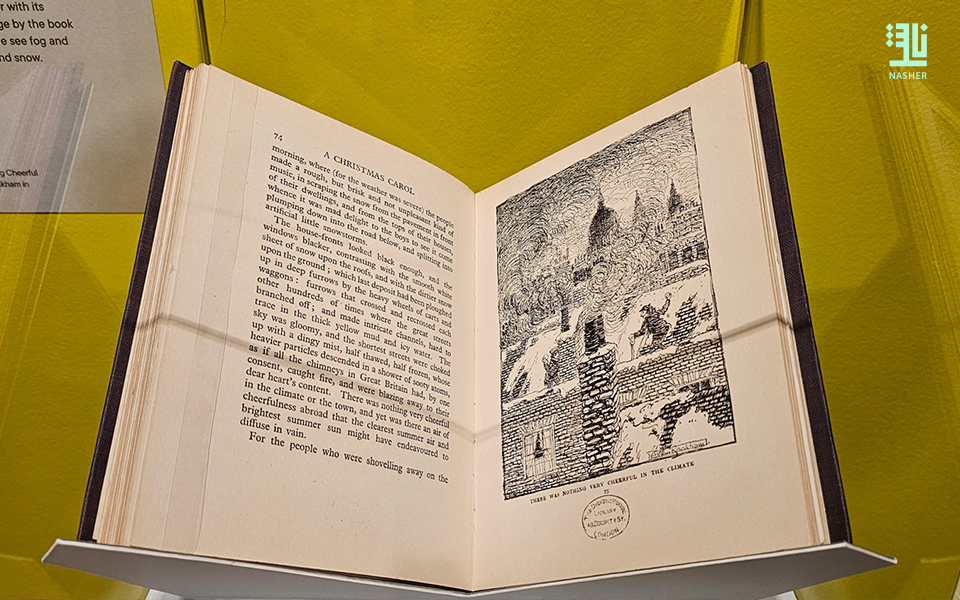
Great and Dirty City: Dickens and the London Fog. This title refers to an exhibition currently being held at the Museum of the English novelist Charles Dickens in London. It deals with the issue of polluted fog, which inspired many of his novels, but contributed to doubling the asthma that the late writer was suffering from.
Dickens’ readers know very well that fog is a prominent feature of his novels, as it often covers London and passes through its streets and alleyways… before finally leaving its mark in its citizens’ hearts.
The fog appears in the four novels Dickens wrote at his home in “Doughty Street” in the London suburb of Holborn, namely “Nicholas Nickleby”, “Oliver Twist”, “The Pickwick Diaries” and “Barnaby Ridge”. Perhaps the most “hazy” of his novels is “Blake House” (the gloomy house), which he begins by talking about “the smoke coming from the chimneys.” Fog also appears strongly in A Christmas Carol, where he enters the office of Scrooge, the famous character in the novel, through “every crack and keyhole”. The fog also appears in the novel “David Copperfield”, who says that “from the window of my room I saw all of London far away as a great vapor under which, here and there, some light appears.” The fog is not absent from the novels “Dombey and Son”, “The Mystery of Edwin Drood”, “Great Expectations”, “Martin Chiselwit”, “The Old Curiosity Shop” and “The Hour of a Mutual Friend”. » (Our mutual friend). In the latter novel, Dickens speaks of “a flash, a buzz and a choking” because of the mist.
The polluted fog covering London was an essential part of the lives of the residents of the British capital when Dickens moved to live on Dotty Street (between 1856 and his death in 1870). The population of London at that time was witnessing a skyrocketing rise, which led to a significant increase in its polluted fog as a result of the large increase in the number of homes that use coal for heating, which was exacerbated by factories that burn coal in the heart of a densely populated city.
The exhibition hosted by the Charles Dickens Museum, which will run until October 22, discusses how polluted fog appeared in Dickens’ novels, how it affected his health and the health of his family members, and how London tried, and failed, to address the pollution crisis during the 200 years. past.
“There is a lot of evidence that he and members of his family suffered from asthma,” says Dr. Nicholas Cambridge, author of Bleak House: A Medical History of Charles Dickens and His Family. In the writer’s case, it may have been a combination of environmental pollution and his lifestyle, particularly his love of cigars. But there are many examples of Dickens complaining of chest pains. In his letters there is a description of panting and coughing from morning till night. He also complained of a deep and persistent cough after he had a cold.
According to Frankie Kubicki, curator of the Charles Dickens Museum, Dickens lived in fog his entire life. He influenced him – and his characters – and became an inspiration, as his presence looms large in his books. But smog wasn’t always seen as a negative thing. Whereas fog and pollution were often used by Dickens to show a malevolent force or a mysterious figure, the sight of London’s coal fires and shimmering streetlights can give a sense of intimacy.
And he adds, “Although it represents a source of terror for the airways (lung), the fog often gives Londoners a sense of pride and nostalgia for the past (nostalgia). Today’s exhibition shows how today’s political wrangling over London’s pollution is nothing new, and how conflicting interests put obstacles in the way of cleaning up the city.