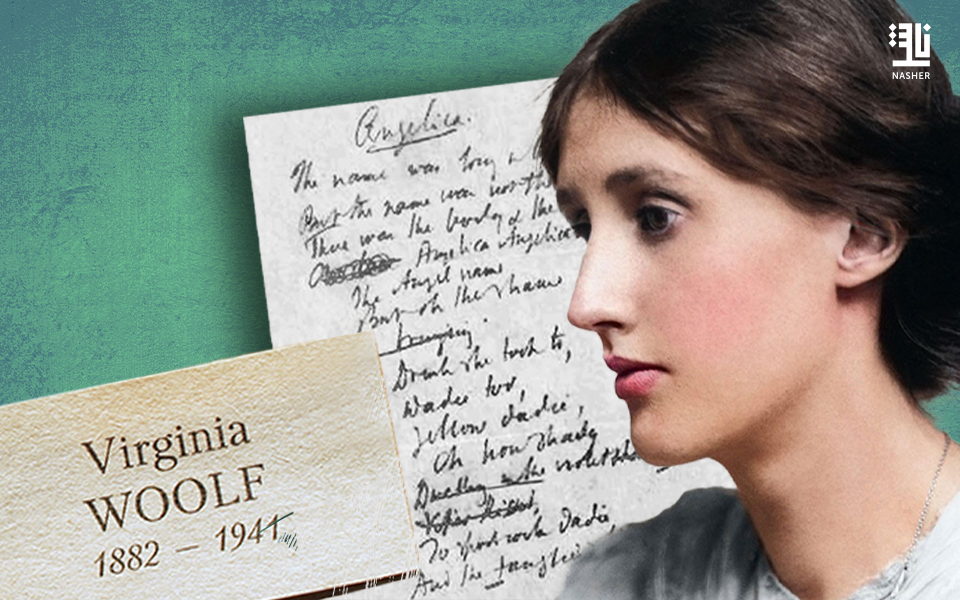
A trio of early stories by Virginia Woolf which together form a spoof biography of a family friend have been rediscovered and are set to be published next month.
The Life of Violet was inspired by Mary Violet Dickinson, who befriended the English writer when she was 20 and would go on to read many of her early writings, introduce her to one of her first editors and a wide circle of aristocratic friends, and look after her following a breakdown in 1904.
The stories are satirical, fantastical and perhaps surprisingly comic. Kaleidoscopic in plot and setting, they move from aristocratic antics in a grand Jacobean house in Hertfordshire to a bedtime tale of two goddesses who arrive in “Tokio”, Japan, on the back of a whale.
The mock biography was drafted in 1907, years before Woolf’s first novel appeared in 1915, and the writer – then called Virginia Stephen – did not, at least initially, want them to be seen. Sending a draft to Dickinson, she demanded that her subject and another friend, Nelly, be “the only readers”. To Nelly, she insisted: “dont quote it – see my vanity! And dont show it: I cant remember now how bad it is; but I know it will have to be re-written in six months; and I shant do it”.
But in fact she did return to fix the stories, we now know, thanks to a chance discovery of a revised manuscript, hidden away in a stately home for 80 years. Woolf scholar Urmila Seshagiri, a professor at the University of Tennessee, was in search of an unpublished memoir that Dickinson had written about Woolf’s childhood. She asked Longleat House, the Elizabethan home in Wiltshire where a collection of Dickinson’s papers are kept, whether they had it. Their response “bewildered” Seshagiri. Yes, they had the “Memoir of the Stephen Family”, but would she also like to see “Friendships Gallery”, an original Woolf typescript, hand-corrected by the author?
Seshagiri knew that the original version of Friendships Gallery, Woolf’s largely ignored trio of short stories about her friend, was in the New York Public Library (NYPL), so she told Longleat they must just have a copy of them. “No no, we have an original document by Virginia Woolf,” they responded. So what was in it? Soon Covid threw a spanner in the works: because of international copyright law, Longleat couldn’t scan the text, or even show it via a video call, so it ended up being a “multi-year mystery”. Finally, in 2022, Seshagiri bagged an invite to the house.
The archivist led her into a reading room and handed her a cream-coloured box. She lifted the lid, hands shaking, and opened the volume. There, professionally typed, were revised versions of the NYPL stories, with hundreds of stylistic changes. While seemingly minor, the edits, made in 1908, prove Woolf took the stories more seriously than anyone had realised. “It’s the kind of moment that you never think you’re going to have as a workaday scholar,” says Seshagiri.
Next month, Seshagiri’s discoveries will be published by Princeton University Press under a new title, The Life of Violet. The Woolf we know is present in these stories. The “fantastical imagination that produced Orlando” – the 1928 mock biography inspired by Woolf’s friend and lover Vita Sackville-West – is “in full flower already”, says Mark Hussey, author of Mrs Dalloway: A Biography of a Novel.
In the second story, The Magic Garden, the seed of the phrase “a room of one’s own”, the title of Woolf’s landmark feminist 1929 essay, is unveiled:
“Do you know it seems to me – well don’t you think Violet – it would be very nice —- ”
“To have a cottage of one’s own? Yes, my good woman,” cried Violet.
Violet’s proclamation is “the beginning of the great revolution which is making England a very different place from what it was”, Woolf goes on to write.
Given all they tell us about Woolf, how have these stories flown under the radar for so long? In 1955, Dickinson’s family offered the early, unrevised NYPL versions to Leonard Woolf, whom Virginia married in 1912. Leonard, perhaps swayed by Woolf’s initial shyness about the stories, declined to purchase the works, deeming them unworthy of publishing. The stories then wound up in a London junk shop, and were bought for a shilling by Booker prize founder Tom Maschler. He showed them to Francis Wyndham (who would go on to edit VS Naipaul and Jean Rhys), who pointed out what Maschler had failed to realise: the author “Virginia Stephen” was Virginia Woolf.