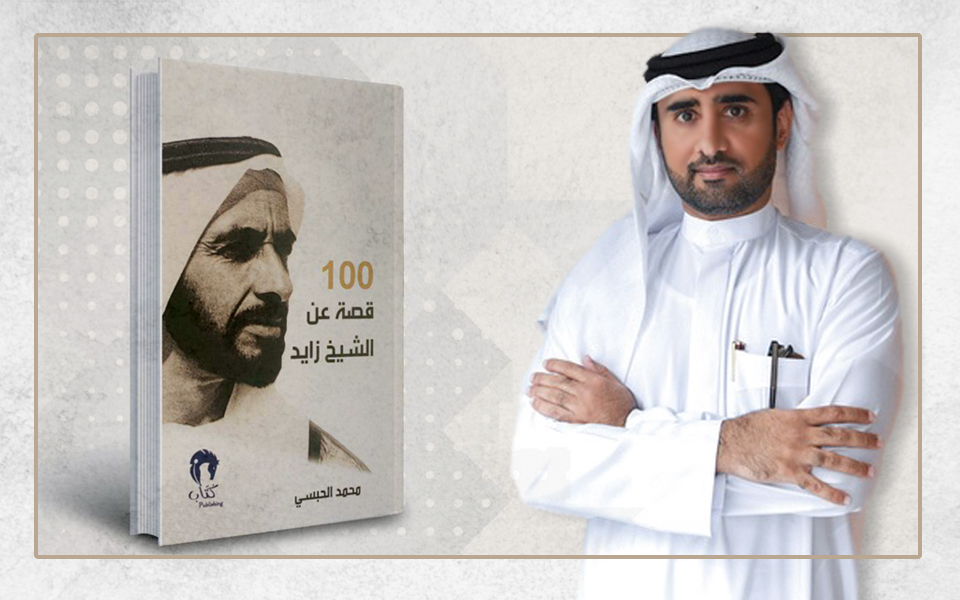
It seems that the scent of heritage is a key component of the works of Emirati writer Mohammed Al Habsi, Acting Director of the Arts Department at the Culture and Arts Authority in Dubai (Dubai Culture). His latest book, “100 Stories about Sheikh Mohammed Bin Rashid”, is a collection of stories and feats of His Highness Sheikh Mohammed Bin Rashid Al Maktoum, Vice President and Prime Minister of the UAE and Ruler of Dubai. The book is an extension of his previous experience with his book “100 Stories about Sheikh Zayed”, in which he provides a glimpse of the late, Sheikh Zayed bin Sultan Al Nahyan, making it a documentation of the march of the founder of the United Arab Emirates.
In our interview with him, Al Habsi acknowledged the heritage impact on him as he always seeks to document heritage. Al Habsi also revealed that he is currently writing a new novel about UAE’s history two thousand years ago.
Al-Habsi considered his book “100 stories about Sheikh Zayed” as a reference for scholars and researchers. “The book is an important fulcrum that is capable of attracting anyone who is looking for the stands and life of the late Sheikh Zayed bin Sultan Al Nahyan. Through this book, I sought to introduce the new generation to Sheikh Zayed’s character, feats and some of his stands in life.”
Emirates Novel Award
In his novel “Satan’s Hut”, for which he received an encouragement prize at the UAE Emirates Novel Award 2015, Al Habsi presents another face of love, where loyalty intersects with supernatural fates that is full of sorrows and bitterness in a breathtaking mythical contexts. “Through “Satan’s Hut”, I tried to integrate imagination with reality using local heritage vocabulary, and of course the exceptional UAE’s mountain environment was a key element”, he said.
Al Habsi pointed out that he has been working for almost two years to make a new novel about the UAE 2,000 years ago. “In my new novel, I try to tell the many facts and attitudes that go back to that time, and to show how life, housing and living were in that ancient history,” he added.
About how local heritage has influenced his writings, Al Habsi said: “I do admit that I am deeply influenced by heritage. Maybe this is derived from the nature of my life and my lifelong accompaniment of the elderly for almost 37 years.”
Search for literary tourism
On the other hand, Al Habsi stressed that the UAE has succeeded in activating cultural tourism, while the distance between it and literary tourism is still far. “Cultural tourism is not confined only to museums, but also includes all the things that enable the tourist to learn about the customs and traditions of the state, its monuments, heritage, folk songs, restaurants and other features, and I think the UAE has gone a long way in this area”, he concluded.